


There is something rather special about a garden in winter. With the leaves fallen and the borders resting, familiar spaces take on a different character. The shapes of trees become clearer, the low sun catches the last of the seedheads, and the smallest signs of life seem all the more precious.
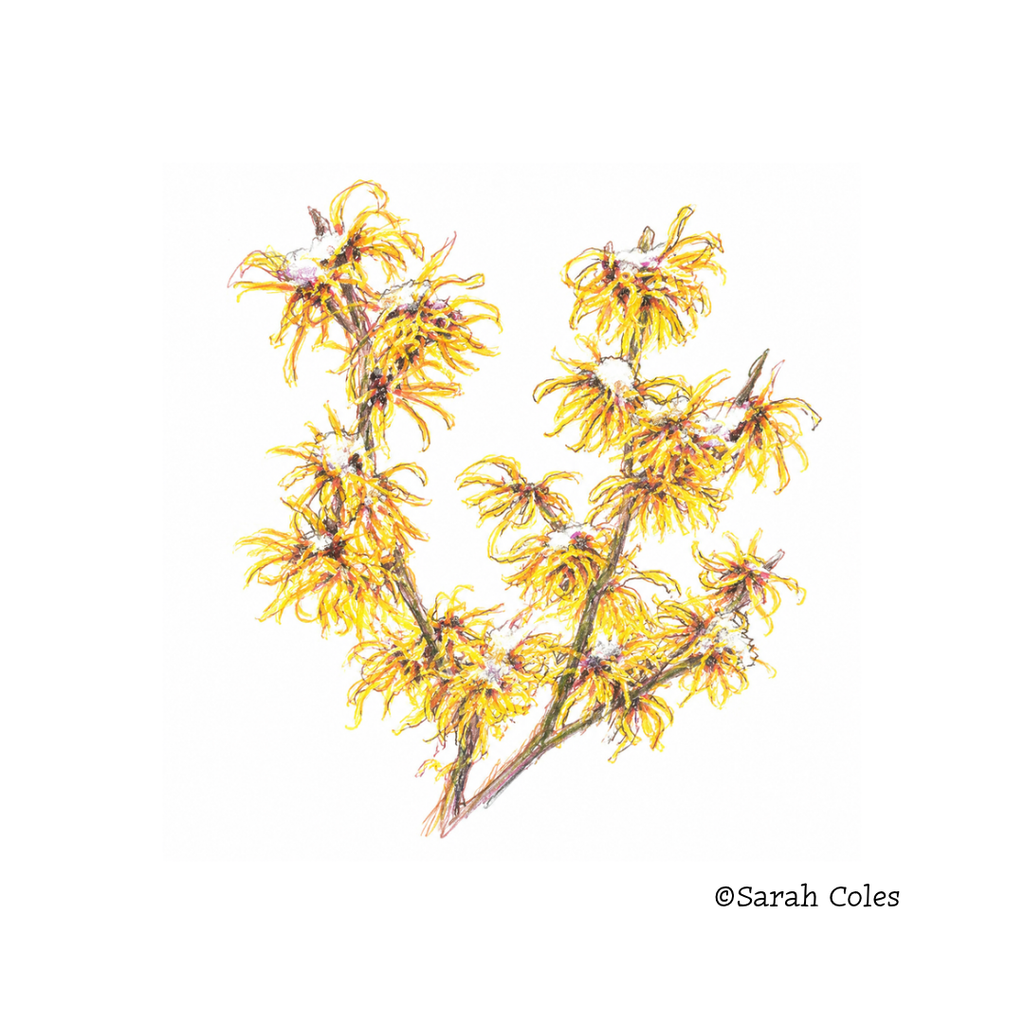
It is at this quiet time of year that witch hazel comes into its own. While much of the garden is still waiting for spring, Hamamelis × intermedia ‘Pallida’ is already putting on a remarkable display. Its bare branches are covered in delicate, sulphur-yellow flowers, each made up of narrow, curling petals that look almost too fragile to withstand the winter weather.
And then there is the fragrance. On a still, bright day, its sweet scent can catch you quite unexpectedly as you walk past. It is enough to make you stop, turn back and take a closer look.
For a shrub that flowers in the depths of winter, ‘Pallida’ has a wonderful way of drawing us outdoors.
A Witch Hazel Worth Getting to Know
Witch hazels belong to a small group of shrubs and trees valued for their unusual flowers, autumn colour and, in many cases, their fragrance. They have a natural elegance, with spreading branches that become particularly striking once the leaves have fallen.
Hamamelis × intermedia is a hybrid of two species from East Asia: the Japanese witch hazel, Hamamelis japonica, and the Chinese witch hazel, Hamamelis mollis. Over the years, gardeners have selected a wonderful range of cultivars, with flowers in shades of yellow, orange, copper and red.
‘Pallida’ is one of the loveliest of the yellow-flowered forms. Its pale, clear yellow petals are long and slender, twisting and curling around small reddish-brown centres. From a distance, the flowers give the branches a soft golden haze. Close up, their intricate shapes are quite extraordinary.
The flowers usually appear between January and March, depending on the weather and where the shrub is growing. They are surprisingly resilient, often curling inwards during very cold spells before opening again as temperatures rise.
‘Pallida’ has also earned the Royal Horticultural Society’s Award of Garden Merit, recognising its value as a reliable garden plant.
From Wisley to Our Gardens
The story of ‘Pallida’ takes us to RHS Garden Wisley in Surrey, where the original plant was raised from seed obtained from a nursery in the Low Countries. It received an Award of Merit in 1932, although it was not until the 1950s that plants became more widely available to gardeners.
Since then, its pale yellow flowers and winter fragrance have made it a much-loved choice for British gardens.
The name Hamamelis comes from Greek and is often interpreted as a reference to the plant’s unusual relationship between flowers and fruit. In some species, the previous year’s seed capsules can remain on the branches as new flowers appear.
The common name, witch hazel, has an equally interesting history. Despite its rather magical associations, the word ‘witch’ is thought to come from the Old English wice, referring to something pliant or bendable.
The flexible branches of North American witch hazel were traditionally used for water divining, a practice in which forked twigs were believed to help locate underground water.
Our garden favourite ‘Pallida’ is grown for its ornamental qualities rather than these traditional uses, but the name has stayed with it.
Finding a Place for ‘Pallida’
A witch hazel is worth choosing a position for carefully. It is not a shrub to tuck into a forgotten corner, particularly when so much of its charm comes from being able to enjoy the flowers and their scent at close quarters.
A position near a garden path, entrance or a window overlooking the garden is ideal. Somewhere you pass regularly during the winter months will give you plenty of opportunities to enjoy it.
On a mild February morning, even a brief walk to the compost heap can become an excuse to linger beside its fragrant branches.
Soil and Growing Conditions
Witch hazels grow best in fertile, moisture-retentive but well-drained soil. They prefer slightly acidic to neutral conditions and are generally unhappy in very alkaline ground.
Very shallow, chalky soils are less suitable, particularly where the ground becomes dry in summer. If your garden has these conditions, it may be worth choosing another shrub better suited to the soil rather than trying to change its nature.
Although young witch hazels can be grown in large containers, they are generally happier planted in the ground, where their roots have room to develop and moisture levels are easier to maintain.
Witch hazels are particularly sensitive to drying out while becoming established, so regular watering during their first two or three years is important, especially during warm, dry spells.
A sunny or lightly shaded position is best. Plenty of light encourages good flowering and helps the leaves develop their lovely autumn colour.
Shelter from cold, drying winter winds is particularly valuable. Although the flowers are remarkably hardy, exposed conditions can damage developing buds and shorten the display. A sheltered position also allows the fragrance to linger rather than being carried away on the wind.
Give It Room to Grow
It is easy to underestimate the eventual size of a young witch hazel. ‘Pallida’ grows slowly, but with time it develops into a substantial, spreading shrub, often reaching around 2.5–4 metres in height and width over 10–20 years.
Its open, branching shape is part of its beauty, so allow enough space for it to develop naturally rather than relying on regular pruning to keep it small.
This is a plant that rewards patience.
A Shrub for More Than One Season
Although its winter flowers are the main attraction, ‘Pallida’ has plenty to offer at other times of year.
As spring arrives, fresh green leaves begin to unfold, gradually hiding the branches beneath a generous canopy. Through summer, the shrub provides a calm, leafy presence, making a lovely backdrop for flowering perennials and smaller plants.
Then, as the days shorten, the foliage begins to change. The leaves turn rich shades of buttery yellow, sometimes touched with orange, bringing warmth to the autumn garden before falling to reveal the buds of the coming winter’s flowers.
There is a pleasing rhythm to its year: the bright flowers of winter, the fresh growth of spring, the quiet greenery of summer and the golden leaves of autumn.
It is this changing character that makes witch hazel such a rewarding shrub to grow.
A Garden Stirring in Winter
On milder winter days, the garden can be surprisingly busy. A few early insects may venture out, particularly in sheltered, sunny spots, and witch hazel flowers can occasionally attract visitors.
Yet it is the flowers themselves that make ‘Pallida’ so valuable in a winter garden. Their unusual shapes and gentle fragrance bring interest at a time when there is little else in bloom.
Planted alongside snowdrops, winter aconites, hellebores and early crocuses, witch hazel helps create a succession of flowers that carries the garden towards spring.
There is something heartening about seeing these small signs of life appearing while the rest of the garden is still quiet.
Caring for Your Witch Hazel
Once established in a suitable position, witch hazels need relatively little attention.
The most important thing is to keep the soil from drying out during prolonged summer droughts, particularly while the plant is young. A generous mulch of well-rotted leaf mould or garden compost in spring will help conserve moisture and improve the soil over time. Keep the mulch clear of the main stems.
Witch hazels rarely need pruning. Their naturally spreading branches are best left to develop without too much interference.
If necessary, remove dead, damaged or crossing branches after flowering, taking care not to spoil the shrub’s shape.
Some plants are grafted onto rootstocks, which may occasionally produce shoots from below the graft union. These should be removed as soon as they appear, otherwise they may compete with the cultivated plant.
Witch hazels are generally trouble-free, although their relatively slow growth means they can take several years to reach an impressive size. Growth will vary according to the soil, available moisture and growing conditions.
Larger specimens can also be expensive, so buying a younger plant and allowing it time to mature is often a sensible choice.
The wait is well worth it.
Making the Most of Winter Colour
One of the pleasures of growing ‘Pallida’ is discovering how beautifully it works with other winter plants.
Its clear yellow flowers look particularly lovely against the dark green foliage of evergreens, or with the rich red and orange stems of dogwoods. Underplanting with snowdrops, winter aconites or early-flowering hellebores can create a gentle succession of colour at ground level.
A dark background, whether an evergreen hedge or a weathered garden wall, will help the delicate flowers stand out.
It is also worth considering the winter light. Planted where low sunshine can shine through its branches, ‘Pallida’ seems almost to glow, each narrow petal catching the light.
And, of course, there is the scent. Choose somewhere sheltered enough for the fragrance to linger, and you may find yourself making a daily visit just to see how the flowers are coming along.
A Reason to Step Outside
Winter gardens have a beauty all of their own, although it can sometimes take a little more time to appreciate it. Without the abundance of summer flowers, we begin to notice other things: the shape of a branch, the texture of bark, the movement of grasses and the first signs of new growth.
Witch hazel ‘Pallida’ brings all these pleasures together.
Its flowers are delicate yet remarkably resilient, appearing when the weather is often at its coldest. Its fragrance is an unexpected delight, and its golden autumn foliage gives us something to look forward to later in the year.
Perhaps its greatest gift, though, is simply that it encourages us to spend time in the garden when we might otherwise stay indoors.
On a bright winter morning, with frost still lying on the grass and the air carrying that unmistakable witch hazel scent, it is difficult to imagine anywhere better to be.
And for a few moments, spring doesn’t seem quite so far away.
Further Reading: Camellia japonica: A Beautiful Evergreen Shrub for Winter & Spring Colour, Clematis ‘Winter Beauty’: A Beautiful Evergreen Climber for the Winter Garden, Sarcococca Confusa – Sweet Box, Mahonia ‘Winter Sun’: A Beautiful Winter-Flowering Shrub, Beautiful Shrubs for Winter Interest: Colour, Fragrance and Life in the Winter Garden, Winter Daphne (Daphne odora): The Beautifully Fragrant Shrub That Brightens the Winter Garden
For Inspiration Follow Me on Instagram, Facebook, Bluesky and Threads
