


There is something rather satisfying about returning what we take from the garden back to the soil. The vegetable peelings from Sunday lunch, the remains of a bunch of flowers, the scraps that gather on the kitchen worktop as meals are prepared. What might otherwise be thrown away can become part of a much more useful story.
For generations, gardeners have relied upon compost heaps, allowing nature to slowly transform garden clippings, fallen leaves and kitchen scraps into the dark, crumbly material that nourishes the earth.
But there is another approach, one that begins not at the bottom of the garden but in a sealed bucket, often tucked beneath the kitchen sink.
It is called Bokashi composting, and although its principles are rooted in traditional fermentation, it offers a rather different way of dealing with everyday food waste.
Unlike conventional composting, Bokashi does not immediately turn scraps into finished compost. Instead, it ferments them, preparing the material for its eventual return to the soil.
For gardeners with limited space, households producing more food waste than garden waste, or anyone looking to make better use of what would otherwise be discarded, it is a method worth understanding.
What Is Bokashi Composting?
The word Bokashi comes from Japanese and is used in agriculture to describe fermented organic material.
In modern household gardening, Bokashi composting involves fermenting food waste using beneficial microorganisms, usually introduced through specially prepared bran.
Rather than allowing food scraps to break down in the presence of air, as they would in a traditional compost heap, Bokashi relies upon fermentation in a largely airtight container.
The process is surprisingly simple.
Food scraps are placed inside a bucket, sprinkled with Bokashi bran, pressed down to remove air pockets and sealed beneath a tight-fitting lid. Over the following weeks, microorganisms begin fermenting the contents.
The food does not disappear. A carrot peeling still looks remarkably like a carrot peeling, and a piece of bread retains much of its original shape. What changes is its condition.
The material becomes acidic and fermented, ready for the next stage of decomposition.
This distinction matters. Bokashi is a fermentation process rather than a complete composting process. The resulting material must still be incorporated into soil or a suitable composting system before it becomes useful, mature compost.
Where Did Bokashi Composting Begin?
Although Bokashi is commonly associated with Japan, its story reaches further back into traditional agricultural practices across East Asia.
The Royal Horticultural Society traces the method’s origins to Korea, where fermentation was used in agriculture long before modern household composting systems appeared.
During the 1980s, Japanese horticultural scientist Professor Teruo Higa helped popularise a modern approach through his research into Effective Microorganisms, often shortened to EM.
These cultures include naturally occurring microorganisms such as lactic acid bacteria and yeasts, which encourage the fermentation of organic materials.
Modern Bokashi composting grew from the combination of these scientific developments and older traditions of fermenting organic matter.
The familiar sealed bucket and inoculated bran have made the process accessible to households far beyond its agricultural beginnings.
What was once associated primarily with farming has become a practical way of managing everyday kitchen waste, even in homes with relatively little outdoor space.
How Is Bokashi Different from Traditional Composting?
At first glance, both methods appear to be working towards the same end: turning unwanted organic material into something useful for the garden.
But the way they achieve this is quite different.
Traditional composting relies upon microorganisms breaking down organic matter in the presence of oxygen. A well-managed compost heap contains a mixture of nitrogen-rich green materials and carbon-rich brown materials, with sufficient moisture and air to encourage decomposition.
Over time, the ingredients lose their original form and become a dark, earthy soil improver.
Bokashi takes another route entirely.
Instead of decomposition through aeration, it encourages fermentation in a sealed environment. The material is preserved in an acidic state before being transferred to soil or a compost heap, where the final breakdown takes place.
| Traditional composting | Bokashi composting |
|---|---|
| Requires oxygen for aerobic decomposition | Relies on low-oxygen fermentation |
| Breaks down organic matter | Ferments organic matter |
| Uses a balance of green and brown materials | Primarily uses food scraps and inoculated bran |
| Generally excludes meat, fish and dairy | Can process meat, fish, dairy and cooked food |
| Usually needs a compost heap or bin | Uses a small airtight bucket |
| Turning can speed up decomposition, but is not always necessary | No turning required |
| Produces mature compost directly | Produces fermented material requiring further decomposition |
| Often takes several months | Around two weeks of fermentation after filling, followed by decomposition in soil or compost |
Traditional garden compost can take six months to two years to mature, although well-managed hot composting can be considerably faster.
Bokashi’s fermentation stage is relatively quick, but its subsequent decomposition must be included when comparing the two methods.
Why Might Bokashi Be Better Than Traditional Composting?
The word better deserves a little consideration here.
Bokashi is not necessarily a replacement for traditional composting, nor does it automatically produce a superior soil improver.
Its real advantage lies in the kinds of waste it can handle and the convenience of the process.
Making use of more kitchen waste
Perhaps the greatest attraction is the range of materials that can be fermented.
A conventional garden compost heap is best kept free from meat, fish, dairy products and most cooked food, largely because these can attract vermin and create unpleasant smells.
Bokashi can accommodate many of these materials.
Bread crusts, leftover rice, vegetable peelings, fruit skins, small quantities of meat, fish and cheese can all be added.
For a household trying to reduce the amount of food waste leaving the kitchen, that is a considerable advantage.
Composting without a large garden
Not everyone has room for a compost heap.
A small courtyard, paved garden or even a kitchen with limited outdoor space may offer little opportunity for conventional composting.
Bokashi buckets are compact enough to fit beneath a sink or in a utility room.
However, the fermented material still needs somewhere to complete its decomposition. Access to a garden, compost bin or suitable soil-filled container remains important.
Less disturbance and less turning
Traditional composting benefits from aeration, particularly when gardeners want to speed up decomposition.
Bokashi requires no turning at all.
In fact, the less the contents are exposed to air, the better.
This makes it appealing to gardeners who want a relatively low-effort way to manage food scraps.
Potentially retaining more nutrients
During fermentation, relatively little of the solid material is broken down or lost as gas.
This has led to interest in whether Bokashi can retain more of the original organic matter and nutrients before they are returned to the soil.
Nevertheless, claims that Bokashi is always more environmentally friendly, produces healthier soil or offers greater nutritional benefits than conventional compost should be treated with caution. Outcomes depend upon the materials, management and subsequent decomposition.
How to Start Bokashi Composting: A Step-by-Step Guide
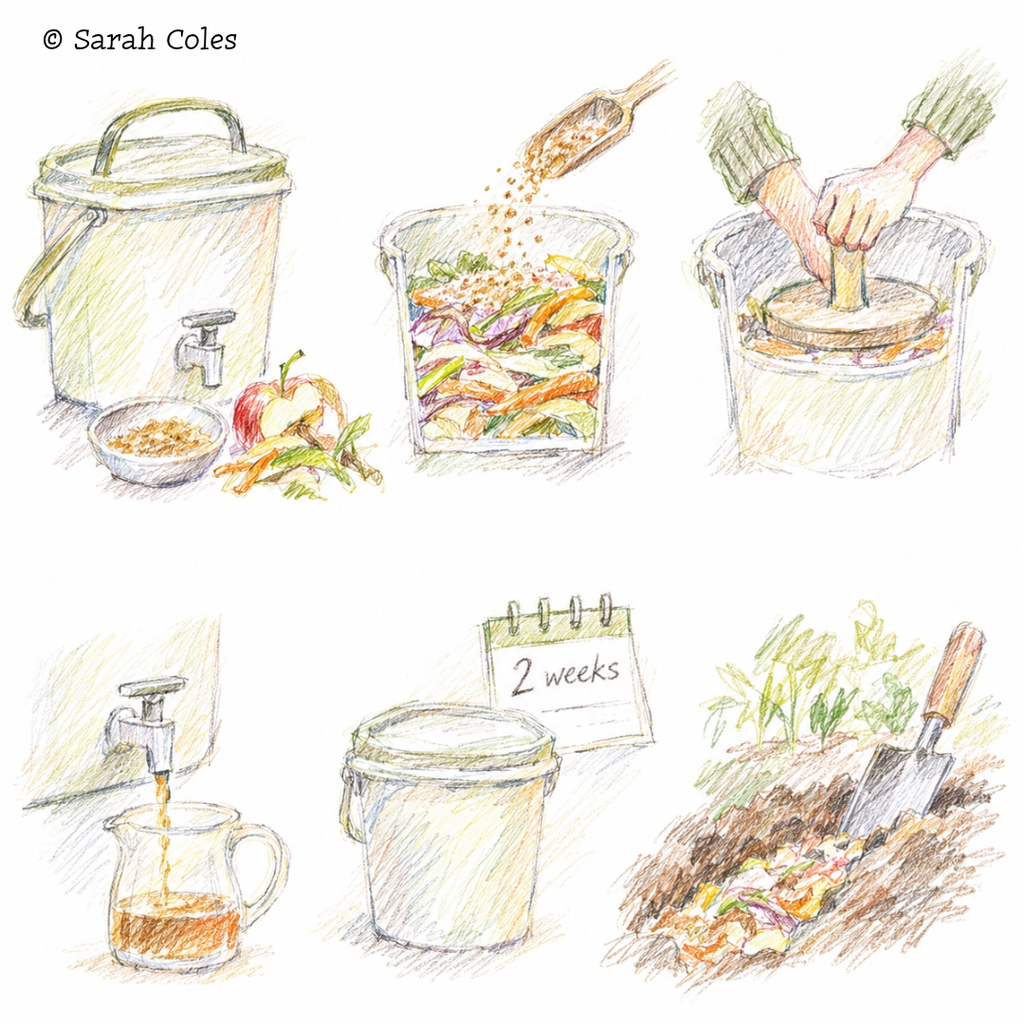
The process is straightforward, although a little care at the beginning will make a considerable difference to the results.
Step 1: Choose your Bokashi bucket
A purpose-made Bokashi bucket generally has an airtight lid, an internal drainage system and a small tap near the base.
Two buckets are particularly useful. While one is fermenting, the other can be filled with fresh kitchen waste.
Keep the bucket somewhere convenient, away from direct sunlight and extremes of temperature.
Step 2: Add your food scraps and Bokashi bran
Begin with a light sprinkling of Bokashi bran in the bottom of the bucket.
Add a layer of chopped food scraps, approximately 3–4 cm deep, followed by another sprinkling of bran.
The bran contains microorganisms that encourage fermentation.
Follow the quantities recommended by your particular supplier, using a little extra for protein-rich food waste where advised.
Step 3: Press everything down
Use a suitable pressing tool to compress the food waste.
This removes trapped air and helps create the low-oxygen conditions required for fermentation.
Replace the lid immediately and ensure it is properly sealed.
Continue adding scraps in layers until the bucket is full, opening it only when necessary.
Step 4: Drain away excess liquid
Depending upon the moisture content of your food waste, liquid may collect at the bottom of the bucket.
Check the tap every couple of days and drain any accumulated liquid.
This prevents the contents from becoming excessively wet and reduces the risk of unwanted putrefaction.
Not every batch produces much liquid, so an almost dry bucket is not necessarily a problem.
Step 5: Allow the fermentation to finish
Once full, seal the bucket and leave it undisturbed for approximately two weeks.
Continue draining any liquid that collects.
When the lid is eventually lifted, the contents should have a mildly sour, pickled smell.
The food scraps will remain recognisable. This is entirely normal.
A little white mould can also appear and is generally associated with successful fermentation.
Step 6: Return the fermented material to the soil
Once the bucket has completed approximately two weeks of fermentation, the contents are ready for the next stage.
Choose an empty garden bed and dig a trench deep enough to accommodate the material beneath a generous covering of soil.
Mix the fermented scraps with some of the surrounding earth before covering them thoroughly. This encourages further decomposition and helps discourage animals from investigating.
The Royal Horticultural Society recommends allowing at least two weeks before planting into the treated ground.
In practice, it is sensible to allow longer, particularly during the colder months when soil organisms are less active.
Do not place freshly fermented Bokashi directly against plant roots, and allow the material to decompose properly before growing crops in the same area.
Alternatively, add it to an established compost heap, covering it with suitable garden materials so that decomposition can continue.
What Can and Cannot Go into a Bokashi Bucket?
One of the pleasures of Bokashi is discovering just how much of the kitchen’s everyday waste can be put to use.
| Suitable materials | Best avoided |
|---|---|
| Fruit and vegetable peelings | Large quantities of liquid |
| Cooked vegetables | Excess cooking oil and grease |
| Bread, pasta and rice | Large, hard bones |
| Coffee grounds | Heavily rotten or mouldy food |
| Meat and fish scraps | Non-food packaging and plastics |
| Cheese and other dairy foods | Large amounts of very wet waste |
| Eggshells | Garden chemicals and contaminated material |
Eggshells and bones will not ferment in quite the same way as softer organic matter and can take much longer to break down.
It is also worth remembering that although Bokashi can process meat and dairy products, the fermented material must be buried securely or incorporated into a properly managed composting system to avoid attracting animals.
What Is Bokashi Liquid, and Can It Be Used in the Garden?
As food waste ferments, liquid may collect at the bottom of the Bokashi bucket.
Often referred to as Bokashi tea, this dark liquid contains dissolved substances released from the food scraps.
Some gardeners use it as a liquid feed, and the Royal Horticultural Society recognises this as one possible use.
However, a little caution is sensible.
Unlike a commercially prepared fertiliser, Bokashi liquid does not have a consistent nutrient composition. Its strength and acidity depend upon the food waste being fermented and the conditions inside the bucket.
Some manufacturers recommend diluting one part Bokashi liquid with 100 parts water before applying it to soil around established plants.
Always follow the instructions for your particular system, avoid applying undiluted liquid to plants and keep it away from seedlings and delicate roots.
The liquid should also be drained regularly, whether or not you intend to use it.
And if you would rather not experiment with homemade liquid feeds, there is no obligation to do so. The principal value of Bokashi remains the fermentation of food waste and its eventual return to the soil.
How Do You Know If Bokashi Composting Is Working?
A successful bucket has a rather distinctive character.
It should smell mildly acidic, rather like pickles or fermented vegetables.
The food remains recognisable, but the contents should not have the unpleasant, rotten smell associated with decomposing kitchen rubbish.
White mould may develop across the surface. This is generally not a cause for concern.
Green or black mould, particularly when accompanied by a foul smell, can indicate that fermentation has gone wrong.
Small patches of unwanted mould may sometimes be corrected by adding more bran and checking that the bucket is properly sealed.
However, substantial dark mould or a strongly putrid smell suggests that the batch has failed and should be discarded in accordance with local waste guidance.
Fermentation should not be regarded as a guaranteed way of eliminating harmful microorganisms from food waste.
The Advantages and Disadvantages of Bokashi Composting
As with most gardening methods, there are reasons to welcome Bokashi and a few practical limitations worth considering.
The advantages
- Handles a wider range of household food waste than an ordinary compost heap.
- Requires very little space for the fermentation stage.
- Can be used indoors throughout the year.
- Does not require turning or aerating.
- Usually produces relatively little unpleasant odour when managed correctly.
- Fermented material can break down relatively quickly once added to suitable soil or compost.
The disadvantages
- Requires an initial investment in buckets and an ongoing supply of inoculated bran.
- Does not produce finished compost directly.
- Needs a suitable place for the final decomposition stage.
- Requires regular draining and careful sealing.
- Fermented waste is acidic and should not be placed directly against living roots.
- Cold soil can slow the final breakdown, particularly during a British winter.
Is Bokashi Composting Suitable for a British Garden?
In many respects, it is particularly well suited to the way we garden in Britain.
Our gardens range from generous country plots to small town courtyards, and our weather is rarely predictable.
During winter, when traditional compost heaps often slow down as temperatures fall, a Bokashi bucket kept indoors can continue fermenting food waste.
That does not mean the entire process is unaffected by the seasons.
Once the fermented material is buried, the microorganisms responsible for its final decomposition still depend upon suitable soil conditions. Cold, saturated or frozen ground will slow their activity.
For gardeners with raised beds, Bokashi can be particularly useful when preparing empty growing areas for future planting.
An unused bed in autumn or early spring provides an opportunity to incorporate fermented food waste well ahead of the next crop.
In smaller gardens, a separate soil-filled container can be used to complete decomposition, provided it is properly managed and protected from pests.
And for those already maintaining a traditional compost heap, Bokashi offers another useful possibility: fermenting kitchen scraps that would otherwise be unsuitable for the heap, before incorporating them into the wider composting process.
Is Bokashi Better for the Environment?
Reducing food waste and returning organic matter to the soil can form part of a more thoughtful approach to household resources.
But environmental claims deserve the same care as gardening advice.
Bokashi fermentation may help retain organic matter during its initial treatment, and it can make use of foods that are difficult to manage in an ordinary domestic compost heap.
However, the overall environmental impact depends upon several factors, including how the bran is produced, how the fermented material is subsequently treated and what would otherwise have happened to the waste.
It is not possible to say that Bokashi is universally greener than traditional composting.
Nor should it distract us from the most effective first step: avoiding unnecessary food waste in the first place.
The best use of an edible vegetable is still to eat it. Composting, however cleverly achieved, is what comes afterwards.
Can Bokashi and Traditional Composting Work Together?
Absolutely. In fact, this may be the most sensible approach for many gardeners.
A traditional compost heap is particularly good at processing fallen leaves, spent plants, grass clippings and other garden materials.
Bokashi is particularly useful for the food scraps that a conventional heap struggles to accommodate.
Using both allows each method to do what it does best.
The garden heap continues producing the crumbly organic matter that improves soil structure, while the Bokashi bucket provides a way to ferment a wider range of kitchen waste before its final decomposition.
Rather than competing methods, they can become two parts of the same cycle.
A Different Way of Thinking About Waste
There is something quietly reassuring about the idea that even the smallest kitchen scraps can have another purpose.
Bokashi composting asks us to look at food waste differently. Not simply as something to be disposed of, but as organic matter that can be carefully returned to the soil.
It is not a miracle solution, and it does not remove the need for patience. The sealed bucket is only the beginning of the process, not the end.
Yet for gardeners who enjoy finding practical ways to reduce waste, it offers another opportunity to work with the natural processes that sustain our gardens.
A little fermentation in the kitchen, a little time beneath the soil, and what was once destined for the bin can eventually become part of the ground from which new life grows.
And perhaps that is the real attraction of composting, whichever method we choose. Very little in a garden is ever truly wasted.
Further Reading: How to Make Good Compost: A Complete Guide to Creating Your Own Garden Compost, Why choosing peat-free compost matters, Who Lives Beneath the Leaves? The Wildlife We Protect by Leaving Them
For Inspiration Follow Me on Instagram, Facebook, Bluesky and Threads
