


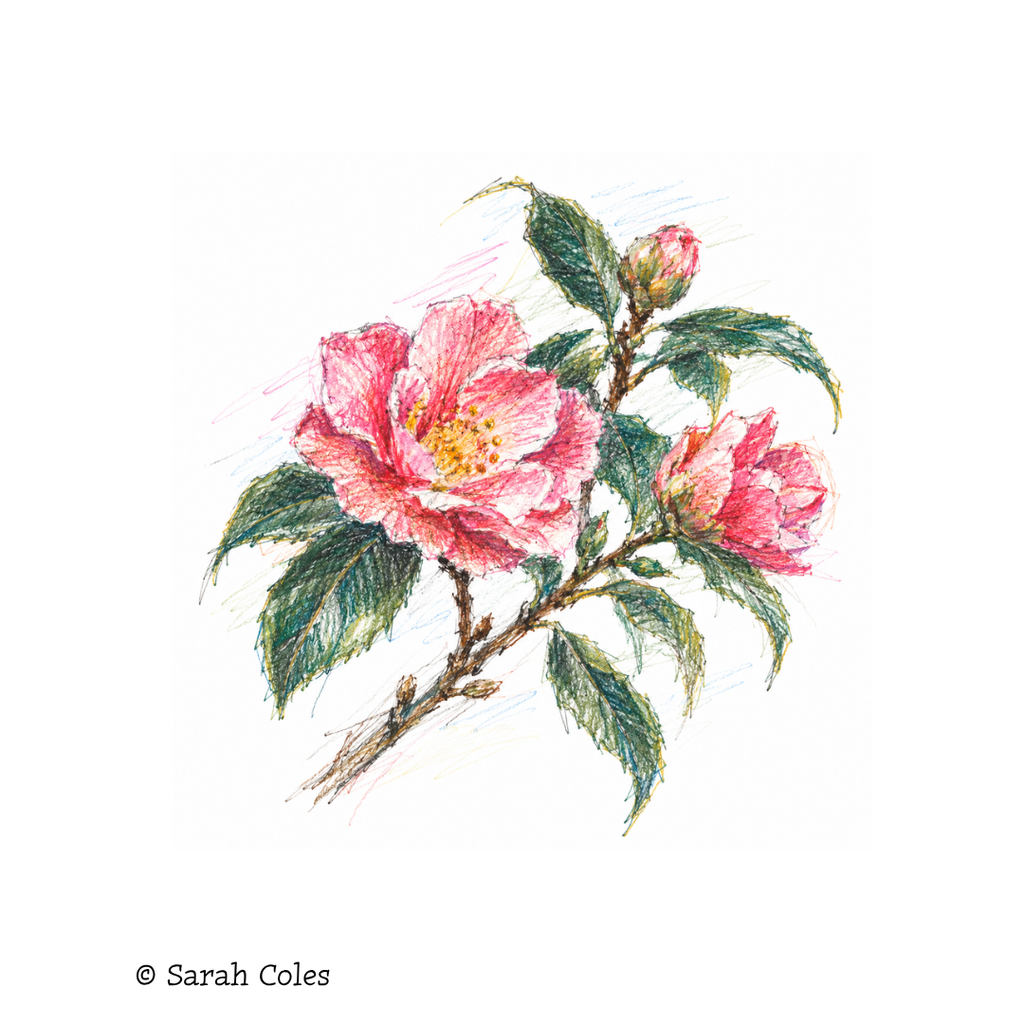
There is something rather special about a camellia in flower. At a time when much of the garden is still finding its way out of winter, its glossy evergreen leaves become the backdrop for flowers of extraordinary beauty. Some are delicate and simple, with golden stamens at their centres, while others are filled with layer upon layer of petals, almost too perfect to be real.
And yet, there they are, flowering amongst the cold mornings, damp afternoons and uncertain weather of late winter and early spring.
Camellia japonica, commonly known as the Japanese camellia, is one of those shrubs that rewards a little patience and the right position with years of enjoyment. Its flowers bring welcome colour to the quieter months, while its handsome foliage gives the garden structure long after the last petals have fallen.
Whether grown as a specimen shrub, tucked into a sheltered woodland border or planted in a generous container beside the house, a camellia has a wonderfully timeless quality.
For anyone looking to create a garden with interest throughout the seasons, it is a plant well worth getting to know.
Getting to Know Camellia japonica
Camellia japonica belongs to the Theaceae family, which also includes the tea plant, Camellia sinensis.
Native to parts of eastern Asia, including Japan, Korea and China, it grows naturally in woodland habitats where it benefits from shelter and filtered light.
Its natural surroundings offer a useful guide to growing it successfully in British gardens.
Camellias enjoy protection from harsh weather, a soil that retains some moisture without becoming waterlogged, and a position where their leaves and flower buds are not exposed to the worst of the winter elements.
The Japanese camellia is a slow-growing, evergreen shrub or small tree. In suitable conditions, mature plants can eventually reach several metres in height, although many cultivated varieties remain considerably smaller, particularly when grown in containers or regularly pruned.
Its leaves are one of its loveliest features.
Glossy, deep green and slightly leathery, they have finely toothed edges and a neat, elegant appearance. They remain on the plant throughout the year, providing a rich green backdrop for other plants in the border.
But it is the flowers that make Camellia japonica such a favourite.
Depending on the variety, they may be white, blush pink, rose, crimson or deep red. Some have contrasting markings, while others display beautifully symmetrical arrangements of overlapping petals.
There are simple, single flowers with prominent golden stamens, semi-double blooms and densely petalled forms that resemble roses or peonies.
Each has its own character, making the choice of camellia almost as enjoyable as growing one.
A Plant with a Remarkable History
The story of Camellia japonica stretches back centuries.
In Japan, camellias have long been admired for their flowers, evergreen foliage and place within the natural landscape.
Known as tsubaki, the Japanese camellia appears in traditional art, textiles and decorative design. Its flowers have been associated with beauty, refinement and the changing seasons.
Unlike many spring flowers that scatter their petals individually, some camellias shed their flower heads more or less intact. This distinctive habit has also contributed to their varied symbolism in Japanese culture.
Camellias began attracting considerable attention in Europe during the eighteenth century, when increasing trade and botanical exploration introduced unfamiliar plants from East Asia.
By the nineteenth century, they had become highly desirable amongst British gardeners and plant collectors.
Large estates developed camellia collections, and specialist nurseries began raising and distributing an increasing range of cultivated varieties.
Early collections were often grown under glass, partly because gardeners were uncertain how well the plants would tolerate the British climate.
Over time, experience showed that many camellias could thrive outdoors in suitable sheltered positions.
Today, they are familiar sights in gardens across Britain, particularly in areas with naturally acidic soil and relatively mild conditions.
And despite the centuries that have passed since their introduction, their flowers have lost none of their appeal.
When Does Camellia japonica Flower?
One of the greatest attractions of Camellia japonica is its flowering season.
Depending on the cultivar, location and weather, Japanese camellias generally flower from late winter into spring, with many producing their finest display between February and April.
Some varieties begin earlier in mild gardens, while others continue flowering well into May.
The flower buds develop during the previous growing season and remain on the plant through autumn and winter.
As temperatures begin to rise, the buds gradually swell and open.
It is a lovely process to watch.
A shrub that has appeared quietly green throughout winter suddenly begins to reveal touches of colour amongst its leaves. Then, over the following weeks, more flowers open until the branches are decorated with beautiful blooms.
Individual flowers may last for several days or longer in cool, settled weather, although heavy rain, frost or sudden temperature changes can shorten their display.
Camellias are particularly attractive when grown somewhere they can be admired from the house.
A view of their flowers through a kitchen window can make even the greyest February morning feel a little brighter.
The Beautiful Flowers and Evergreen Foliage
There is considerable variation amongst the many cultivars of Camellia japonica.
Some produce large, loosely arranged flowers, while others have tightly packed petals forming wonderfully intricate shapes.
Single-flowered varieties are particularly attractive for their visible golden stamens, which may provide pollen for visiting insects during suitable weather.
Double-flowered cultivars are often chosen for their decorative appearance, although the abundance of petals can make their reproductive parts less accessible to pollinators.
The flowers also vary in size, with some relatively modest and others reaching more than 10 centimetres across.
Their colours range from the purest white to deep, velvety red.
The evergreen foliage provides a handsome setting for this display.
Its glossy leaves catch the light throughout the year and give the shrub a sense of permanence, even when the rest of the border is changing.
This makes camellias particularly valuable in mixed planting schemes, where they can provide structure behind spring bulbs, woodland perennials and summer-flowering plants.
Where to Plant Camellia japonica
Choosing the right position is probably the most important part of growing a camellia successfully.
Once established in suitable conditions, these shrubs can live for many decades.
A little thought before planting can therefore make an enormous difference.
Does Camellia japonica Prefer Sun or Shade?
Camellias generally grow best in partial shade or dappled sunlight.
A position with gentle morning or afternoon light can be ideal, provided the plant is protected from strong, drying sunshine during the hottest part of summer.
They can tolerate more sun where the soil remains adequately moist, but excessive exposure may stress the plant, particularly in hot, dry conditions.
One important consideration in British gardens is the combination of frost and early morning sunshine.
When frozen flower buds are suddenly warmed by direct sunlight, they can thaw rapidly and suffer damage.
For this reason, an east-facing position exposed to bright winter sunshine is not always the best choice.
A sheltered position facing north-west or west can work well, provided the plant receives sufficient light.
The aim is to offer protection without placing the shrub in excessively deep shade.
Shelter from Wind and Frost
Although many established camellias are hardy in much of the UK, their flowers and developing buds can be damaged by severe frost and cold winds.
The plant itself may survive perfectly well while the flowers become browned or spoiled.
A sheltered position beside a wall, fence or established hedge can help protect the shrub.
Avoid exposed sites where strong winds continually dry the foliage and soil.
In coastal gardens, shelter from salt-laden winds is also important, as camellias are not particularly tolerant of maritime exposure.
A sheltered courtyard or protected woodland border can provide much better growing conditions than an open, windswept lawn.
The Best Soil for Camellia japonica
Camellias are ericaceous plants, meaning they prefer acidic soil.
For healthy growth, aim for a soil pH of approximately 5.0–6.5.
In naturally acidic gardens, they can thrive with relatively little intervention.
However, in alkaline or chalky soil, camellias may struggle to absorb essential nutrients, particularly iron.
This can result in chlorosis, where the leaves turn yellow while the veins remain green.
If your garden has alkaline soil, it is usually more practical to grow a camellia in a large container filled with suitable ericaceous compost rather than attempting to alter the pH of an entire border.
Camellias also appreciate soil that is rich in organic matter, retains moisture and drains freely.
They dislike both prolonged drought and waterlogged conditions.
On heavy clay, improving the soil structure and choosing a well-drained planting position is important.
On sandy ground, adding organic matter can help retain moisture.
A mulch of composted bark, leaf mould or another suitable organic material can help protect the shallow roots and maintain more even soil moisture.
How to Plant Camellia japonica
Spring and autumn are generally good times to plant camellias in the UK, provided the ground is not frozen or waterlogged.
Spring planting can be particularly useful in colder gardens, giving the roots time to establish before the following winter.
Begin by choosing a position with suitable light, shelter and soil conditions.
Dig a hole approximately twice the width of the rootball, but no deeper than the rootball itself.
Camellias have relatively shallow root systems, and planting too deeply can cause problems.
Position the shrub so that the top of the rootball sits level with, or very slightly above, the surrounding soil.
Backfill carefully, firm gently and water thoroughly.
Apply a mulch around the base to help conserve moisture, keeping it clear of the main stem.
During the first couple of years, water regularly in dry weather while the roots establish.
Camellias are slow-growing shrubs, so it may take a little time before a newly planted specimen begins to make a substantial impression.
But given the right conditions, it will gradually develop into a beautiful, long-lived feature.
Growing Camellia japonica in Pots
If your garden has chalky or alkaline soil, growing a camellia in a container is an excellent alternative.
It also allows you to enjoy the flowers close to the house, perhaps beside a doorway, on a sheltered terrace or in a courtyard.
Choose a generous container with drainage holes and fill it with a good-quality ericaceous compost.
The pot should be large enough to accommodate the root system comfortably, but there is no need to place a small plant immediately into an enormous container.
Repot into a slightly larger pot when necessary.
Container-grown camellias need more attention to watering because compost dries out much faster than garden soil.
Rainwater is particularly useful in hard-water areas, as repeated watering with alkaline tap water can gradually affect compost conditions.
However, tap water is preferable to allowing the plant to become severely dry if rainwater is unavailable.
Feed during the growing season with a fertiliser formulated for ericaceous plants, following the manufacturer’s instructions.
Avoid excessive feeding, which can damage roots and encourage unbalanced growth.
During very cold weather, protect containers from prolonged freezing, as roots in pots are more exposed than those growing in the ground.
How to Care for Camellia japonica
Camellias are not especially demanding plants once established, but a few seasonal tasks can make a considerable difference to their health and flowering.
Watering During Summer
One of the most important things to understand about camellias is that their flower buds develop during summer and autumn.
This means the care you give the plant during warm weather can influence the flowers you enjoy the following spring.
If the soil becomes excessively dry while buds are forming, the plant may produce fewer flowers or shed some of its developing buds.
Water during prolonged dry spells, particularly from late summer into early autumn.
A generous mulch can help retain moisture and protect the shallow roots.
Try to maintain reasonably consistent soil moisture rather than allowing the plant to become very dry and then suddenly soaking it.
Feeding Camellias
Camellias growing in healthy, fertile garden soil may require little additional feeding.
Where growth is poor or the plant is growing in a container, an ericaceous fertiliser can be beneficial.
Apply it during spring or early summer according to the product instructions.
Avoid feeding late in the season, as this may encourage soft new growth that is vulnerable to frost.
Mulching
An annual mulch of leaf mould, composted bark or another suitable organic material helps improve soil conditions and retain moisture.
Apply it around the root area without piling it against the stem.
Because camellia roots are relatively shallow, avoid deep cultivation or vigorous hoeing beneath the shrub.
When and How to Prune Camellia japonica
One of the pleasures of growing camellias is that they generally require very little pruning.
Their natural shape is attractive, and established plants often develop a handsome, rounded or upright framework without much intervention.
If pruning is necessary, the best time is immediately after flowering.
This allows the plant to produce new growth and develop the following season’s flower buds.
Remove dead, damaged or crossing branches first.
You can then shorten any stems that spoil the overall shape.
Avoid heavy pruning late in summer or autumn, as this is likely to remove developing flower buds.
Mature camellias can sometimes tolerate more substantial renovation pruning, but severe cutting back may reduce flowering for a season or two.
For most garden plants, gentle, occasional pruning is all that is required.
Why Is My Camellia Not Flowering?
A camellia covered in glossy green leaves but producing very few flowers can be disappointing.
Fortunately, the cause is often something that can be improved.
One of the most common reasons is insufficient moisture during summer, when the flower buds are developing.
Too much shade can also reduce flowering, particularly if the shrub receives very little natural light.
Late pruning may remove developing buds before they have a chance to open.
An unsuitable soil pH can affect the plant’s overall health, while severe frost may damage buds that would otherwise have flowered.
Occasionally, a newly planted camellia simply needs time to settle into its surroundings.
Rather than reaching immediately for fertiliser, begin by checking the growing conditions.
Healthy roots, suitable soil, sufficient light and consistent moisture are usually the foundations of reliable flowering.
Why Do Camellia Buds Fall Off?
Camellia bud drop is a familiar frustration for gardeners.
Sometimes a shrub develops plenty of promising buds during autumn, only for some to fall before opening.
This can happen for several reasons.
Water stress during the previous summer or autumn is a common contributor.
Sudden changes in temperature, severe frost and other environmental stresses may also play a part.
Some bud drop is natural, particularly when a plant has developed more buds than it can support.
The best approach is to provide consistent growing conditions throughout the year.
Keep the roots cool and moist, avoid unnecessary disturbance and protect the plant from particularly harsh exposure.
Common Camellia Problems
Although Camellia japonica is generally a reliable shrub, a few problems are worth recognising.
Yellow Leaves
Yellowing foliage can indicate nutrient deficiencies, particularly where soil or compost is too alkaline.
Check the growing conditions before applying fertiliser.
Poor drainage, root damage and other stresses can also cause leaves to yellow.
Camellia Flower Blight
Camellia flower blight is a fungal disease that causes flowers to develop brown patches and deteriorate prematurely.
Affected flowers may fall to the ground.
Collecting and disposing of infected flowers can help reduce the amount of fungal material remaining beneath the plant.
Scale Insects
Scale insects occasionally appear on camellia stems and leaves.
Small infestations may cause little noticeable harm, but heavy populations can weaken growth.
Regular inspection helps identify problems before they become severe.
Frost-Damaged Flowers
Brown or discoloured flowers following a cold spell are not necessarily a sign of disease.
Camellia flowers can be sensitive to frost even when the shrub itself is hardy.
A sheltered planting position is the best long-term protection.
Beautiful Companion Plants for Camellias
Camellias work particularly well in gardens inspired by woodland planting.
Their evergreen foliage provides a wonderful backdrop for smaller plants, while their spring flowers bring colour above the emerging growth beneath them.
Hellebores
Hellebores are natural companions, enjoying similar sheltered positions and flowering during late winter and early spring.
Their nodding flowers create a lovely contrast with the larger camellia blooms.
Snowdrops
A drift of snowdrops beneath a camellia is a particularly beautiful sight.
Their delicate white flowers bring life to the ground while the camellia begins its display above.
Ferns
Ferns introduce texture and movement, especially in shady borders.
Evergreen varieties can help maintain interest throughout the year.
Japanese Maples
In suitable acidic soil, Japanese maples can make elegant companions.
Their finely divided foliage and autumn colour contrast beautifully with the camellia’s glossy evergreen leaves.
Together, these plants can create a garden with interest extending from the earliest flowers of spring through to the rich colours of autumn.
Are Camellias Good for Wildlife?
Camellias can provide useful shelter within a garden thanks to their dense evergreen foliage.
Their flowers may also attract insects during suitable weather, particularly single-flowered varieties with accessible stamens.
However, not all camellia flowers offer the same value to pollinators.
Highly double forms may have fewer accessible reproductive parts, making them less useful than simple, open flowers.
For a wildlife-friendly garden, consider combining camellias with native shrubs, early-flowering bulbs and a variety of nectar- and pollen-producing plants.
A garden that offers different flowering times and habitats will generally support a wider range of wildlife than one relying on a single ornamental shrub.
The Meaning and Folklore of Camellias
Camellias have gathered a wealth of symbolism over the centuries.
In Japanese culture, the camellia has long appeared in art and literature, admired for its elegance and distinctive flowers.
In the Victorian language of flowers, camellias became associated with admiration, affection and beauty.
Different colours acquired their own romantic meanings.
White camellias were often linked with purity or admiration, while pink and red flowers were associated with affection and love.
These interpretations varied between traditions and were not universal, but they added another layer of fascination to an already fashionable garden plant.
There is something rather fitting about a flower that appears during the colder months becoming associated with devotion and lasting affection.
Its beauty is not fleeting in quite the same way as many summer flowers.
The plant itself remains, year after year, quietly preparing for another season of blossom.
Choosing the Right Camellia japonica
With so many beautiful cultivars available, choosing a camellia can be one of the most enjoyable parts of planning a garden.
Some are particularly admired for their flower colour, while others are selected for their shape, growth habit or flowering season.
A few well-known examples include:
- Camellia japonica ‘Adolphe Audusson’ – a striking cultivar with large, rich red, semi-double flowers.
- Camellia japonica ‘Alba Plena’ – an elegant variety with beautifully arranged, pure white, double flowers.
- Camellia japonica ‘Nuccio’s Pearl’ – admired for its soft, pale pink flowers, often deepening towards the centre.
- Camellia japonica ‘Donation’ – often encountered in camellia collections, although botanically it belongs to the Camellia × williamsii group rather than Camellia japonica.
When choosing a plant, consider its eventual size, flowering period and suitability for your particular garden.
It is also worth visiting a nursery when the plants are in flower.
Photographs are useful, but seeing the flowers in person gives a much better impression of their colour, size and form.
Why Camellia japonica Deserves a Place in Your Garden
There are shrubs that provide structure, others that offer beautiful flowers, and some that bring interest during the quieter months.
Camellia japonica manages to do all three.
Its evergreen foliage creates a sense of permanence throughout the year, while its flowers bring remarkable colour to late winter and spring.
It is particularly valuable in sheltered gardens with acidic soil, where it can develop into a magnificent, long-lived shrub.
For those gardening on chalk, a container offers the opportunity to enjoy its beauty without struggling against unsuitable ground conditions.
And while camellias do appreciate thoughtful planting and consistent moisture, they are not difficult plants once their basic needs are understood.
Perhaps their greatest charm is the timing of their flowers.
Just when winter begins to feel rather long, the buds start to open.
A little colour appears amongst the dark green leaves, followed by another flower, and then another.
Before long, the shrub is transformed.
It is a reminder that the garden is never truly standing still, even during the coldest months.
And few plants celebrate that quiet return of colour quite as beautifully as a camellia.
Further Reading: Beautiful Shrubs for Winter Interest: Colour, Fragrance and Life in the Winter Garden, Winter Daphne (Daphne odora): The Beautifully Fragrant Shrub That Brightens the Winter Garden
For Inspiration Follow Me on Instagram, Facebook, Bluesky and Threads
