


There is something particularly lovely about discovering flowers in the garden when the days are short and the weather has turned cold. The borders have quietened, the trees are bare, and much of the garden seems content to wait for spring.
Yet amongst the evergreens and winter-flowering shrubs, there are plants that choose this quieter season to put on their finest display.
Clematis ‘Winter Beauty’ is one of them.
With its handsome dark green foliage and delicate, bell-shaped white flowers, this beautiful climbing plant brings an unexpected freshness to the winter garden. While many of the clematis we know and love flower during late spring and summer, ‘Winter Beauty’ saves its display for the colder months.
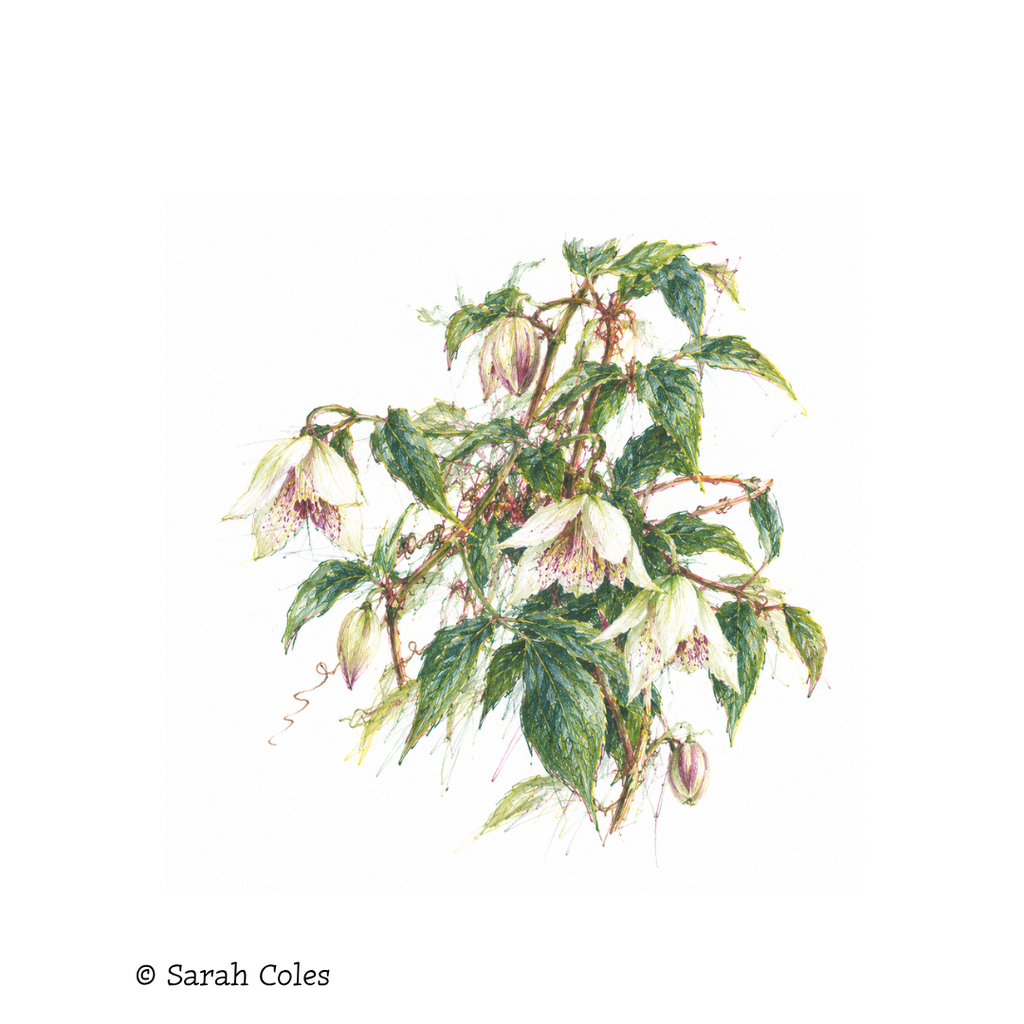
Its flowers hang gracefully amongst the leaves, rather like little porcelain bells, offering a welcome contrast to the subdued colours of winter.
And perhaps that is what makes this clematis so appealing. It is not simply the beauty of the flowers, but the pleasure of finding them at a time when we least expect to see something in bloom.
For gardeners with a sheltered wall, courtyard or sunny corner, Clematis ‘Winter Beauty’ can be a wonderful way to introduce height, evergreen structure and seasonal interest.
Getting to Know Clematis ‘Winter Beauty’
Clematis ‘Winter Beauty’ is commonly listed under the botanical name Clematis urophylla ‘Winter Beauty’, although the plant has also appeared in horticultural literature under other names and classifications.
It belongs to the Ranunculaceae family, alongside familiar garden plants such as hellebores, anemones and buttercups.
The name Clematis comes from an ancient Greek word associated with climbing plants, reflecting the scrambling, twining habit that makes these plants so useful in the garden.
Unlike many popular large-flowered clematis, ‘Winter Beauty’ is an evergreen climber.
Its foliage remains attractive through much of the year, while its flowering season generally falls between late autumn and early spring, depending on the weather and growing conditions.
The plant is valued particularly for its combination of glossy foliage and elegant white flowers.
It is a more unusual choice than the familiar summer-flowering clematis, but one that can bring a great deal of character to a thoughtfully planted winter garden.
What Does Clematis ‘Winter Beauty’ Look Like?
The flowers are undoubtedly its greatest attraction.
Rather than producing the large, open blooms associated with many summer clematis, ‘Winter Beauty’ carries smaller, hanging, bell-shaped flowers.
These are generally creamy white to pure white, with a softly waxy appearance.
They emerge amongst the dark foliage, creating a delicate contrast that is particularly attractive in the low light of winter.
Look closely and you can appreciate the elegant shape of each flower, with its gently pointed tips and pale interior.
The flowers may appear from around November or December and continue into late winter, although their timing and abundance can vary considerably according to temperature and shelter.
In a mild, protected garden, the display can be particularly rewarding.
Attractive Evergreen Foliage
The leaves are another important feature.
‘Winter Beauty’ has glossy, dark green foliage that provides structure and interest even when the plant is not flowering.
The leaves are divided into leaflets, giving the plant a lighter, more delicate appearance than some of the larger-leaved evergreen climbers.
As it grows, the stems climb and scramble through suitable supports, creating a covering of green that can soften a wall, trellis or sheltered boundary.
It is worth remembering, however, that evergreen does not always mean a plant retains every leaf throughout the year.
Cold weather, drought and other stressful conditions can cause some foliage to yellow or fall.
In particularly exposed gardens, winter damage may also affect the leaves and developing flower buds.
Given a suitable position, though, this is a climber that can offer interest well beyond its flowering season.
Where to Plant Clematis ‘Winter Beauty’
Choosing the right position is perhaps the most important part of growing this clematis successfully.
Although it can be a rewarding plant, ‘Winter Beauty’ is not as reliably hardy as many of the deciduous clematis commonly grown throughout Britain.
It is best suited to a sheltered garden where it can enjoy good light without being exposed to prolonged severe frost or cold, drying winds.
Does Clematis ‘Winter Beauty’ Need Full Sun?
A sunny, sheltered position is generally best.
A south-facing or west-facing wall can provide the warmth and protection that this climber appreciates, particularly during winter.
Walls absorb warmth during the day and can create a slightly milder environment for plants growing nearby.
This can make a considerable difference to the survival and flowering of less hardy climbers.
A position with plenty of light will also help encourage flowering.
However, as with many clematis, the roots benefit from soil that does not become excessively hot or dry during summer.
A mulch around the base can help conserve moisture, while nearby low-growing plants may provide some additional shade for the root area.
The aim is to give the climbing stems plenty of light while keeping the roots comfortably moist.
Is Clematis ‘Winter Beauty’ Hardy in the UK?
This is an important consideration, particularly for gardeners in colder or more exposed parts of the country.
‘Clematis’ ‘Winter Beauty’ is generally considered less hardy than many familiar garden clematis and may suffer damage during prolonged freezing weather.
It is therefore best grown in a mild, sheltered position, such as a protected courtyard or against a warm house wall.
In coastal gardens, the relatively mild winter temperatures can be an advantage, although exposure to strong winds and salt-laden air may still cause problems.
For gardens in colder inland areas, it may be more sensible to grow the plant in a large container that can be moved into a cool, frost-free greenhouse or conservatory during severe weather.
Even in relatively mild parts of the UK, an exceptionally cold winter may damage an established plant.
For that reason, ‘Winter Beauty’ is best regarded as a climber that
Further Reading: Beautiful Shrubs for Winter Interest: Colour, Fragrance and Life in the Winter Garden, Winter Daphne (Daphne odora): The Beautifully Fragrant Shrub That Brightens the Winter Garden
For Inspiration Follow Me on Instagram, Facebook, Bluesky and Threads
