


There is a particular stillness to the garden in winter. The borders have settled, the trees stand bare against the sky, and the bright colours of summer seem a long way off. Yet even on the coldest days, there are small signs that the garden is quietly getting on with life.
Sometimes, the first clue is not something you see, but something you smell.
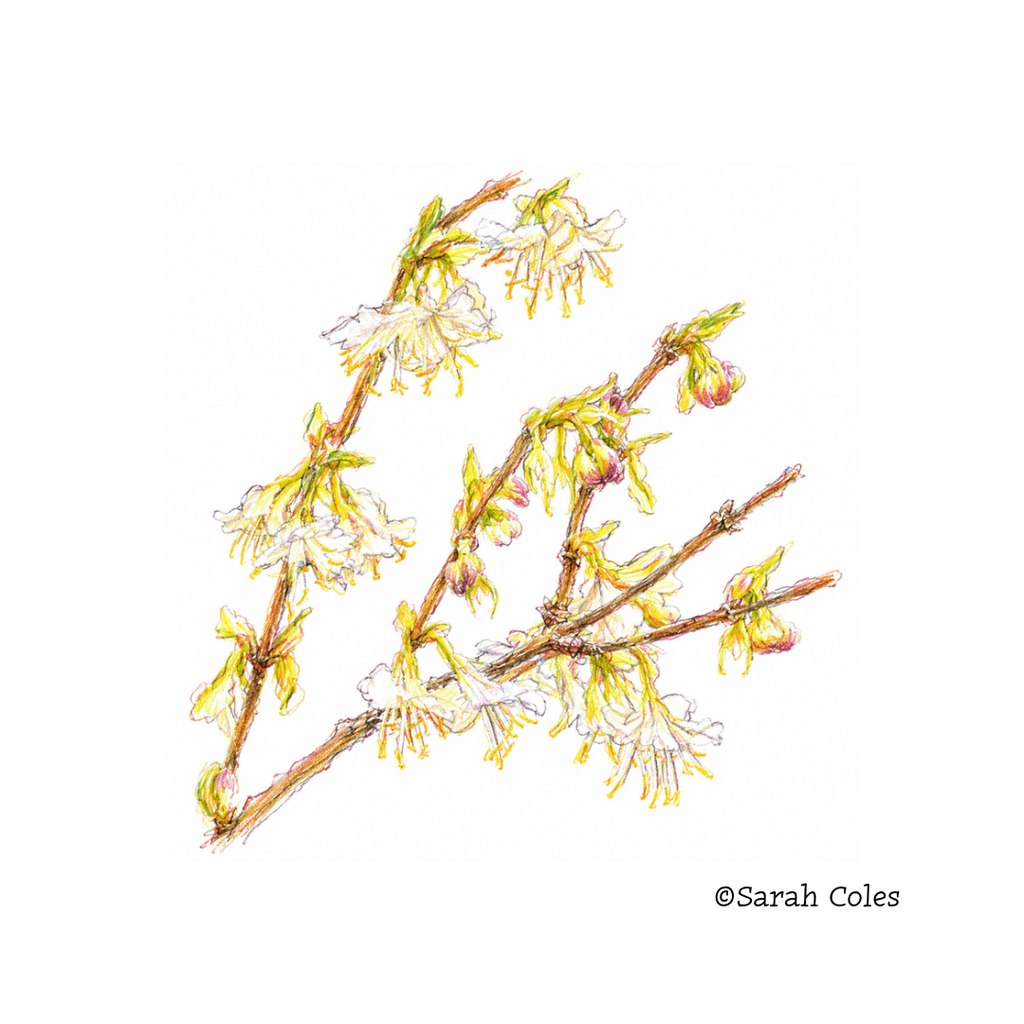
A sweet, almost lemony fragrance drifts through the chilly air, quite unexpected amongst the bare branches and damp earth. Follow it, and you may discover a winter-flowering honeysuckle, Lonicera fragrantissima, its slender stems dotted with delicate, creamy-white flowers.
It is an unassuming shrub for much of the year, easily overlooked amongst showier garden plants. But from midwinter into early spring, it becomes something rather special. Its flowers may be small, but their fragrance is wonderfully generous, bringing a little warmth to even the greyest winter afternoon.
For anyone who enjoys finding beauty in the quieter corners of the garden, winter honeysuckle is a plant worth getting to know.
A Honeysuckle with a Difference
Mention honeysuckle, and most of us picture the familiar climbing woodbine, Lonicera periclymenum, winding its way through hedgerows and over garden arches, filling summer evenings with its heady scent.
Winter-flowering honeysuckle is quite different.
Rather than climbing, Lonicera fragrantissima forms a broad, arching shrub with a loose, informal shape. Its branches spread and intertwine, creating a slightly untidy tangle that seems entirely at home in a relaxed garden.
It is usually deciduous, although in milder winters it may retain some of its leaves. As the colder months arrive, small, paired flowers begin to appear along the stems, often before the new foliage emerges.
The creamy-white blooms are delicate, with slender petals and prominent stamens. Look closely, and you may notice the pale yellow centres and soft pinkish tones of the unopened buds.
Flowering generally takes place between December and March, depending on the weather and the part of the country in which it is growing.
The flowers themselves are modest, but their fragrance is anything but. Sweet, fresh and gently citrus-like, it can carry surprisingly far on a mild, still day.
It is this unexpected perfume that makes winter honeysuckle such a pleasure to grow.
A Journey from China
Like many familiar shrubs in British gardens, winter-flowering honeysuckle has its origins far from our shores.
Lonicera fragrantissima is native to China, where it grows as a woody shrub. It was introduced to Britain during the nineteenth century, when plant collectors were bringing an extraordinary range of unfamiliar trees, shrubs and flowers into cultivation.
The Scottish botanist and plant collector Robert Fortune is closely associated with its introduction.
Fortune travelled extensively in China, collecting plants for British gardens at a time when journeys into the country’s interior could be difficult and dangerous. His discoveries included many ornamentals that would eventually become familiar features of our gardens.
Among the plants Fortune introduced to Britain in 1845 was winter-flowering honeysuckle, a shrub whose quiet appearance concealed one of the most memorable fragrances of the colder months.
Its botanical name gives a clue to this quality. Fragrantissima means ‘very fragrant’, a fitting description for a plant whose scent can be noticed long before its flowers are seen.
It is sometimes known as ‘sweet breath of spring’, a name that captures rather beautifully the feeling of encountering its flowers on a winter’s day.
Finding the Right Place in the Garden
The secret to enjoying winter honeysuckle is to plant it somewhere you will pass regularly during the colder months.
It would be a shame to hide such a fragrant shrub at the far end of a border, where its flowers might go unnoticed until spring.
Instead, consider a position beside a path, near a garden gate or close to the back door. Somewhere you walk past on the way to the shed or compost heap is ideal.
On a mild January morning, you may find yourself lingering a little longer than usual, wondering where that lovely scent is coming from.
Soil, Sunshine and Shelter
Winter honeysuckle is a remarkably accommodating shrub. It grows happily in a range of soils, including clay, loam and chalk, provided the ground is reasonably well drained.
It prefers fertile soil that retains some moisture without becoming waterlogged. Adding well-rotted garden compost when planting can help improve the soil, particularly where the ground is very sandy or heavy.
A position in full sun or partial shade is best. Although it will tolerate some shade, flowering is generally more generous where the plant receives a reasonable amount of light.
Shelter is worth considering too. The shrub itself is hardy in most parts of Britain, but its delicate flowers can suffer during prolonged severe weather. A position protected from the coldest winds will help preserve the blooms and allow their fragrance to linger.
Winter honeysuckle is not a particularly neat shrub, and it is best given room to develop its natural shape. Over time, it generally reaches around 1.5–2.5 metres in height and spread, although established plants may grow wider if left unpruned.
Its arching branches are part of its character, so it is worth allowing enough space for them to grow without constant trimming.
A Plant with a Place in Folklore
Honeysuckles have long been associated with affection, devotion and the bonds between people.
Much of this symbolism comes from the climbing species, whose twining stems wrap themselves around neighbouring plants and supports.
In the traditional language of flowers, honeysuckle came to represent affection and devotion, its twining stems offering a natural image of closeness and attachment.
These associations belong largely to the climbing honeysuckles familiar in British hedgerows and cottage gardens. They are part of a long tradition of finding meaning in the plants around us, although our winter-flowering honeysuckle arrived in Britain much later.
Shakespeare drew on the image of entwining woodbine in A Midsummer Night’s Dream, using the plant to suggest a tender embrace. It is a lovely reminder of how closely honeysuckle has become woven into our gardens, stories and imagination.
Our winter honeysuckle does not climb or entwine itself around other plants in quite the same way, but its fragrance has a charm of its own.
There is something wonderfully comforting about a plant that flowers when the garden is at its quietest, offering a reminder that the seasons are always moving forwards.
A Welcome Flower in the Winter Garden
Although fragrance is the main reason many gardeners grow winter honeysuckle, its flowers also have value for wildlife. Rich in nectar, they can attract bees and other pollinating insects during milder spells, when relatively few shrubs are in flower.
The Royal Horticultural Society recognises Lonicera fragrantissima as a plant for pollinators. Its winter flowers can make a useful contribution to a garden planted to provide food for insects across the seasons.
It is worth remembering that winter insect activity varies considerably with the weather, and no single plant can meet the needs of pollinators throughout the colder months.
Growing a mixture of winter and early spring flowers is a better way to provide a succession of food sources.
Snowdrops, winter aconites, hellebores, crocuses and winter-flowering heathers can all contribute to a garden that offers interest and opportunities for wildlife as the seasons change.
Even when there are no insects about, the honeysuckle’s pale flowers are a lovely sight against the dark framework of winter branches.
Living with Winter Honeysuckle
One of the pleasures of growing this shrub is that it asks for relatively little attention.
Once established, winter honeysuckle is generally hardy and adaptable, tolerating occasional dry spells and a range of growing conditions.
Young plants will benefit from watering during prolonged dry weather, particularly through their first couple of summers. A spring mulch of garden compost or leaf mould will help retain moisture and improve the soil.
Pruning is straightforward, although it is worth understanding how the plant grows.
Winter honeysuckle flowers on older wood, so the best time to prune is immediately after flowering. This gives new growth time to develop before the following winter.
Remove dead, damaged or crossing branches, and thin out some of the oldest stems if the shrub has become congested.
An established plant can be rejuvenated gradually by removing a proportion of the oldest stems near ground level over several years.
Avoid cutting it back hard every autumn, as this may remove the wood that would otherwise carry the winter flowers.
A Quieter Presence in Summer
Winter honeysuckle is not a shrub that demands attention throughout the year.
Once flowering has finished, fresh green leaves appear, and the plant settles into a rather ordinary summer appearance. Its foliage is pleasant enough, but it lacks the drama of many flowering shrubs.
In late spring or early summer, small red berries may develop where flowers have been pollinated. These can be attractive to birds, but the berries should not be eaten by people.
The shrub’s loose, spreading habit can also look untidy in a formal garden, particularly if it has been planted in a space that is too small.
Yet these are small considerations when weighed against the pleasure it brings in winter.
Rather than expecting it to be the centre of attention all year, it is better to think of winter honeysuckle as a seasonal highlight, quietly providing structure through summer before coming into its own when other plants have finished flowering.
Making the Most of Its Winter Flowers
Winter honeysuckle is particularly effective in a mixed shrub border, where its arching branches can mingle with other plants.
During summer, flowering perennials and neighbouring shrubs can provide colour and interest around its leafy framework. As autumn passes and the borders begin to fade, the honeysuckle gradually takes centre stage.
It also works beautifully in an informal woodland-edge planting, where its pale flowers can be enjoyed alongside snowdrops, hellebores and early bulbs.
A dark evergreen background helps the small blooms stand out, while a sheltered corner can hold their fragrance on a still winter afternoon.
For a particularly lovely combination, try growing it near a winter-flowering daphne or witch hazel, provided the soil and growing conditions suit each plant. Each has its own distinctive fragrance, and together they can transform a quiet corner of the garden into somewhere worth visiting throughout the colder months.
A few flowering stems can also be cut for the house.
Placed in a simple vase, their delicate flowers bring a little of the winter garden indoors, where the fragrance can be enjoyed at close quarters. Take only a few stems, cutting just above a healthy bud, so that the shrub retains its natural shape.
A Reason to Wander Outside
There are times in winter when the garden seems to be holding its breath. The borders are quiet, the days are short, and spring still feels some way off.
Yet there is always something happening if we take the time to look.
A snowdrop pushing through the leaf litter, the first green shoots of a bulb, or the sound of birds beginning to sing on a brighter morning can make even the smallest garden feel full of possibility.
Winter-flowering honeysuckle belongs to these quieter pleasures.
Its flowers are not particularly showy, and for much of the year it is content to remain in the background. But on a cold morning, when its sweet fragrance drifts unexpectedly across the path, it becomes one of the most memorable plants in the garden.
Perhaps that is what makes it so special. It doesn’t need bright colours or extravagant flowers to capture our attention.
Just a handful of creamy-white blooms, a little winter sunshine and a fragrance that hints at the spring still to come.
Further Reading: Camellia japonica: A Beautiful Evergreen Shrub for Winter & Spring Colour, Clematis ‘Winter Beauty’: A Beautiful Evergreen Climber for the Winter Garden, Sarcococca Confusa – Sweet Box, Mahonia ‘Winter Sun’: A Beautiful Winter-Flowering Shrub, Beautiful Shrubs for Winter Interest: Colour, Fragrance and Life in the Winter Garden, Winter Daphne (Daphne odora): The Beautifully Fragrant Shrub That Brightens the Winter Garden
For Inspiration Follow Me on Instagram, Facebook, Bluesky and Threads
