


There is something rather special about a garden that continues to flower through winter. When the borders have quietened, the trees have shed their leaves and the days are short, even the smallest splash of colour can make a remarkable difference.
And few shrubs bring quite as much cheer to the winter garden as Mahonia × media ‘Winter Sun’.
With its bold evergreen foliage, tall sprays of golden-yellow flowers and delicate fragrance, this is a plant that seems particularly well suited to the quieter months of the year. Just when much of the garden is resting, its flowers begin to open, bringing colour and life to a season that can sometimes feel rather subdued.
But ‘Winter Sun’ is far more than a shrub that happens to flower in winter.
Its handsome, architectural leaves provide structure throughout the year, while its ability to grow in partial shade makes it especially useful in those parts of the garden where other flowering shrubs may struggle.
It is also a plant worth getting to know a little better. From its fascinating botanical history to its value for winter-active insects, there is much to appreciate about this distinctive evergreen.
Getting to Know Mahonia ‘Winter Sun’
Mahonia × media ‘Winter Sun’ belongs to the barberry family, Berberidaceae, and is one of several popular cultivars of the hybrid Mahonia × media.
This group of mahonias originated from crosses between Mahonia japonica and Mahonia lomariifolia, bringing together the attractive evergreen foliage and winter-flowering qualities of both parents.
‘Winter Sun’ was selected at Slieve Donard Nursery in Northern Ireland during the twentieth century and has since become a familiar sight in British gardens.
Its name is particularly appropriate.
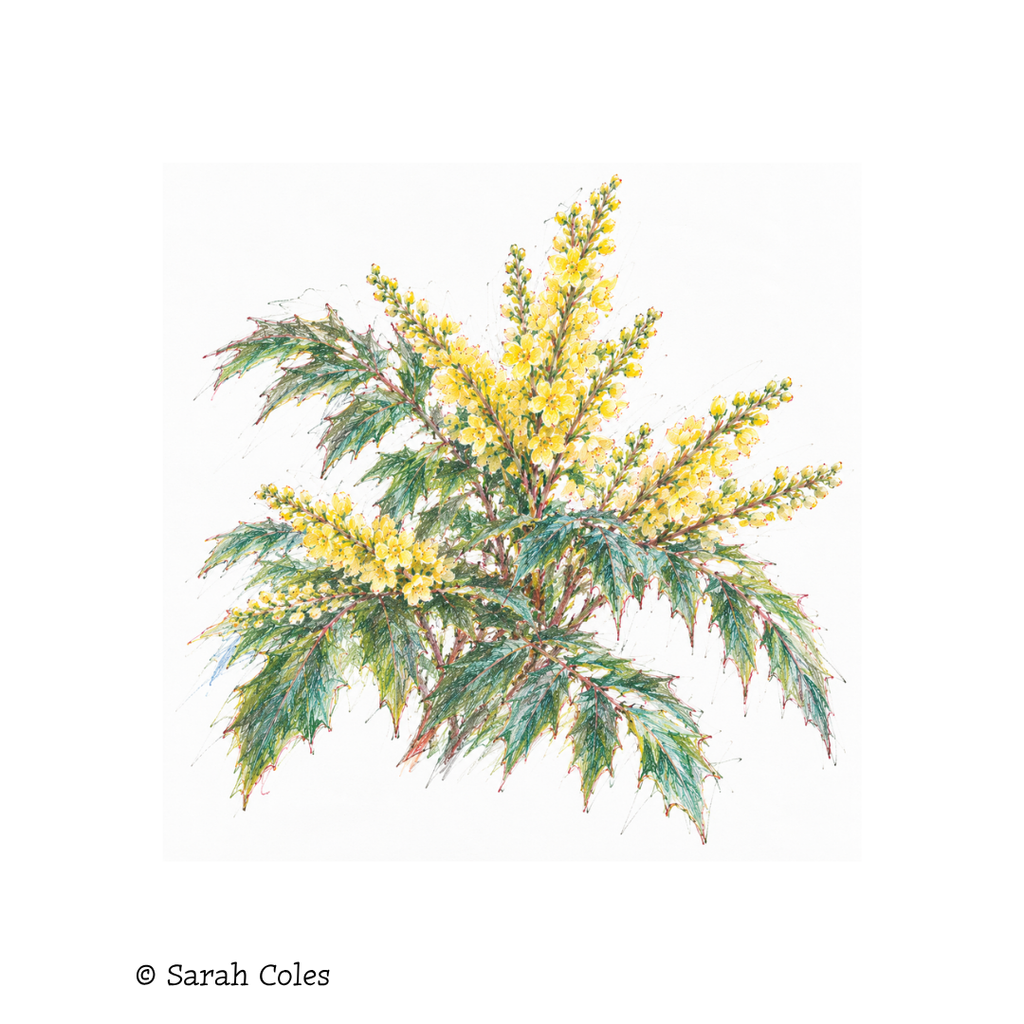
From late autumn into winter, the shrub produces clusters of long, slender flower racemes, each carrying numerous small, bright yellow flowers. These rise above the foliage and spread outwards, creating a striking display against the darker colours of the season.
The flowers often begin appearing in November or December, although the exact timing varies with the weather and growing conditions. In some gardens, flowering may continue into January or beyond.
What makes the display especially attractive is the contrast between the flowers and the foliage.
The leaves are large, leathery and deeply divided into numerous pointed leaflets, giving the shrub an almost exotic appearance.
Each leaf is pinnate, meaning that the individual leaflets are arranged along a central stalk. The leaflets have sharply toothed edges, rather like holly, although the overall effect is quite different.
As the shrub matures, these handsome leaves form distinctive clusters towards the ends of its upright stems.
It is a bold plant, certainly, but one that can bring a wonderful sense of structure to a garden throughout the year.
Why Mahonia ‘Winter Sun’ Is Such a Valuable Winter Shrub
Many of us naturally concentrate our gardening efforts on spring and summer.
We plan borders around roses, herbaceous perennials and colourful annuals, while the quieter months are sometimes left to look after themselves.
Yet winter offers opportunities for a different kind of planting.
Rather than great sweeps of colour, it is often the shape of a shrub, the texture of evergreen leaves or the fragrance of a few flowers that makes the greatest impression.
Mahonia ‘Winter Sun’ brings all three together.
Beautiful Yellow Flowers in the Depths of Winter
The most obvious attraction is its flowers.
Held in long, upright or spreading sprays, they form bright clusters of yellow above the evergreen leaves.
On a dull winter day, the effect can be quite remarkable.
The flowers are small individually, but together they create a generous display, particularly on a well-established shrub.
And because they appear when relatively few other plants are flowering, they are often noticed and appreciated far more than they might be during the abundance of summer.
A Lovely Winter Fragrance
Mahonia flowers are also known for their fragrance.
On a mild, still day, ‘Winter Sun’ can release a sweet scent, sometimes compared with lily of the valley.
It is not necessarily a fragrance that fills the whole garden, but it can be especially enjoyable when you approach the plant closely.
This makes a position near a regularly used path or somewhere visible from the house particularly appealing.
However, remember that mahonia leaves have sharp points. Leave enough room around paths and doorways so that people can pass comfortably without brushing against the foliage.
Evergreen Structure Throughout the Year
One of the great advantages of mahonia is that it never completely disappears into the background.
Its foliage remains attractive through spring, summer, autumn and winter, providing a strong architectural shape even when the plant is not flowering.
This makes it useful for adding height and structure to mixed borders, particularly where deciduous shrubs and herbaceous plants leave gaps during winter.
Its dark green leaves also provide a lovely backdrop for smaller plants, helping pale flowers and fresh spring foliage stand out.
Is Mahonia ‘Winter Sun’ Good for Wildlife?
Winter can be a difficult season for wildlife, particularly when cold weather limits the availability of flowers, berries and shelter.
Although many insects are inactive during the coldest periods, some bees and other pollinators will emerge on milder days.
The flowers of Mahonia ‘Winter Sun’ can provide nectar and pollen at a time when relatively few other garden plants are in bloom.
This makes it a useful addition to a garden planted with wildlife in mind.
After flowering, mahonias may also produce clusters of rounded, blue-black berries.
These can be eaten by birds, although the quantity of fruit varies between plants and seasons.
The evergreen foliage offers another benefit, providing shelter and cover when many surrounding shrubs have lost their leaves.
Of course, no single plant can provide everything wildlife needs.
A well-balanced garden benefits from a mixture of native plants, flowering shrubs, trees, grasses and areas of undisturbed habitat.
But Mahonia ‘Winter Sun’ can certainly play a useful part, particularly by extending the availability of flowers into winter.
Where to Plant Mahonia ‘Winter Sun’
Despite its rather exotic appearance, Mahonia ‘Winter Sun’ is generally a hardy and adaptable shrub that grows well in many British gardens.
The important thing is to give it sufficient room and choose a position where its foliage and flowers can develop naturally.
Does Mahonia ‘Winter Sun’ Prefer Sun or Shade?
One of the most useful qualities of mahonia is its tolerance of shade.
‘Winter Sun’ grows particularly well in partial shade, making it a good choice for woodland-style planting, sheltered borders and areas beneath the light canopy of deciduous trees.
It can also tolerate deeper shade, although flowering may be reduced where light levels are very low.
In many gardens, a position receiving morning sunshine followed by afternoon shade is ideal.
The shrub can grow in sunnier positions too, provided the soil retains enough moisture, but exposed sites with strong winds and drying summer sunshine are less suitable.
A little shelter will help protect the foliage and keep the plant looking its best.
What Soil Does Mahonia ‘Winter Sun’ Need?
Mahonia is reasonably tolerant of different soil types, including clay, loam and chalky soils, provided conditions are not excessively wet.
It generally prefers fertile, moisture-retentive but well-drained soil.
Before planting, improve the soil with well-rotted garden compost or leaf mould, particularly if it is very sandy or compacted.
Organic matter helps improve soil structure, allowing heavy soils to drain more freely while helping lighter soils retain moisture.
Avoid planting in ground that remains waterlogged during winter.
Although mahonia is hardy, prolonged saturation around the roots can cause problems.
Once established, it can tolerate occasional dry spells, but young plants benefit from regular watering during their first growing seasons.
How Big Does Mahonia ‘Winter Sun’ Grow?
This is an important consideration before planting.
Mahonia ‘Winter Sun’ is an upright, vigorous evergreen shrub that can eventually reach approximately 3–4 metres in height, with a spread of around 2–3 metres, depending on conditions and pruning.
It is not a plant to squeeze into a narrow gap simply because that space happens to be shady.
Given room, its stems develop an attractive, upright framework topped with handsome clusters of foliage.
Crowded into a small border, however, it can become awkward and difficult to manage.
For the best effect, allow it space towards the back of a mixed border, within a shrubbery or as a specimen plant in a sheltered garden.
How to Plant Mahonia ‘Winter Sun’
Autumn and spring are generally good times to plant container-grown mahonias, provided the ground is not frozen or waterlogged.
Begin by preparing the planting area, removing perennial weeds and loosening any compacted soil.
Dig a hole slightly wider than the rootball but no deeper than the plant was growing in its pot.
Carefully remove the shrub from its container and gently loosen any tightly circling roots.
Position it so that the top of the rootball sits level with the surrounding soil.
Backfill with the excavated soil, firming gently to remove large air pockets.
Water thoroughly after planting.
A layer of well-rotted compost or leaf mould around the base will help conserve moisture and gradually improve the soil, although it is best to leave a little space around the main stems.
During dry weather, keep the plant watered while its roots become established.
A little attention during the first year or two can make a considerable difference to its long-term growth.
How to Prune Mahonia ‘Winter Sun’
Mahonia ‘Winter Sun’ generally needs very little pruning when grown in a suitable position.
Its naturally upright habit is part of its appeal, and allowing it to develop without excessive cutting often produces the most attractive result.
However, older plants can sometimes become tall and rather bare towards the base.
This is not unusual.
As mahonias mature, their foliage tends to concentrate towards the ends of the stems, leaving the lower branches more exposed.
If you prefer a fuller appearance, careful pruning can encourage fresh growth.
When Is the Best Time to Prune Mahonia?
The best time to prune Mahonia ‘Winter Sun’ is usually in spring, once flowering has finished.
This allows you to enjoy the winter display before making any changes.
Begin by removing dead, damaged or crossing branches.
If the shrub has become too tall, selected stems can be shortened to encourage new shoots lower down.
Mahonias can often respond well to more substantial renovation pruning, but it is sensible to approach this gradually, particularly with older or stressed plants.
Rather than cutting every stem back severely at once, consider reducing some of the tallest stems over successive years.
This helps maintain the plant’s appearance while encouraging a healthier framework.
Always use clean, sharp secateurs or loppers and wear sturdy gardening gloves.
Those sharply pointed leaflets are surprisingly unforgiving when you reach into the centre of the shrub.
Growing Mahonia ‘Winter Sun’ in a Small Garden
Although ‘Winter Sun’ is a relatively large shrub, it can still have a place in some smaller gardens if positioned thoughtfully.
Its upright growth means it can provide height without necessarily occupying as much ground as a broad, spreading shrub.
However, it is important to allow for its eventual size.
A position in the corner of a generous border may work well, particularly if the surrounding planting is relatively low.
It can also be useful as a backdrop to a small woodland-style garden.
For very restricted spaces, however, a naturally smaller mahonia cultivar may be a more practical choice.
Trying to keep a vigorous shrub permanently confined to a tiny space can create unnecessary work and spoil its natural shape.
It is usually better to choose a plant that suits the garden than spend years trying to make the garden suit the plant.
Beautiful Companion Plants for Mahonia ‘Winter Sun’
One of the pleasures of gardening in winter is discovering how different plants complement one another.
Mahonia’s bold foliage and bright yellow flowers make it particularly effective when combined with plants that offer softer textures or contrasting colours.
Hellebores
Hellebores are wonderful companions for mahonias.
Their elegant flowers appear during winter and early spring, often in shades of white, pink, plum and green.
Planted beneath or in front of a mahonia, they provide a softer layer of interest below its taller stems.
The Christmas Rose, Helleborus niger, is particularly lovely where soil conditions suit both plants.
Snowdrops
Few sights are more welcome than the first snowdrops appearing through the winter soil.
Their delicate white flowers look beautiful against the dark green foliage of mahonia.
Try planting small groups of snowdrops towards the front of the border, where they can gradually naturalise.
As the mahonia flowers begin to fade, the snowdrops help carry the garden towards spring.
Evergreen Ferns
Ferns provide a lovely contrast to the bold, spiny foliage of mahonia.
The Hart’s-tongue fern, Asplenium scolopendrium, is particularly useful in sheltered, shady borders.
Its glossy, strap-shaped fronds bring a softer texture and help create an attractive woodland atmosphere.
Cyclamen coum
For a little colour at ground level, Cyclamen coum is a charming choice.
Its small pink, magenta or white flowers appear during winter and early spring, often accompanied by beautifully patterned leaves.
The contrast between its delicate flowers and the strong architectural shape of mahonia can be particularly effective.
Together, these plants create a winter border that offers colour, texture and interest at several different heights.
The History Behind the Mahonia Name
Mahonia has an interesting connection with horticultural history.
The name commemorates Bernard McMahon, an Irish-born nurseryman and horticultural writer who established himself in Philadelphia during the late eighteenth and early nineteenth centuries.
McMahon played an important part in the development of American horticulture and was associated with the cultivation of plants collected during the Lewis and Clark expedition.
The plants we know as mahonias belong to the barberry family, and their botanical classification has changed over time.
Some authorities place them within the genus Berberis, while others continue to recognise Mahonia as a separate genus.
For gardeners, however, the familiar name mahonia remains widely used.
The hybrid Mahonia × media is a much more recent horticultural development than many of the plants traditionally grown in British gardens.
‘Winter Sun’, with its upright habit and winter flowers, is a particularly successful example of how plant breeding and selection can bring useful qualities together.
It is a shrub that combines the distinctive character of its parent species with the practical needs of modern gardens.
Mahonia in Traditional Plant Uses
Some mahonia species have a history of traditional use, particularly in North America.
Related plants such as Mahonia aquifolium, commonly known as Oregon grape, were used by Indigenous communities for various purposes, including traditional remedies and food preparation.
The roots and bark of certain species contain berberine, a naturally occurring compound that has attracted scientific interest.
However, traditional uses of one mahonia species should not be assumed to apply safely to another.
Mahonia ‘Winter Sun’ is grown primarily as an ornamental shrub, and there is no reason to harvest its roots, bark or berries for home remedies.
The safest and most rewarding way to appreciate it is simply to enjoy its flowers, fragrance, foliage and contribution to the garden.
Common Problems with Mahonia ‘Winter Sun’
Although Mahonia ‘Winter Sun’ is generally a reliable shrub, there are a few things worth watching for.
Yellowing Leaves
Occasional yellow leaves are a normal part of evergreen growth, as older foliage is gradually replaced.
However, widespread yellowing may indicate stress caused by poor drainage, drought or unsuitable growing conditions.
Check the soil before adding fertiliser or making other changes.
Brown or Damaged Leaf Edges
Exposed plants may suffer leaf damage during periods of cold, drying wind or strong summer sunshine.
A sheltered position and consistent moisture during establishment can help reduce this problem.
Few or No Flowers
A mahonia growing in very deep shade may produce fewer flowers than one receiving a little more light.
Young plants may also take time to establish before producing their best display.
If your shrub is healthy but flowering poorly, consider whether surrounding trees or shrubs have gradually reduced the available light.
A Bare or Leggy Appearance
Older mahonias naturally develop more exposed lower stems.
Careful pruning after flowering can encourage fresh growth, although the shrub’s upright character should not necessarily be considered a fault.
Sometimes a mature mahonia is at its most attractive when allowed to show its natural structure.
A Little Winter Sunshine in the Garden
There is a particular kind of beauty in a winter garden.
It is not always the abundance of colour we associate with summer, or the fresh excitement of spring. Sometimes it is simply the pleasure of discovering something flowering when we least expect it.
Mahonia ‘Winter Sun’ captures that feeling beautifully.
Its golden flowers bring warmth to the colder months, its fragrance encourages us to pause for a moment, and its evergreen foliage provides a sense of permanence when so much else has disappeared.
It is also a reminder that gardens need not be designed around the warmer months alone.
With thoughtful planting, there can be flowers to enjoy, fragrance to discover and wildlife to observe throughout the year.
And on a grey December morning, when the garden seems particularly quiet, a mahonia in full flower can be a very welcome sight.
Sometimes a little winter sunshine is all a garden needs.
Further Reading: Putting the garden to bed for winter, Poinsettia Care: How to Keep Your Christmas Poinsettia Looking Beautiful, Beautiful Shrubs for Winter Interest: Colour, Fragrance and Life in the Winter Garden, Winter Daphne (Daphne odora): The Beautifully Fragrant Shrub That Brightens the Winter Garden
For Inspiration Follow Me on Instagram, Facebook, Bluesky and Threads
