

There is a particular kind of stillness that settles over a garden in winter. The borders that were overflowing with colour just a few months ago have faded, the trees have shed their leaves, and the familiar sounds of summer have given way to the occasional call of a robin or the rustle of a blackbird searching amongst fallen leaves.
At first glance, there may seem to be very little happening.
Yet step outside on a cold December morning, when the grass is silver with frost and the low winter sun catches the bare branches of the trees, and the garden reveals an entirely different sort of beauty.
It is quieter, certainly, and less colourful than the abundance of spring and summer. But there is something rather special about a garden that has been allowed to settle naturally into winter.
Without the distraction of flowers and lush foliage, we begin to notice things that might otherwise pass us by. The shape of an old apple tree, the delicate outline of dried seedheads, the rich green of ivy climbing a wall, or the way a few fallen leaves gather in the shelter of a hedge.
Winter invites us to look a little more closely.
When Frost Transforms the Garden
Few things change the appearance of a garden quite so completely as a hard frost.
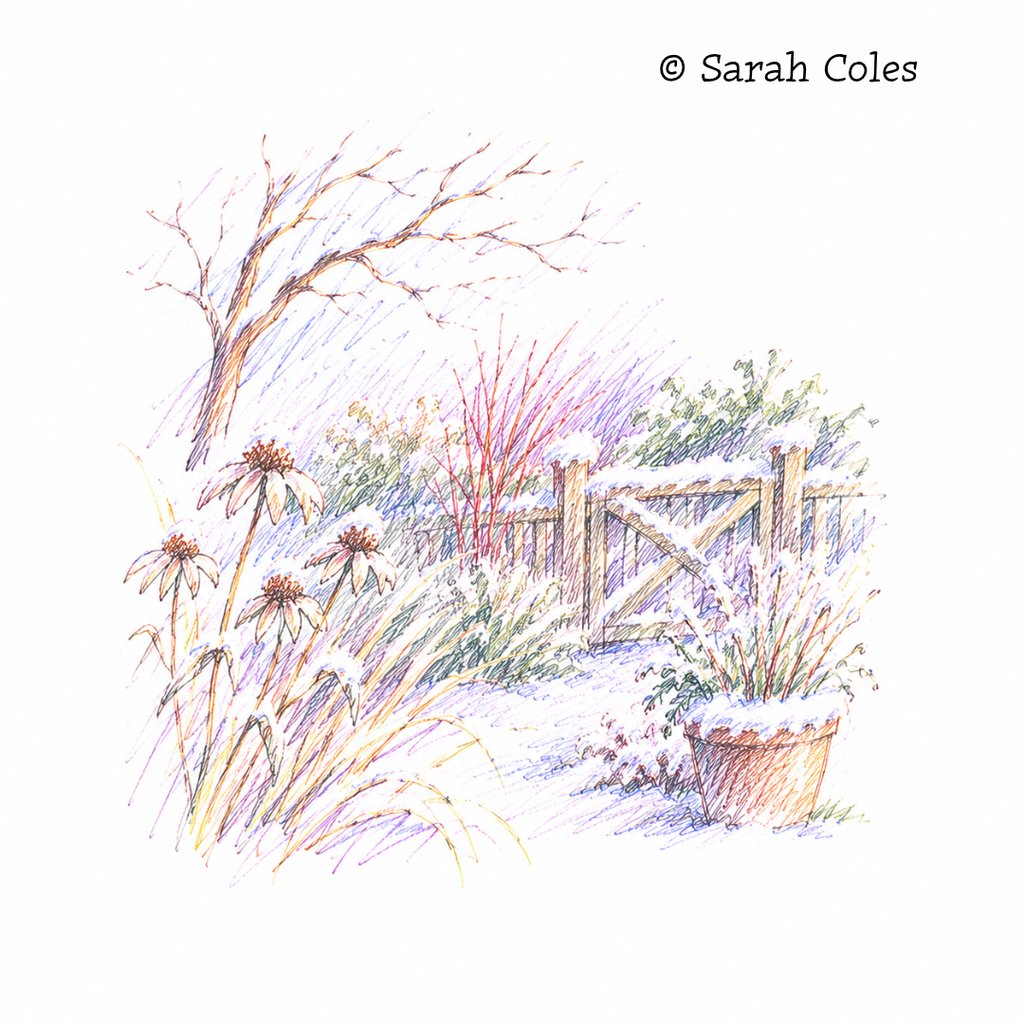
A familiar border can become almost unrecognisable overnight. The leaves of hardy geraniums lie edged with silver, ornamental grasses sparkle in the early light, and the dried flowerheads of summer perennials are transformed into delicate sculptures.
Even the most ordinary plants take on a new character.
A cobweb stretched between two stems becomes a fine thread of white lace. The last rosehips glow red against the frozen hedgerow, while fallen leaves lie beneath a thin coating of ice.
There is something fleeting about this beauty. By mid-morning, the sun may have reached the garden, and the frost begins to disappear. What seemed almost magical at breakfast time has returned to its familiar appearance by lunchtime.
Perhaps that is part of its charm.
A frosty morning encourages us to step outside for a few moments, even if only with a warm coat and a cup of tea, to appreciate something that will not last.
It is worth remembering, however, that frozen plants and lawns are best left undisturbed. Walking across frosted grass can damage the blades, while handling frozen foliage may cause bruising.
Sometimes the kindest thing we can do for the winter garden is simply to admire it.
The Quiet Strength of Evergreens
As the deciduous trees lose their leaves and the herbaceous borders retreat into the soil, evergreen plants begin to take centre stage.
Holly, yew, ivy and box provide structure throughout the year, but their importance becomes especially apparent in December.
Against bare branches and muted winter colours, their foliage seems richer and more vibrant.
A mature holly tree, with its glossy leaves and bright berries, can become one of the most striking features in the garden. Yew offers a deep, almost velvety green, while ivy softens old walls and fences with its trailing stems.
Evergreens also provide something valuable for wildlife.
Their dense branches offer shelter for small birds during cold, wet and windy weather, while holly berries provide food for thrushes and blackbirds as winter progresses.
Not all evergreens need to be large or imposing. A clipped rosemary bush beside the kitchen door, a small evergreen fern in a shaded corner or a winter-flowering hellebore beneath a tree can bring life to even the smallest garden.
There is a temptation to think that a winter garden needs to be filled with colour to be interesting. In reality, a few well-placed evergreens can be just as effective.
Their different shades, textures and shapes provide a sense of permanence when much of the garden has disappeared beneath the winter sky.
The Beauty of Leaving Seedheads Standing
For many years, the traditional approach to autumn gardening was to cut everything back, clear the borders and leave the garden tidy for winter.
There are times when cutting back is necessary, particularly where plants are diseased or have collapsed across paths. But leaving healthy stems and seedheads standing can bring unexpected beauty to the colder months.
The rounded heads of alliums, the dark centres of rudbeckias and the tall, architectural stems of teasels can remain attractive long after their flowers have faded.
On a frosty morning, these dried structures become some of the most beautiful features in the garden.
Ornamental grasses are particularly lovely in winter. Their pale stems move gently in the breeze, catching the low sunlight and bringing a softness to otherwise bare borders.
There is a practical benefit to leaving some of this growth untouched.
Seedheads can provide food for birds, while hollow stems and fallen plant material offer shelter to overwintering insects and other small creatures.
Not every dried flowerhead will attract wildlife, and some plants collapse into untidy heaps after heavy rain. The secret is to observe what works in your own garden rather than following a strict rule.
A few carefully chosen stems left standing can make the difference between a border that looks empty and one that still has character.
And there is a certain satisfaction in knowing that a garden can remain useful to wildlife even when its main flowering season is over.
The Trees Reveal Their True Shapes
Winter is perhaps the best time to appreciate the natural shape of a tree.
Without leaves to hide their branches, the structure of deciduous trees becomes wonderfully clear.
The twisting limbs of an old apple tree, the graceful branches of a silver birch and the broad silhouette of a mature oak all have a beauty that is easily overlooked in summer.
Even a small garden tree can become a striking feature against a pale winter sky.
Look closely and there are details everywhere.
The bark of a silver birch catches the light, while the ridged trunk of an older tree reveals years of slow growth. Moss gathers in the crevices, and lichens create delicate patterns across branches and bark.
These small details tell the story of a garden over time.
An old fruit tree may no longer produce the finest crop, but its character and value to wildlife can be considerable. Cracks and crevices provide places for insects to shelter, while birds search the branches for food.
Where a tree is safe and healthy enough to remain, there is often good reason to appreciate its age rather than rush to replace it.
Winter allows us to see the garden’s framework, the living structure that supports everything else throughout the year.
A Garden That Still Belongs to Wildlife
Although the garden may appear quiet, it is far from empty.
Robins remain active throughout winter, often appearing when the soil is disturbed in the hope of finding a worm or other small creature.
Blackbirds turn over fallen leaves beneath hedges, searching for food, while blue tits and great tits explore branches and shrubs for insects and their eggs.
On milder days, there may even be the occasional bumblebee or other insect venturing out when conditions allow.
Much of the garden’s wildlife, however, is hidden from view.
Some insects spend winter amongst fallen leaves, inside hollow stems or beneath loose bark. Others survive as eggs, larvae or pupae, waiting for warmer weather.
Hedgehogs may be hibernating in sheltered nests made from leaves and other natural materials, although they can occasionally wake and become active during mild spells.
This is one reason why leaving a little untidiness in the garden can be so beneficial.
A pile of leaves beneath a hedge, a patch of long grass or an undisturbed corner behind a shed can provide valuable shelter.
There is no need to abandon garden maintenance altogether. Paths should remain safe, diseased plant material may need removing, and some areas will benefit from occasional attention.
But a garden does not have to be perfectly tidy to be beautiful.
In many ways, allowing nature a little space is one of the most rewarding things we can do.
Winter Colour in Unexpected Places
Winter gardens are often described as colourless, yet this is rarely true when we begin to look carefully.
The colours are simply more subtle.
There are the deep reds and purples of bare dogwood stems, the warm copper tones of beech leaves that remain on young hedges, and the soft gold of ornamental grasses.
Rosehips and holly berries provide flashes of red, while snowdrops may begin to appear towards the end of winter, depending on the weather and location.
Some plants even choose the coldest months to flower.
Winter jasmine produces bright yellow blooms on bare green stems, while fragrant winter honeysuckle can fill a sheltered corner with scent during mild weather.
Hellebores are particularly valuable, their nodding flowers appearing from winter into spring in shades of white, pink, plum and green.
And then there is the wonderful scent of wintersweet, Chimonanthus praecox, whose small, pale yellow flowers can perfume the air on a still winter day.
These plants remind us that winter is not simply a pause between the gardening seasons.
It has its own flowers, fragrances and moments of interest, often made more precious because they appear when so little else is blooming.
The Pleasure of a Slower Season
Perhaps the greatest gift of a winter garden is the opportunity to slow down.
During spring and summer, gardening can become a constant succession of tasks. There are seeds to sow, plants to water, weeds to remove, vegetables to harvest and borders to maintain.
It is easy to become so occupied with looking after the garden that we forget to enjoy it.
Winter offers a different rhythm.
There may still be pruning to consider, tools to clean or plans to make for the coming year, but there is less urgency about many everyday jobs.
A short walk around the garden can become a pleasure in itself.
You might notice the first swelling buds on a shrub, a robin perched on a fence post or the intricate pattern of frost across a fallen leaf.
Perhaps there is a sheltered bench where the afternoon sun lingers for a few minutes, or a view from the kitchen window that looks particularly lovely on a misty morning.
These small moments are easy to miss, but they are often the ones that stay with us.
There is no need for a grand garden or expensive planting scheme to enjoy them. A few pots beside the back door, a small patch of lawn or a tree beyond the window can offer just as much seasonal interest.
Looking Ahead Without Rushing Spring
By December, many gardeners are already thinking about the year ahead.
Seed catalogues begin to arrive, plans are made for new borders, and thoughts turn towards the first signs of spring.
There is pleasure in anticipation, of course, but it would be a shame to wish winter away entirely.
The garden needs this quieter season. Many plants enter dormancy, conserving resources until conditions become suitable for growth again. Fallen leaves gradually break down, returning nutrients to the soil, while countless small creatures find shelter amongst the garden’s quieter corners.
Beneath the surface, the processes that sustain a healthy garden continue, even when there is little to see.
And as the weeks pass, the first signs of change begin to appear.
Buds slowly swell on bare branches. Early bulbs push through the soil. The days lengthen almost imperceptibly, and birdsong gradually becomes more noticeable.
Spring will arrive in its own time.
For now, there is something deeply satisfying about allowing the garden to be exactly what it is in December.
A place of quiet beauty, gentle movement and small discoveries.
Finding Beauty in the Stillness
A winter garden may not offer the exuberance of a June border or the abundance of an autumn harvest, but it has qualities that are entirely its own.
Frost reveals delicate patterns, evergreens bring structure and shelter, and dried seedheads catch the pale winter light. Bare trees show their character, while birds and other wildlife continue their daily lives amongst the branches and fallen leaves.
It is a season that rewards patience and observation.
Perhaps the next time you look out at the garden on a cold morning, rather than seeing empty borders and bare branches, you might notice the quiet beauty that has been there all along.
The silver edge of a frosted leaf. The warm colour of a robin against dark ivy. The gentle movement of grasses in the breeze.
Sometimes the most memorable moments in a garden are not those filled with flowers and sunshine, but the quiet ones, when the world seems still and nature asks very little of us.
Only that we stop for a moment and look.
For Inspiration Follow Me on Instagram, Facebook, Bluesky and Threads
Further Reading: Who Lives Beneath the Leaves? The Wildlife We Protect by Leaving Them, Best Plants for Wildlife: Flowers, Shrubs and Climbers for a Nature-Friendly Garden, How to Create a Wildlife-Friendly Garden, The Art of Leaving the Garden Alone in Winter, Why Your Garden Soil Needs a Winter Blanket, Dead Stems, Seedheads and Hollow Stalks: Why They Matter in Winter
