


A wildlife-friendly garden does not need to look wild.
It can still have structure, colour and carefully chosen planting.
The difference is that some of those plants are doing more than looking lovely.
They are feeding bees, butterflies and moths. They are producing seeds for birds. They are providing shelter, nesting places and somewhere for insects to disappear when the weather turns cold.
That is the real strength of a wildlife garden.
It is not simply a garden with a few flowers for bees.
It is a living network of food and shelter that changes through the year.
The good news is that many of the best plants for wildlife are also excellent garden plants in their own right.
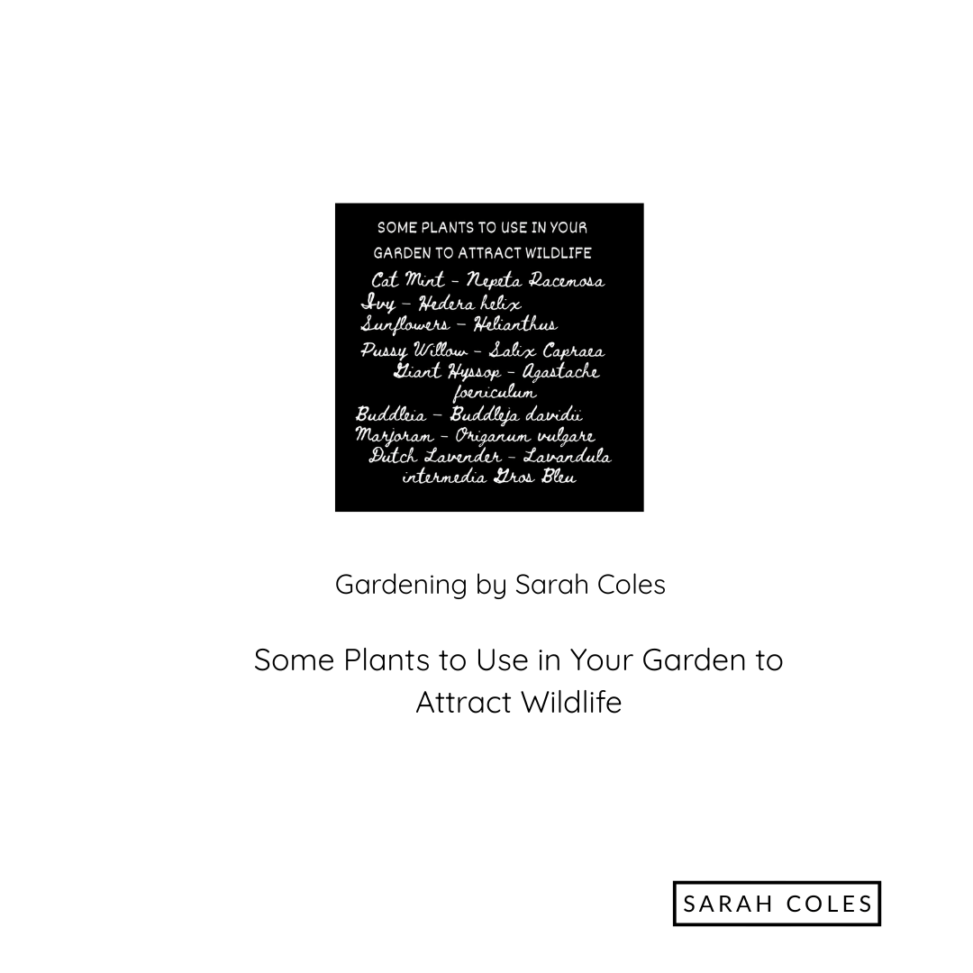
Here are eight worth making room for.
1. Catmint
Nepeta racemosa
Catmint is one of those plants that earns its place twice.
It is attractive to pollinators and remarkably useful in a border.
Soft grey-green foliage forms generous mounds, while purple-blue flowers appear over a long season.
Bees are particularly fond of it.
Plant catmint somewhere sunny in well-drained soil and it will usually reward you with a long flowering display.
It works beautifully spilling over the edge of a path or softening the front of a border.
And unlike actual cats, it rarely demands breakfast at five in the morning.
Cutting the plant back after the first flush of flowers can often encourage another show later in the season.
That gives both gardener and pollinators a second helping.
2. Lavender
Lavandula × intermedia ‘Gros Bleu’
Few plants announce summer quite like lavender.
Warm leaves release their scent as you brush past, flower spikes hum with bees, and the whole plant seems to belong naturally beside a sunny path or terrace.
Lavender is especially valuable for pollinating insects when in full flower.
Bees visit it in large numbers, and butterflies may also feed from the blooms.
The key to growing it well is drainage.
Lavender enjoys full sun and dislikes sitting in wet, heavy soil, particularly through winter.
Plant it somewhere open and bright, and avoid treating it too generously.
Lavender is at its happiest when life is slightly difficult.
Too much rich soil and moisture can make it soft and short-lived.
Sometimes a little neglect is horticulturally sophisticated.
3. Goat willow
Salix caprea
Goat willow, sometimes known as pussy willow, is particularly useful early in the year.
Its soft catkins appear in spring, when the number of flowering plants available to insects can still be limited.
That makes willow an important source of early pollen and nectar for bees and other insects.
It is also a valuable plant for caterpillars and supports a wide range of wildlife more generally.
This is not a tiny shrub for the edge of a patio.
Given space, goat willow can become a substantial small tree, so choose its position carefully.
It is well suited to damper ground and can be useful in gardens with naturally moist soil.
Its spring catkins are one of those quiet signs that the gardening year is beginning again.
4. Wild marjoram
Origanum vulgare
Wild marjoram is excellent for pollinators and extremely useful in the kitchen.
Which feels like a fair arrangement.
Clusters of small pink-purple flowers appear in summer and can become crowded with bees, hoverflies and butterflies.
The foliage is aromatic, and the plant has a relaxed habit that suits herb gardens, gravel gardens and informal borders.
Give it a sunny, well-drained position for the best flowering.
Once established, it is relatively unfussy.
Allow some flowers to remain after blooming and you’ll also add structure and seed into the garden later in the year.
There is no rule saying every herb must be cut for supper.
Some can be left for the insects.
5. Giant hyssop
Agastache foeniculum
If you want a plant that looks good and pulls in pollinators, giant hyssop is hard to overlook.
Its upright flower spikes are packed with small blooms that are particularly attractive to bees.
The foliage is aromatic, often with an aniseed-like scent, and the tall stems add useful height to borders.
Agastache prefers full sun and free-draining soil.
Like lavender, it is not fond of winter wet.
Plant it among grasses, echinaceas or other late-summer perennials and it can help keep a border lively when earlier flowers are beginning to fade.
The bees will find it before you do.
They usually do.
6. Buddleja
Buddleja davidii
Buddleja has earned its familiar name: the butterfly bush.
When in flower, its long clusters of blooms can attract large numbers of butterflies, moths, bees and other pollinating insects.
It is particularly valuable in late summer, when some earlier-flowering plants have finished.
But there is an important note.
Buddleja davidii can seed itself very freely and may become invasive in some situations, especially on disturbed ground.
If you grow it, manage seedlings and prune the plant appropriately.
You may also wish to choose less invasive cultivars where available.
In the right place, buddleja can still be a wonderfully useful nectar source.
Just don’t assume the plant understands property boundaries.
It does not.
7. Sunflowers
Helianthus annuus
Sunflowers are perhaps the most cheerful way to feed wildlife.
Their broad flower heads attract bees while in bloom, and later in the season the seeds become valuable food for birds.
Goldfinches and other seed-eating birds may visit mature heads if they are left standing.
This creates one of the great dilemmas of late summer.
Do you save the seed for next year?
Or leave it for the birds?
The sensible answer is both.
Grow several.
Sunflowers prefer a sunny position and reasonably fertile soil, and taller varieties may need support in exposed gardens.
Their wildlife value continues after flowering, so resist the urge to cut every head down the moment the petals fade.
A brown sunflower head may not look glamorous.
To a finch, it looks excellent.
8. Ivy
Hedera helix
Ivy is one of the most valuable wildlife plants in a British garden.
And also one of the most misunderstood.
Mature ivy flowers late in the year, often when relatively few other nectar sources are available.
Those flowers can be exceptionally important for bees, hoverflies, wasps and other insects.
Later, the berries provide food for birds.
The dense evergreen foliage also offers shelter and potential nesting habitat.
Ivy is vigorous, so it needs managing in smaller spaces, but that does not make it a bad plant.
The problem is usually location rather than ivy itself.
Allow it to grow where there is room and it can become one of the hardest-working plants in the garden.
It is worth remembering too that ivy climbing a healthy tree is not a parasite.
It uses the trunk for support rather than feeding from the tree itself.
This small botanical misunderstanding has cost an awful lot of ivy its life.
Think in seasons, not individual plants
One excellent wildlife plant is useful.
A succession of plants flowering across the year is much better.
Try to create a garden where something is offering nectar or pollen from early spring through to autumn.
Willow can help early in the year.
Catmint, lavender and marjoram carry things through summer.
Agastache and buddleja extend the season.
Ivy becomes especially important later on.
This succession matters because different insects are active at different times.
A garden that bursts into flower for three weeks in June and then stops is less useful than one that keeps offering food steadily.
The same principle applies to birds.
Flowers become seed heads.
Shrubs produce berries.
Dense growth becomes shelter.
A good wildlife garden keeps changing what it offers.
Don’t forget native plants
Garden cultivars can be excellent for wildlife, but native plants deserve plenty of space too.
Hawthorn, holly, foxglove, knapweed, scabious, primrose and many others support wildlife particularly well.
Native plants have long-standing relationships with local insects and other species.
Some caterpillars, for example, depend on particular host plants rather than simply visiting whatever happens to be flowering.
That is why a wildlife garden should include more than nectar-rich flowers.
Pollinators are only one part of the picture.
Leaves get eaten.
Stems provide shelter.
Seeds get carried away.
A plant with a few holes in it may be doing its job extremely well.
Choose simple flowers where possible
Highly bred double flowers can be beautiful, but some provide relatively little accessible nectar or pollen.
Extra petals can make the centre of the flower difficult or impossible for insects to reach.
If wildlife value is one of your priorities, include plenty of open, single flowers where the pollen-bearing parts are easy to access.
You do not have to ban elaborate garden flowers.
Just don’t make every flower complicated.
Bees have enough to do already.
Leave some plants standing in winter
Wildlife value doesn’t disappear when flowering ends.
Dry stems can shelter insects.
Seed heads feed birds.
Leaf litter protects invertebrates at ground level.
This means one of the easiest ways to make a garden more wildlife-friendly is to become a little less efficient with the autumn tidy-up.
Leave some perennial stems standing.
Keep seed heads where practical.
Allow leaves to remain beneath shrubs and hedges.
There is plenty of time to cut things back later.
Winter gardens can look beautiful when dry stems and seed heads catch frost.
And if anyone asks why you haven’t tidied the border yet, you can explain that you are supporting overwintering invertebrates.
Which sounds considerably better than “I haven’t got round to it.”
Grow different heights
Wildlife benefits from structure.
A garden containing only low bedding plants offers much less shelter than one with several layers.
Think about including:
- trees
- shrubs and hedges
- climbers
- tall perennials
- lower flowering plants
- groundcover
- long grass or meadow areas
Each layer creates slightly different conditions.
Birds may nest in dense shrubs.
Insects shelter in stems.
Ground beetles move beneath low vegetation.
Climbers provide cover against walls and fences.
The more varied the garden, the more opportunities it creates.
Avoid unnecessary pesticides
If you are planting specifically for wildlife, widespread pesticide use rather undermines the effort.
A plant covered in aphids may look alarming, but aphids are also food.
Ladybirds eat them.
Hoverfly larvae eat them.
Birds feed them to chicks.
This does not mean you must allow every pest to consume every plant.
It simply means considering whether intervention is really necessary.
Often, healthy plants can tolerate a certain amount of insect activity without serious harm.
Wildlife gardening requires a small change in perspective.
The caterpillar is not always the enemy.
Sometimes it is the butterfly you wanted.
Just earlier in the story.
Plant generously
A single pollinator plant will be used.
A generous patch is often better.
Groups of the same flower are easier for insects to find and allow them to feed efficiently without repeatedly searching for the next bloom.
If you have room, plant in drifts rather than isolated specimens.
Three catmints together.
A group of marjoram.
Several lavender plants.
A patch of sunflowers.
This can also look more confident from a design point of view.
Conveniently, what helps the bees can help the border too.
A wildlife garden can still be beautiful
There is sometimes a fear that gardening for wildlife means abandoning good design.
It doesn’t.
A wildlife-friendly garden can be formal or informal.
It can contain clipped hedges, generous borders and carefully placed paths.
It can have strong colour schemes and beautifully considered planting.
The difference is that life is part of the design.
A lavender hedge that feeds bees.
A wall softened with ivy where birds can shelter.
A border of agastache and marjoram alive with insects.
Sunflower heads left standing for finches.
These aren’t compromises.
They are additions.
Start with what you already have
You don’t need to replace your entire garden.
Look at what is already growing.
Which plants are covered in bees?
Where do birds shelter?
Which flowers keep attracting butterflies?
Where could you add something for spring or late autumn?
Then build from there.
Add a patch of marjoram.
Plant a lavender.
Let ivy flower.
Leave some sunflower heads standing.
One plant won’t transform the natural world.
But gardens exist side by side, street by street, town by town.
Together they form an enormous network of potential habitat.
And every garden that provides a little more food, shelter and space helps strengthen that network.
Make the garden beautiful.
But let it be busy too.
If the lavender is humming, the sunflower heads are being dismantled by finches and something mysterious is rustling beneath the ivy, you’ve probably got the balance about right.
Further Reading: My Garden Journal & Notes
