


There is something rather wonderful about a garden beginning to wake after winter. The days are still short, the ground is often cold and damp, and much of the planting is waiting patiently for spring. Yet look a little closer and there are signs of life everywhere. Buds are swelling, the earliest bulbs are pushing through the soil, and amongst the bare branches of certain shrubs, something quite extraordinary is beginning to happen.
Salix gracilistyla ‘Mount Aso’ is one of those plants that makes you stop and look twice.
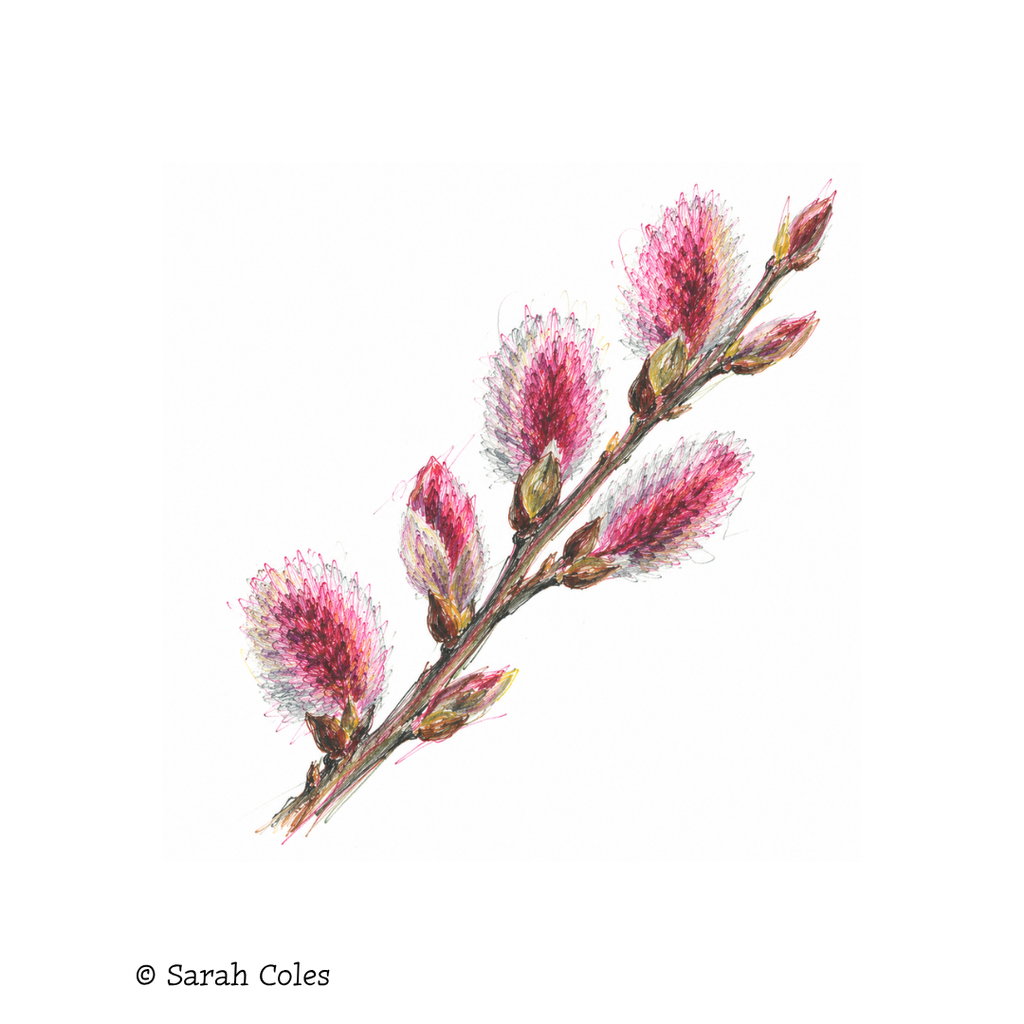
While most willows are familiar for their soft, silvery catkins, this beautiful Japanese selection produces something altogether more unusual. Its branches become decorated with velvety pink catkins, bringing a remarkable splash of colour to the garden in late winter and early spring.
Against the muted greens and browns of the season, those little pink catkins are a lovely sight. They catch the low winter light, stand out against a frosty morning and bring a sense of warmth to the garden before many other plants have begun to flower.
Commonly known as the Japanese pink pussy willow, ‘Mount Aso’ is a hardy, deciduous shrub that offers far more than its unusual colouring. It is a plant with character, seasonal interest and considerable value to wildlife.
And for anyone who enjoys a garden that offers something to appreciate throughout the year, it is certainly worth getting to know.
Getting to Know Salix ‘Mount Aso’
Salix gracilistyla ‘Mount Aso’ belongs to the Salicaceae family, alongside other willows and poplars.
The genus Salix includes hundreds of species, ranging from low-growing shrubs to large, graceful trees. Many are naturally associated with rivers, streams, damp meadows and other places where moisture is readily available.
‘Mount Aso’ is a cultivated selection of Salix gracilistyla, a willow species native to parts of eastern Asia, including Japan, Korea and China.
It is a deciduous shrub, losing its leaves in autumn and revealing a framework of slender branches.
For much of winter, it may appear rather unassuming.
But as the season begins to turn, the branches develop the remarkable pink catkins for which the plant is grown.
Unlike the familiar flowers of roses or hellebores, willow flowers are arranged in catkins. These compact clusters contain numerous tiny individual flowers, creating the soft, furry appearance that gives pussy willows their common name.
‘Mount Aso’ is a male cultivar, producing catkins that eventually reveal pollen-bearing stamens as they mature.
This gradual transformation is one of the most fascinating things about the plant.
The catkins begin with their distinctive rosy colouring, then change as they expand and the yellow pollen becomes visible.
It is a beautiful example of how much detail there is to discover in the garden, even before spring has properly arrived.
A Japanese Willow with an Unusual Name
The cultivar takes its name from Mount Aso, the famous volcanic landscape on the Japanese island of Kyushu.
Mount Aso is known for its enormous volcanic caldera and surrounding mountains, where the landscape has been shaped over thousands of years by geological activity.
The name gives this ornamental willow a particularly evocative connection with Japan.
The species Salix gracilistyla occurs naturally in eastern Asia, where it grows in suitable moist habitats.
The pink-catkin cultivar has become popular in ornamental horticulture because of its striking colour, which distinguishes it from the more familiar silver-grey pussy willows.
Although accounts of the cultivar’s origin associate it with Mount Aso, its precise selection and introduction history is not always consistently documented.
What is certain is that it has become a much-admired shrub amongst gardeners looking for something a little different in the late-winter garden.
And it is easy to understand why.
The Extraordinary Pink Catkins of Salix ‘Mount Aso’
The real beauty of this willow is revealed before the leaves appear.
During late winter, usually around February or March in many UK gardens, the bare stems begin to carry soft, oval catkins in shades of rosy pink.
Their appearance can vary according to the stage of development, growing conditions and weather.
Some are a gentle blush pink, while others have a deeper reddish tone.
Each catkin is covered in fine, silky hairs that give it a wonderfully soft appearance.
In the low light of winter, the catkins seem almost to glow against the darker branches.
As they mature, the tiny flowers develop and the yellow pollen-bearing stamens become increasingly visible.
The original pink colouring gradually changes, creating an interesting contrast of pink, silver and yellow.
It is not a long-lasting floral display in the traditional sense, but it is a memorable one.
And because the catkins appear on otherwise bare branches, there is very little to distract from their beauty.
When Does Salix ‘Mount Aso’ Flower?
In the UK, the catkins generally appear in late winter or early spring.
The exact timing depends on the weather, location and individual growing conditions.
In mild coastal gardens, they may begin to develop earlier, while plants in colder inland areas can flower later.
A prolonged cold spell may slow their development, but once temperatures begin to rise, the display can progress quite quickly.
For the best view, plant ‘Mount Aso’ somewhere you regularly pass or can admire from the house.
There is something particularly cheering about looking through the window on a grey February morning and seeing those little pink catkins appearing amongst the branches.
What Does Pink Pussy Willow Look Like in Summer?
Although the catkins are undoubtedly the main attraction, Salix gracilistyla ‘Mount Aso’ remains an attractive shrub throughout the growing season.
Once flowering has finished, the leaves begin to emerge.
These are elongated and lance-shaped, with a softly textured appearance.
The upper surfaces are generally green, while the undersides have a paler, sometimes silvery or softly hairy finish.
This gives the foliage a gentle, natural quality, particularly when the leaves move in the breeze.
The shrub develops a spreading, bushy habit with numerous slender stems.
Left largely unpruned, it can become a substantial plant, reaching approximately 2–3 metres in height and spread, although its eventual size will depend on growing conditions and management.
Regular pruning can keep it considerably smaller.
During autumn, the leaves change colour and fall, leaving the branches exposed once again.
And so the cycle begins, with the shrub quietly preparing for another display of pink catkins as winter draws to a close.
Where to Plant Salix ‘Mount Aso’
Choosing the right position is the key to growing a healthy, attractive pink pussy willow.
Fortunately, this is a relatively straightforward shrub, particularly if your garden has naturally moisture-retentive soil.
Does Salix ‘Mount Aso’ Need Full Sun?
For the strongest growth and best catkin display, choose a position in full sun.
A bright, open spot allows the shrub to develop sturdy stems and encourages plenty of flowering growth.
It can tolerate some partial shade, but flowering may be reduced where light levels are low.
A position that receives several hours of direct sunlight each day is generally a good choice.
The pink catkins are especially beautiful when illuminated by low winter sunshine, so consider how the light moves through your garden during February and March.
A position where the shrub catches the morning or afternoon sun can make its display particularly attractive.
The Best Soil for Pink Pussy Willow
Willows are well known for their preference for moisture, and ‘Mount Aso’ is no exception.
It grows best in fertile, moisture-retentive soil that does not dry out excessively during summer.
Clay and loamy soils can be particularly suitable, provided the ground is not permanently stagnant or severely compacted.
If your garden has a naturally damp area, this willow may be a useful choice.
It can also work beautifully near a pond or in a border where the soil remains reasonably moist.
However, it is important to distinguish between moisture-retentive soil and ground that remains deeply waterlogged for prolonged periods.
Although many willows tolerate wet conditions, young plants still need a healthy root environment in which to establish.
On light, sandy soils, incorporating organic matter and applying a mulch can help retain moisture.
Very dry, free-draining positions are less suitable unless you are prepared to water regularly.
How to Plant Salix ‘Mount Aso’
Autumn and early spring are generally good times to plant deciduous shrubs in the UK, provided the ground is not frozen or waterlogged.
Planting during cooler weather allows the roots to establish before the demands of summer.
Choose a sunny position with sufficient space for the shrub to develop.
Prepare the ground by removing perennial weeds and loosening the soil across a reasonably wide area.
Dig a planting hole approximately twice the width of the rootball, but no deeper than necessary.
Place the plant in the hole so that the top of the rootball sits level with the surrounding soil.
Backfill with the excavated soil, firm gently and water thoroughly.
A layer of well-rotted garden compost or leaf mould around the base will help retain moisture and improve the soil over time.
Keep the mulch clear of the main stems to reduce the risk of decay.
During the first growing season, check the soil regularly and water during dry spells.
Young willows can establish relatively quickly in suitable conditions, but they still need consistent moisture while their root systems develop.
How to Care for Salix ‘Mount Aso’
Once established, pink pussy willow is a relatively easy shrub to maintain.
Its main requirements are sufficient moisture, good light and occasional pruning to encourage fresh flowering stems.
Watering
Watering is particularly important during dry spring and summer weather.
Although established plants may tolerate short periods of dryness, prolonged drought can cause stress, reduce growth and affect the following season’s catkin display.
A thorough soaking during dry spells is generally more effective than frequent light watering.
Mulching in spring can help reduce moisture loss from the soil.
For gardens on sandy ground, additional watering may be needed during hot weather.
Feeding and Mulching
Willows are generally vigorous plants and rarely require elaborate feeding.
Where the soil is reasonably fertile, an annual mulch of well-rotted organic matter is often sufficient.
This gradually improves soil structure and helps conserve moisture.
If growth is poor and soil fertility is low, a balanced general-purpose fertiliser may be beneficial in spring.
Avoid excessive feeding, particularly with high-nitrogen fertilisers, as this can encourage very soft, vigorous growth.
The aim is to support healthy stems rather than force unnecessary growth.
How and When to Prune Salix ‘Mount Aso’
Pruning is one of the most useful ways to maintain a good display of catkins.
Pink pussy willow flowers on stems produced during the previous growing season.
This means that the strong new shoots made in spring and summer carry the catkins that will appear the following late winter.
Understanding this simple cycle makes pruning much easier.
When Should You Prune Pink Pussy Willow?
The best time to prune is immediately after the catkins have finished their display, usually in early spring.
Avoid cutting the plant back in autumn or winter, as this would remove the stems carrying the developing catkins.
Once flowering has finished, you can shorten the stems to encourage fresh growth.
For a compact, bushy plant, cut back the previous season’s shoots to a suitable framework of healthy buds.
This encourages the shrub to produce vigorous new stems during the growing season.
Can Salix ‘Mount Aso’ Be Cut Back Hard?
Yes. Established plants can generally tolerate quite hard pruning.
Some gardeners use a technique similar to coppicing, cutting stems back close to a low framework to encourage long, vigorous shoots.
This can be particularly useful when growing the shrub for decorative catkins or cut stems.
However, severe pruning is not essential every year.
For a more natural-looking shrub, simply remove some of the oldest stems and shorten overly vigorous growth after flowering.
This maintains a balanced shape while allowing the plant to retain a softer, more informal character.
If a mature plant has become very overgrown, renovation pruning can be spread over more than one season.
Whichever method you choose, the important thing is to allow plenty of new growth to develop before the following winter.
Growing Pink Pussy Willow in a Small Garden
Although ‘Mount Aso’ can develop into a substantial shrub, regular pruning makes it possible to enjoy it in a smaller garden.
Its natural habit is attractive in an informal border, but it can also be managed as a compact specimen.
A position near the back of a border allows the pink catkins to rise above lower-growing plants.
Alternatively, it can be grown as a focal point where its winter display can be appreciated from several directions.
For very small gardens, consider whether you have enough room for its developing roots and branches.
It is worth remembering that willows are naturally vigorous plants, and even shrub forms appreciate space.
Growing in a large container may be possible with careful watering and pruning, but this is not necessarily the easiest long-term option.
Containers dry out quickly, particularly during summer, and a thirsty willow can become stressed if moisture is not maintained.
Where space allows, planting directly into suitable garden soil is generally the more straightforward choice.
Beautiful Companion Plants for Salix ‘Mount Aso’
One of the pleasures of growing a shrub with such an unusual flowering season is discovering how beautifully it can be combined with other early-flowering plants.
The pink catkins provide a lovely contrast to white, yellow and purple flowers.
Snowdrops
Snowdrops are amongst the most natural companions.
Their delicate white flowers appear at much the same time as the willow catkins, creating a gentle display beneath the bare branches.
A drift of snowdrops around the base of an established shrub can be particularly attractive in late winter.
Hellebores
Hellebores offer a wider range of colours, from creamy white and soft pink to deep plum and burgundy.
Their substantial flowers contrast beautifully with the soft texture of the willow catkins.
Choose varieties suited to the light and soil conditions in your border.
Early-Flowering Crocuses
Crocuses can bring little pools of purple, yellow and white beneath the shrub.
Their flowers open in sunshine, adding another layer of colour to the early garden.
They are especially effective when planted in groups rather than individually.
Cornus with Coloured Stems
For a larger winter border, consider combining pink pussy willow with dogwoods such as Cornus alba ‘Sibirica’.
The bright red stems of the dogwood provide structure and colour throughout winter, while the willow introduces its pink catkins as spring approaches.
Both appreciate moisture-retentive soil, making them useful companions in suitable positions.
Together, they can create a border that is interesting long before the summer perennials begin to grow.
Is Salix ‘Mount Aso’ Good for Wildlife?
Willows are amongst the most valuable early-flowering plants for wildlife.
Their catkins can provide important food for insects emerging during mild weather in late winter and early spring.
Because ‘Mount Aso’ is a male cultivar, its catkins produce pollen.
This can be particularly useful to bees and other pollen-collecting insects when few other flowers are available.
However, male willow catkins do not provide the same nectar resource as female flowers, so it is more accurate to describe ‘Mount Aso’ primarily as a source of early pollen.
Different willow species and cultivars offer varying resources to wildlife.
Including a range of early-flowering plants in the garden is therefore a good way to support insects throughout the changing seasons.
The foliage of willows can also support caterpillars and other insects, although the precise wildlife value of an ornamental cultivar may differ from that of native willow species.
For a wildlife-friendly garden, ‘Mount Aso’ can be a beautiful addition alongside native shrubs, early bulbs and plants that flower later in spring.
Can You Cut Pink Pussy Willow for Flower Arrangements?
One of the loveliest things about ‘Mount Aso’ is that its flowering stems can be brought indoors.
A few branches arranged in a simple vase can make a beautiful late-winter display.
The pink catkins are particularly attractive against plain backgrounds, where their unusual colouring can be fully appreciated.
Cut stems when the catkins have developed good colour but before they have completely matured.
Place them in water if you want them to continue developing, or experiment with drying stems for decorative arrangements.
The catkins may change appearance as they mature, so the display will not necessarily remain bright pink indefinitely.
Cutting a few stems can also form part of your spring pruning routine.
Just avoid removing too many flowering branches if you want to enjoy the display in the garden as well.
Common Problems with Pink Pussy Willow
Although ‘Mount Aso’ is generally a robust shrub, it can occasionally experience the same problems as other ornamental willows.
Aphids
Aphids may gather on tender new growth during spring and summer.
Small populations are often controlled naturally by ladybirds, hoverfly larvae and other beneficial insects.
Where infestations are heavy, affected shoots can sometimes be washed with water or removed during routine pruning.
Willow Leaf Beetles
Willow leaf beetles can feed on the foliage, sometimes leaving noticeable damage.
Established plants usually tolerate some leaf feeding without serious consequences.
Encouraging a healthy garden ecosystem can help support the natural predators of these insects.
Willow Rust
Rust is a fungal disease that can produce orange or yellow pustules on willow leaves.
Affected foliage may eventually fall prematurely.
Good air circulation, sensible pruning and clearing heavily infected fallen leaves can help reduce the build-up of disease.
Canker and Dieback
Occasionally, branches may suffer from canker or dieback.
Remove affected stems, cutting back into healthy wood with clean secateurs.
Avoid leaving the plant under prolonged drought stress, as healthy, well-established shrubs are generally better able to withstand problems.
Are Willow Roots a Problem Near Buildings?
Willows have a reputation for vigorous root systems, and this is worth considering when choosing a planting position.
Large willow trees can develop extensive roots that seek out moisture, particularly where drainage pipes are already damaged or leaking.
Although ‘Mount Aso’ is a shrub rather than a large tree, it is still sensible to allow adequate space between the plant and vulnerable structures.
Avoid planting immediately beside old drains, septic systems or other areas where roots could become troublesome.
The appropriate distance will depend on the size of the mature plant, soil conditions and the nature of nearby structures.
If you are unsure about planting close to a building or drainage system, seek site-specific advice before planting.
In a suitable position, however, there is no reason this attractive shrub cannot be enjoyed as part of an ordinary garden.
Why Grow Salix ‘Mount Aso’?
There are plenty of shrubs that bring colour to the garden in summer, but far fewer that offer something so distinctive during late winter.
That is what makes ‘Mount Aso’ special.
Its pink catkins appear at a time when the smallest signs of colour can bring enormous pleasure.
The shrub is hardy, generally easy to grow and responds well to pruning.
It can be particularly useful in gardens with naturally moist soil, where some drought-loving shrubs would struggle.
Its catkins provide early pollen for insects, while the branches can also be enjoyed indoors as part of a simple seasonal arrangement.
The main considerations are its need for moisture, its eventual size and the importance of pruning at the correct time.
But given the right position, it can become a wonderfully reliable part of the winter garden.
A Little Pink Promise of Spring
There is something quietly reassuring about the first signs of spring.
They rarely arrive all at once.
Instead, the season reveals itself in small details: a snowdrop opening beneath a hedge, a blackbird beginning to sing earlier in the morning, or a cluster of pink catkins appearing on otherwise bare branches.
Salix gracilistyla ‘Mount Aso’ captures that moment beautifully.
Its extraordinary pink pussy willow catkins bring colour and interest to the garden just when we are beginning to long
Further Reading: Beautiful Shrubs for Winter Interest: Colour, Fragrance and Life in the Winter Garden, Winter Daphne (Daphne odora): The Beautifully Fragrant Shrub That Brightens the Winter Garden
For Inspiration Follow Me on Instagram, Facebook, Bluesky and Threads
