


There is something rather special about finding flowers in the garden when winter still has a firm hold. The trees are bare, the borders have quietened, and the first signs of spring can seem a long way off. Yet beneath the shelter of a shrub or amongst last autumn’s fallen leaves, a hellebore may already be preparing to flower.
And few are quite as striking as Helleborus × hybridus ‘Hello Red’.
With its richly coloured, deep red flowers and handsome evergreen foliage, this lovely Lenten Rose brings warmth to the garden at a time when colour is often in short supply.
Its flowers have a quiet elegance. Rather than demanding attention with enormous displays, they invite us to look a little more closely, to appreciate the depth of their colour, the delicate arrangement of their stamens and the way they sit amongst the darker foliage.
Hellebores are amongst the most rewarding plants for winter and early spring gardens. They are hardy, long-lived and particularly useful for bringing interest to partially shaded borders.
And once established in a position they enjoy, they can return year after year, often becoming more beautiful as their clumps mature.
For anyone hoping to create a garden that offers something worth discovering in every season, ‘Hello Red’ is certainly a plant to consider.
Getting to Know Helleborus ‘Hello Red’
Despite its common name, the Lenten Rose is not a rose at all.
Hellebores belong to the buttercup family, Ranunculaceae, alongside familiar garden plants such as clematis, anemones and delphiniums.
The name Lenten Rose comes from the flowering season of many Helleborus × hybridus cultivars, which often coincides with Lent, the period leading up to Easter.
In British gardens, these hellebores generally flower from late winter into spring, with the precise timing depending on the weather, location and individual plant.
‘Hello Red’ is a named selection within the Helleborus × hybridus group, valued for its richly coloured flowers.
Hybrid hellebores have a complicated horticultural background, involving several species associated with woodland and scrub habitats in parts of Europe and western Asia.
Many of their ancestors grow in places where they receive winter and spring sunshine before surrounding trees develop their summer foliage.
This gives us an important clue about how best to grow them.
They appreciate light during the cooler months, protection from the strongest summer sunshine and soil that remains reasonably moist without becoming waterlogged.
Although their flowers appear delicate, hellebores are remarkably resilient plants, well suited to the changing conditions of a British winter.
The Beauty of Red Hellebores
One of the loveliest things about hellebores is the remarkable variety of flower colours available.
Some are creamy white, others soft pink or green, while the darker varieties can range from rich plum and burgundy to almost black.
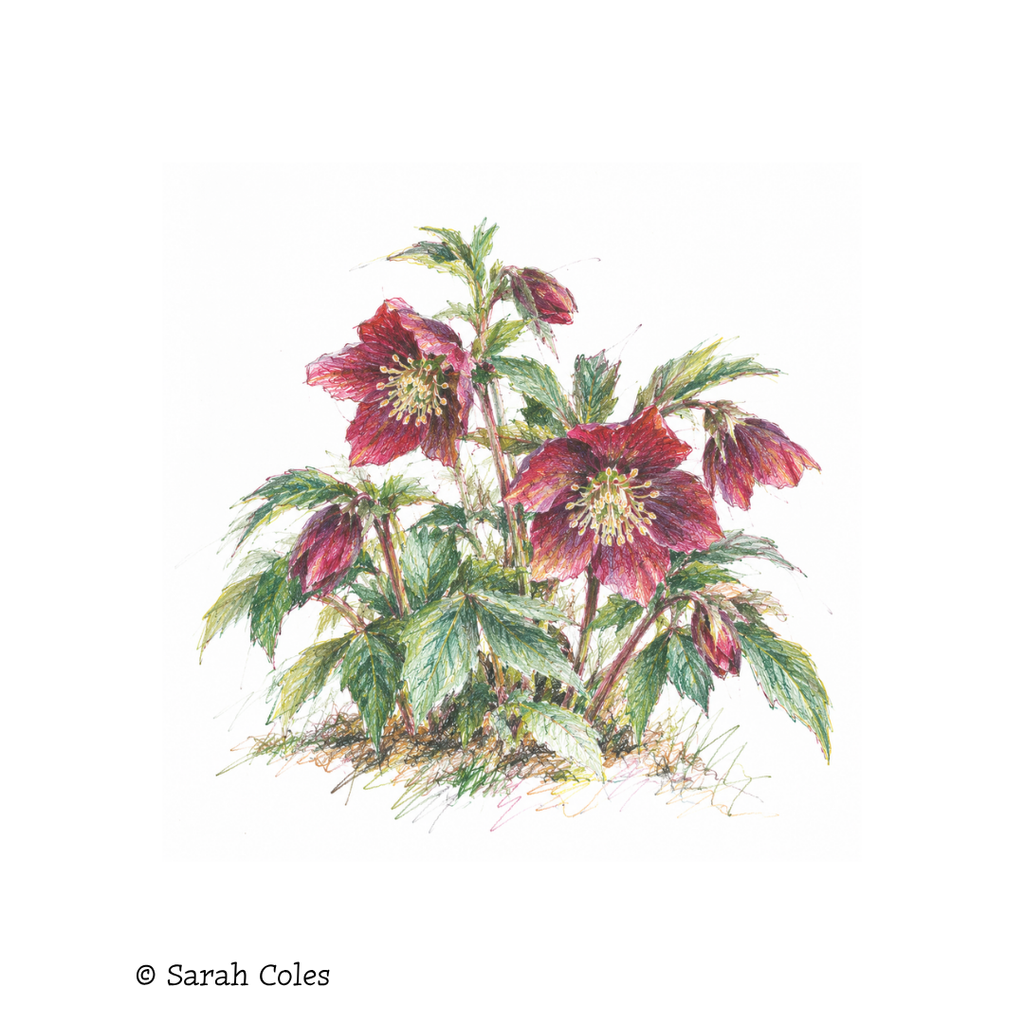
‘Hello Red’ belongs amongst the deeper-coloured selections, bringing a warm red tone to the winter and early spring garden.
Against dark green foliage, these flowers can be particularly striking.
The flowers of hybrid hellebores are generally cup-shaped, with a central cluster of stamens surrounded by broad, petal-like sepals.
And this is one of the fascinating things about hellebores.
What we usually think of as their petals are actually sepals.
Unlike the petals of many other flowers, these sepals remain on the plant long after pollination, gradually changing colour as the seedheads develop.
This gives hellebores an unusually long season of interest.
A flower that begins as a rich, velvety red may gradually take on softer, muted tones as it ages.
The foliage is attractive too.
Hybrid hellebores have leathery, deeply divided leaves, often arranged in a distinctive fan-like shape. In many gardens, these remain through much of the year, providing useful ground cover and structure.
Some older leaves naturally deteriorate during winter, but fresh growth soon replaces them as the growing season progresses.
Where to Plant Helleborus ‘Hello Red’
One of the great advantages of hellebores is their ability to grow in places where many summer-flowering perennials struggle.
They are particularly well suited to woodland-style borders, the edges of shrubberies and positions beneath deciduous trees.
However, choosing the right spot is important if you want them to flower well and remain healthy for many years.
Does Helleborus ‘Hello Red’ Prefer Sun or Shade?
Partial shade is generally ideal.
A position beneath a deciduous shrub or small tree can work beautifully, allowing winter and spring sunshine to reach the plant before the surrounding canopy develops.
During summer, the returning leaves provide shelter from strong sunshine and help prevent the soil from drying too quickly.
Hellebores can tolerate some direct sunshine, particularly in cooler parts of the UK, provided the soil remains sufficiently moist.
However, prolonged exposure to strong summer sun may cause the foliage to scorch or become stressed.
Deep shade is less suitable.
Although the plants may survive, flowering can be reduced where light levels are very low.
A sheltered position with morning sunshine and some afternoon shade is often an excellent compromise.
What Soil Do Hellebores Need?
Hellebores appreciate fertile, humus-rich soil that retains moisture while allowing excess water to drain away.
They generally grow well in neutral to alkaline soils, although many hybrid hellebores are adaptable and can tolerate slightly acidic conditions.
Before planting, incorporate well-rotted garden compost or leaf mould into the surrounding soil.
This improves soil structure and helps create the moisture-retentive but free-draining conditions that hellebores enjoy.
If your garden has heavy clay, avoid planting in areas where water regularly collects during winter.
Improving the soil with organic matter can help, but severely waterlogged ground may be better suited to raised planting.
On sandy soils, annual mulching is particularly useful for helping the soil retain moisture during summer.
The important thing is to provide a balance.
Hellebores dislike sitting in wet soil for long periods, but they are equally unhappy if their roots become excessively dry during the growing season.
How to Plant Helleborus ‘Hello Red’
Autumn and spring are generally good times to plant hellebores, provided the soil is workable and not waterlogged.
Begin by choosing a position where the plant can remain undisturbed.
Hellebores can live for many years and often develop into handsome, established clumps when allowed to settle.
Prepare the planting area by removing weeds and loosening compacted soil.
Dig a hole slightly wider than the rootball but no deeper than the plant was growing in its nursery pot.
Carefully remove the hellebore from its container, gently loosening any tightly circling roots.
Place it in the planting hole so that the crown sits at approximately the same level as the surrounding soil.
Avoid burying the crown too deeply, as this can encourage problems with rotting.
Backfill with the excavated soil and firm gently around the roots.
Water thoroughly after planting.
A light mulch of well-rotted compost or leaf mould will help conserve moisture, although it is best to leave a little space around the crown.
During the first growing season, water regularly in dry weather while the roots establish.
Hellebores are not plants that need constant attention, but a little care at planting time can make a considerable difference to their long-term success.
Caring for Helleborus ‘Hello Red’ Throughout the Year
Once established, hellebores are relatively low-maintenance perennials.
They do not need regular division, elaborate feeding programmes or constant pruning.
In fact, they often perform best when allowed to grow undisturbed.
There are, however, a few seasonal tasks that will help keep them healthy and attractive.
When to Cut Back Hellebore Leaves
As winter approaches, the older foliage of hybrid hellebores can begin to look rather tired.
Leaves may become marked, damaged or discoloured, particularly after prolonged wet weather.
In late autumn or winter, as the new flower buds begin to emerge, you can carefully remove old or badly affected leaves.
This allows the developing flowers to be seen more clearly and can help reduce the amount of infected foliage associated with hellebore leaf spot.
Use clean, sharp secateurs and cut the leaves close to the base without damaging the emerging buds.
There is no need to remove healthy new growth.
It is also worth remembering that hellebore black death is a separate, serious viral disease, not simply another name for leaf spot.
Removing old leaves does not cure or prevent black death. Plants showing characteristic black streaking, severe distortion and stunted growth should be removed and disposed of rather than propagated.
Watering During Dry Weather
Established hellebores are reasonably resilient, but they still appreciate moisture during prolonged dry spells.
This is particularly important in summer, when the roots may be competing with nearby trees and shrubs.
Newly planted hellebores should be watered regularly until established.
For mature plants, a thorough watering during extended dry weather is generally more useful than frequent light sprinkling.
Feeding and Mulching
An annual mulch of well-rotted garden compost or leaf mould in autumn or spring is often sufficient to maintain healthy growth.
This helps improve the soil, retain moisture and suppress weeds.
On reasonably fertile soil, hellebores rarely need heavy feeding.
If growth appears weak, a modest application of a balanced fertiliser in spring may help, although it is worth checking drainage and soil moisture before assuming a lack of nutrients.
Growing Helleborus ‘Hello Red’ in Pots
Hellebores can also make lovely container plants, particularly when positioned somewhere their flowers can be appreciated during winter.
A generous pot beside a sheltered doorway, on a patio or near a garden bench can provide a welcome splash of colour during the colder months.
Choose a deep container with adequate drainage holes.
Fill it with a good-quality, peat-free compost that retains moisture without becoming waterlogged. A loam-based compost can be particularly useful for longer-term container planting.
Position the pot in partial shade, sheltered from strong summer sunshine and drying winds.
Container-grown hellebores need more regular watering than those growing in the ground, especially during warm weather.
Check the compost regularly and water when necessary, allowing excess moisture to drain away.
During prolonged freezing weather, a sheltered position can help protect the roots, which are more exposed in containers than in garden soil.
Although hellebores are sometimes sold as decorative indoor plants around Christmas, they are outdoor perennials and are not suited to permanently warm rooms.
They are far happier in the garden.
Beautiful Companion Plants for Red Hellebores
One of the pleasures of winter gardening is discovering how a few carefully chosen plants can complement one another.
The rich red flowers of ‘Hello Red’ look particularly lovely alongside pale winter blooms, fresh green foliage and the delicate textures of woodland plants.
Snowdrops
Few combinations are more charming than red hellebores and snowdrops.
The crisp white flowers of Galanthus provide a beautiful contrast to the deeper tones of the hellebore blooms.
Planted in small groups amongst the hellebores, snowdrops can gradually naturalise, creating a gentle carpet of flowers during late winter.
Cyclamen coum
For colour closer to the ground, Cyclamen coum is a wonderful companion.
Its small pink, magenta or white flowers appear during winter and early spring, often above beautifully patterned leaves.
The contrast between the delicate cyclamen flowers and the larger hellebore blooms can be particularly attractive.
Pulmonaria
Pulmonaria, commonly known as lungwort, is another lovely plant for partially shaded borders.
Its spotted foliage brings interest before the flowers appear, while its spring blooms often change from pink to blue as they mature.
This creates a soft, colourful transition from the hellebore season into spring.
Evergreen Ferns
Ferns provide texture and structure without competing with the flowers.
The Hart’s-tongue fern, Asplenium scolopendrium, is particularly useful in sheltered, shady gardens.
Its glossy, strap-shaped fronds make an attractive contrast to the deeply divided foliage of hellebores.
Together, these plants can create a woodland-style border that offers interest throughout much of the year.
Are Hellebores Good for Wildlife?
Winter and early spring can be challenging times for insects, particularly when few plants are flowering.
On mild days, some bumblebees and other pollinators become active and begin searching for nectar and pollen.
Hellebores can provide a useful food source during this period.
Their flowers contain numerous stamens, and many forms are visited by bees when conditions allow.
However, the wildlife value of individual cultivars can vary, particularly where flower breeding has altered their structure.
Single-flowered hellebores with accessible centres are generally a good choice when planting with pollinators in mind.
For a wildlife-friendly garden, it is best to grow hellebores alongside a variety of other early-flowering plants, including snowdrops, winter honeysuckle and suitable native shrubs.
Together, these provide a more reliable succession of flowers through the changing seasons.
Are Hellebores Poisonous?
Hellebores are beautiful plants, but they should be handled with care.
All parts of the plant are poisonous if eaten, and the sap can irritate the skin.
Wear gardening gloves when planting, pruning or dividing hellebores, and wash your hands afterwards.
If you have young children or pets that are likely to chew plants, consider carefully where they are grown.
Although hellebores have a long history of traditional medicinal use, they contain toxic compounds and should never be used for home remedies.
Their place today is firmly in the ornamental garden.
Hellebores in History and Folklore
Hellebores have fascinated people for centuries.
Their unusual flowering season, dark roots and poisonous properties have all contributed to their place in European folklore and traditional medicine.
In ancient Greek accounts, hellebore was associated with attempts to treat mental illness.
One well-known story tells of the seer Melampus, who was said to have used hellebore to cure the daughters of King Proetus.
The story belongs to mythology rather than modern medicine, but it illustrates how strongly these plants were associated with healing and danger in the ancient world.
Other traditions linked hellebores with protection against harmful influences and supernatural forces.
Such beliefs reflected a time when the boundary between herbal medicine, superstition and folklore was often blurred.
The Christmas Rose, Helleborus niger, has its own particularly charming legend.
According to the story, a young shepherdess named Madelon was upset because she had no gift to offer the newborn Jesus.
An angel brushed away the snow to reveal a cluster of white flowers, which she gathered as her gift.
Although this tale concerns the Christmas Rose rather than the Lenten Rose, it reflects the enduring symbolism of hellebores as flowers of hope during winter.
Today, we appreciate them for rather different reasons.
Their beauty, resilience and ability to flower through the colder months continue to make them amongst the most treasured plants in the winter garden.
Why Isn’t My Hellebore Flowering?
It can be disappointing to plant a hellebore in anticipation of beautiful winter flowers, only to find that it produces plenty of leaves but very few blooms.
There are several possible explanations.
A plant growing in deep shade may not receive enough light to flower well.
Excessively dry soil during summer can also cause stress, while poor drainage may affect root health.
Young plants sometimes need a year or two to establish before producing their best display.
It is also important to remember that hybrid Lenten Roses generally flower later than the Christmas Rose.
In many British gardens, February, March and even April can be perfectly normal flowering months.
If your plant looks healthy but has not yet flowered in December or January, there may be nothing wrong with it.
Sometimes patience is all that is required.
A Little Colour to Carry the Garden Towards Spring
There is a particular pleasure in growing plants that encourage us to appreciate the quieter months of the year.
Helleborus ‘Hello Red’ is one of them.
Its rich flowers bring warmth to winter borders, its handsome foliage provides structure, and its ability to grow in partial shade makes it useful in places where many other flowering perennials struggle.
But perhaps its greatest attraction is simply the timing of its flowers.
When the garden appears to be resting, the first hellebore buds begin to open, offering a small but welcome reminder of the seasons ahead.
And there is something rather lovely about that.
A garden does not need to be filled with flowers to be worth visiting. Sometimes a single bloom, discovered on a cold morning, is enough to make the whole garden feel alive.
That is the quiet beauty of hellebores.
They remind us that even in winter, there is always something growing, changing and waiting to be discovered.
Further Reading: Putting the garden to bed for winter, Poinsettia Care: How to Keep Your Christmas Poinsettia Looking Beautiful, Sarcococca Confusa – Sweet Box, Mahonia ‘Winter Sun’: A Beautiful Winter-Flowering Shrub
For Inspiration Follow Me on Instagram, Facebook, Bluesky and Threads
