


Flowers have a habit of getting all the attention.
We wait for the first roses to open, admire great clouds of hydrangea flowers and notice immediately when a favourite perennial bursts into bloom. Yet behind much of that colour there’s often something far less showy quietly holding the garden together.
Shrubs.
Take them away and many gardens would suddenly feel rather bare.
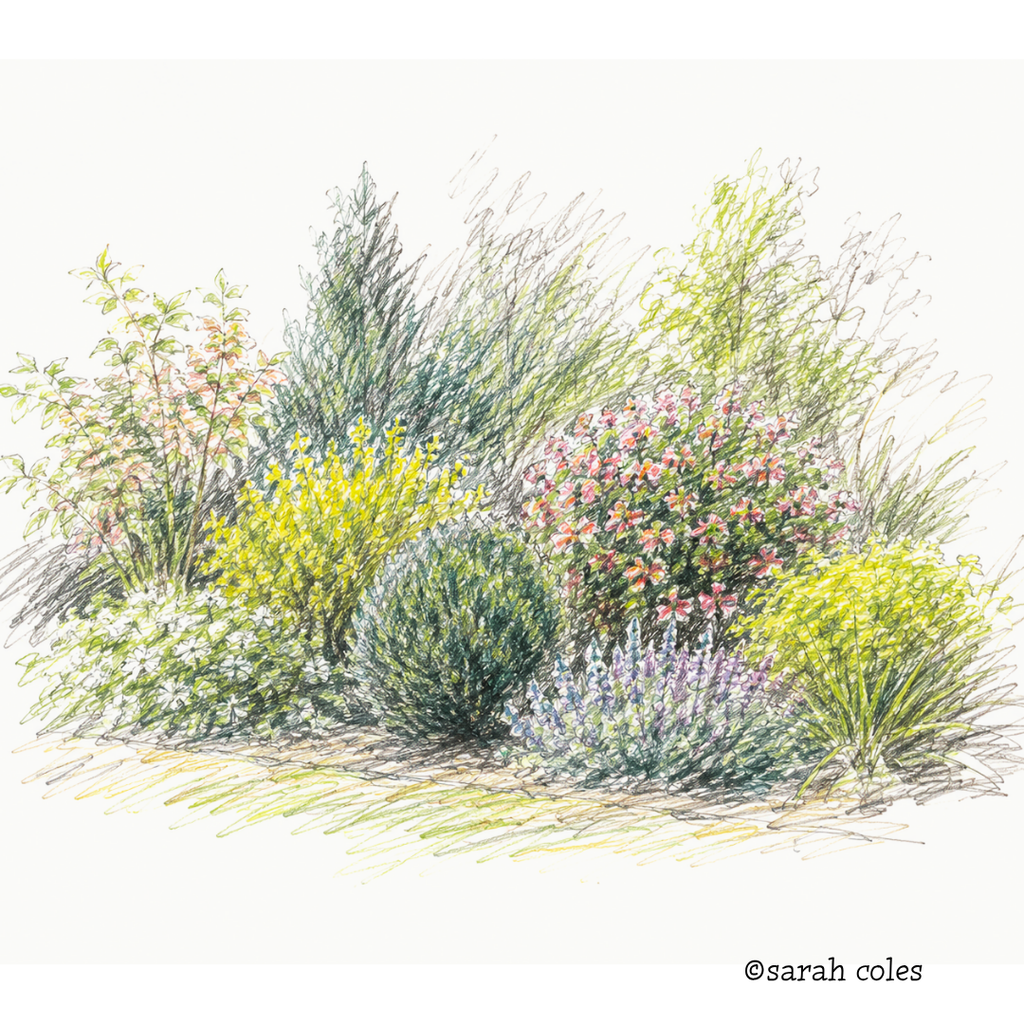
Shrubs give borders height and substance, hide fences, soften the corners of buildings and create those lovely layers of foliage that make a garden feel established. Some flower spectacularly, others produce berries, colourful stems or autumn leaves, while evergreens quietly keep going through winter when much of the garden has disappeared underground.
And they’re valuable to wildlife too.
If you’re planning a new garden – or wondering why an existing border doesn’t quite feel right – shrubs are a very good place to start.
What exactly is a shrub?
The boundary between a shrub and a small tree can become surprisingly blurred, but shrubs are essentially woody, perennial plants that usually produce several stems from low down, rather than developing the single dominant trunk we tend to associate with a tree. The RHS notes that distinguishing a large shrub from a small tree isn’t always clear-cut.
They come in almost every shape imaginable.
There are tiny ground-covering shrubs that creep across the soil, neat rounded evergreens, arching flowering shrubs and substantial specimens capable of forming a large part of a garden’s structure.
Some are evergreen; others lose their leaves each autumn.
Some earn their place with flowers. Others are worth growing for fragrance, foliage, berries, bark or brilliantly coloured winter stems.
That’s really the joy of shrubs: there’s one for almost every job.
Start with the garden, not the plant
It’s very easy to fall in love with a shrub at a nursery.
We’ve probably all done it.
You see something smothered in flowers, put it in the trolley and only when you get home start wondering where on earth you’re going to put it.
A better approach is to look at the space first.
Is it sunny or shady? Sheltered or exposed? Does the soil remain damp or dry quickly? Is it acidic or alkaline? And – something that’s very easy to overlook when faced with a small plant in a pot – how large will that shrub eventually become?
Choosing a shrub suited to your conditions is one of the most important things you can do for its long-term health.
Get that right and gardening becomes much easier.
Rather than constantly persuading a plant to tolerate somewhere it dislikes, you allow it to get on with what it naturally does best.
Use shrubs to give a garden its bones
I tend to think of shrubs as the bones of a border.
Perennials can weave between them, bulbs appear at their feet and annuals provide extra colour, but shrubs give the planting permanence.
This becomes particularly obvious in winter.
Once herbaceous plants have died back, a border that looked wonderfully full in July can suddenly appear rather empty. A few carefully positioned shrubs prevent the whole thing collapsing visually until spring.
Evergreens are especially useful for this, although you don’t need to fill the garden with them.
A dark green holly can provide a backdrop for lighter planting. A clipped evergreen can introduce a strong shape. Something with silvery foliage can brighten a sunny border, while a deciduous shrub with beautiful bark or coloured stems may be every bit as valuable in winter.
It’s about creating layers.
And that often makes a garden feel much bigger and more interesting.
Don’t forget flowering shrubs
Structure doesn’t have to mean green blobs.
Some of our loveliest garden plants are shrubs.
Think of the fragrance of Daphne on a cold day, spring-flowering viburnums, lilacs, philadelphus, flowering currants, hydrangeas and, of course, roses.
Choosing several shrubs that flower at different times can carry colour and fragrance through much of the year.
And there is a useful design trick here.
Rather than treating every shrub as a stand-alone specimen, try using them as part of the border. Let perennials grow around their feet and bulbs emerge between them.
The result tends to feel much more natural than a row of isolated shrubs surrounded by bare soil.
Shrubs can make a garden better for wildlife
This is where shrubs really begin to earn their keep.
Their branches and foliage can provide shelter and nesting places, while flowers offer nectar and pollen and later fruits and seeds may provide food for birds and other wildlife. The RHS recommends growing a mixture of trees, shrubs and climbers to provide both food and shelter.
A flowering shrub can be particularly valuable because one established plant can produce a considerable amount of food for pollinating insects while it is in bloom. Choosing shrubs that flower at different times helps extend that supply through the seasons.
Native shrubs can be excellent choices.
Hawthorn, hazel and holly, for example, can all make useful garden plants while supporting wildlife.
But there’s an important distinction from the original article.
You don’t need to plant exclusively native shrubs to create a wildlife-friendly garden. RHS research and guidance recognise that both native and suitable non-native garden plants can support wildlife.
The more useful goal is diversity: flowers across different seasons, berries and fruits, dense cover and a mixture of plant heights and structures.
A hedge can be much more than a boundary
Shrubs also make some of our best hedges.
And hedges do far more than mark where one garden ends and another begins.
A dense hedge can give privacy, filter wind, provide shelter for wildlife and create a green backdrop for the rest of your planting.
If you have room, a mixed hedge containing plants such as hawthorn, hazel, holly and other suitable species can be particularly rewarding.
In a more formal garden, clipped evergreen hedging creates an entirely different effect.
But this is where I’d update an old gardening assumption.
For years, box (Buxus sempervirens) was the automatic choice for neat low hedges and topiary. Box blight and box tree caterpillar have made it much more difficult to grow successfully in many parts of Britain, and the RHS is actively researching and recommending alternatives.
So if you’re creating a new formal hedge, it’s worth considering the alternatives before automatically reaching for box.
Shrubs for autumn and winter
A shrub shouldn’t necessarily have to justify its place with flowers.
Some become most interesting once summer is over.
Autumn foliage can turn an otherwise quiet corner of the garden red, orange or gold. Berries bring another splash of colour, while bare stems and interesting bark become much more noticeable after the leaves have fallen.
Evergreen foliage then becomes the steady background against which all of this happens.
It’s worth thinking about this when buying plants.
Instead of asking only, “What does it look like when it flowers?”, ask:
“What will this give my garden for the rest of the year?”
A shrub that offers spring flowers, good summer foliage, autumn colour and perhaps winter berries is working remarkably hard for the space it occupies.
Shrubs don’t need to be difficult to care for
One reason shrubs are so useful is that, once established and when planted in the right place, many need relatively little intervention.
The first couple of years matter.
Newly planted shrubs need attention to watering while their roots establish, particularly during dry weather. Even plants considered drought tolerant need adequate water while they’re getting settled.
After that, requirements depend on the plant and conditions.
And this is where I’d resist turning shrub care into a rigid annual routine.
Not every shrub needs feeding each spring.
Not every shrub needs heavy pruning.
And certainly not every shrub should be pruned at the same time.
When should you prune shrubs?
This is one of those gardening questions where “it depends” is actually the correct answer.
Some flowering shrubs produce their flowers on growth made the previous year. Prune those at the wrong time and you can remove the very stems that were about to flower.
Others flower on new growth and respond well to a different pruning regime.
Evergreens have their own requirements, while some shrubs need little more than the occasional removal of dead, damaged or badly positioned branches.
So before reaching for the secateurs, identify the shrub and find out how it flowers.
It takes a minute and can save a year’s worth of blooms.
Feeding shrubs: don’t do it just because it’s spring
The original article suggested routinely feeding shrubs in spring. I wouldn’t make that a general rule.
A healthy shrub growing happily in reasonable garden soil may not need regular feeding at all.
Mulching with well-rotted organic matter can help improve soil structure, conserve moisture and suppress weeds, while fertiliser is better used where there is an actual need rather than automatically applied to every shrub in the garden.
Container-grown shrubs are different.
Because their roots are confined to a relatively small amount of compost, they depend much more heavily on us for both water and nutrients.
As ever, the plant and its growing conditions should decide what you do.
What if a shrub isn’t looking happy?
Before reaching for a spray or bottle of feed, have a good look.
Yellow leaves don’t automatically mean a nutrient deficiency. Wilting doesn’t always mean a plant needs more water. Poor flowering isn’t necessarily a disease.
Ask a few basic questions first.
Has the soil become waterlogged? Has the plant dried out? Is it receiving enough light? Has it been planted too deeply? Is it being crowded by neighbouring plants? Are the leaves actually showing signs of a pest or disease?
Correctly identifying the problem is much more useful than treating the symptom.
This is particularly important with pests.
A few aphids on a healthy shrub are often simply part of the garden ecosystem – and food for ladybirds, hoverfly larvae and birds. Not every insect requires intervention.
Gardening becomes considerably less stressful once you stop expecting every leaf to be perfect.
Can you grow shrubs in a small garden?
Definitely.
A small garden arguably needs good shrubs even more than a large one because every plant has to earn its place.
The trick is choosing by eventual size, not the size of the plant when you buy it.
Compact cultivars can provide structure without overwhelming a border, and some shrubs are perfectly happy growing in containers.
Pots can be particularly useful on patios, balconies and beside doors, where a permanent shrub provides structure between more temporary seasonal displays. The RHS recommends choosing container shrubs carefully, as not every shrub is well suited to spending its life in a pot.
Remember that a pot-grown shrub will generally need more attention than the same plant growing in the ground.
Containers dry out more quickly, nutrients are finite and roots are more exposed to winter cold. Good drainage is essential too.
So container gardening is wonderfully flexible – but it isn’t necessarily lower maintenance.
Look upwards in a small space
Small gardens also benefit from making use of walls and fences.
This is where the line between shrubs and other woody plants becomes useful.
Wall shrubs can be trained against a boundary, while climbers can provide flowers and foliage without occupying much ground space. The RHS specifically recommends climbers and wall shrubs where space is limited.
You can also train suitable fruit trees as fans, cordons or espaliers.
Suddenly a bare wall becomes productive growing space.
It’s one of my favourite small-garden tricks: when you run out of room across the ground, start gardening upwards.
Choosing the right shrub
If I were choosing a new shrub for the garden, I wouldn’t begin with a list of fashionable varieties.
I’d begin with questions.
How much room do I actually have?
What is the soil like?
How much sun reaches the spot?
Do I want flowers, fragrance, berries, autumn colour or evergreen structure?
Would I like it to help screen a view?
Could it provide food or shelter for wildlife?
And, most importantly, what size will it be in ten years?
Answer those and the list of suitable shrubs becomes much shorter – and much more useful.
Give shrubs a little more attention
Shrubs rarely shout as loudly as a border full of summer flowers.
Perhaps that’s why we sometimes overlook them.
But take a walk around an established garden in the middle of winter and you’ll soon notice which plants are really holding everything together.
It’s the evergreen giving shape to an otherwise empty border. The bare branches creating a silhouette against the sky. The viburnum beginning to flower when very little else is awake. The berry-covered shrub bringing blackbirds into the garden.
Then spring arrives and the perennials begin pushing through again.
The shrubs simply become the backdrop.
And perhaps that’s exactly their strength.
They don’t always need to be the stars of the garden. They make the rest of it look better.
Further Reading: My Garden Journal & Notes
