



There is a particular moment familiar to anyone who grows chillies.
You’ve watched the plant develop from a tiny seedling on the windowsill. You’ve watered it, fed it, moved it around the garden in pursuit of sunshine and possibly brought it indoors on unexpectedly cold nights.
Eventually, glossy little fruits appear amongst the leaves.
You pick one.
It looks perfectly harmless.
You slice off a piece and taste it.
And that is when you discover whether you’ve grown something pleasantly warm or something capable of making you stand at the kitchen sink reconsidering every decision that brought you to this moment.
Chillies are wonderfully varied things.
Some offer little more than a gentle warmth. Others build slowly until there’s an unmistakable tingle around your lips. And then there are the truly ferocious varieties, where a piece no larger than your fingernail can transform dinner – and possibly the rest of your evening.
Fortunately, there’s a way of making sense of all this heat.
It’s called the Scoville Scale.
And whether you’re choosing chilli seeds, harvesting your own crop or deciding how much of that suspiciously small red chilli to put into dinner, it’s a useful thing to understand.
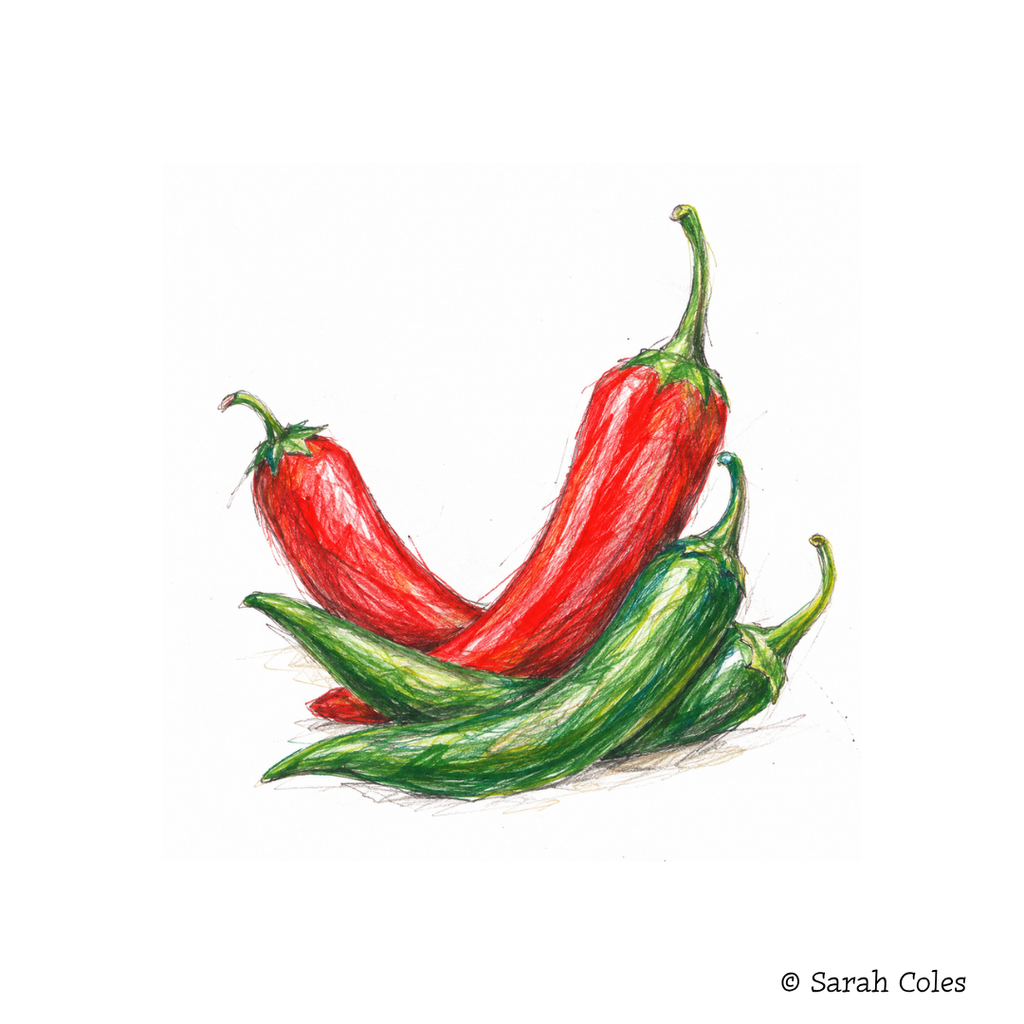
What is the Scoville Scale?
The Scoville Scale measures the pungency – what we generally call the heat – of chillies.
It’s expressed in Scoville Heat Units, or SHU.
At the peaceful end of the scale you’ll find sweet peppers, which contain little or no capsaicin and sit at around zero SHU.
Then the numbers begin to climb.
An Anaheim chilli might be around 500–2,500 SHU.
A jalapeño generally comes in at about 2,500–8,000 SHU.
Move into Scotch Bonnet territory and you’re looking at something closer to 100,000–350,000 SHU.
And then there are the extraordinary super-hot chillies whose ratings run into the millions.
The current Guinness World Record holder is ‘Pepper X’, recorded at an average 2.69 million SHU.
Which is interesting to know.
Whether you need to grow one is another matter entirely.
Who was Scoville?
Behind all those alarming numbers was an American pharmacist named Wilbur Scoville.
In 1912, Scoville devised what became known as the Scoville Organoleptic Test.
His method relied on human taste.
An extract of dried chilli was diluted in a sweetened solution and given to a panel of tasters. It was repeatedly diluted until the heat could no longer be detected.
The more dilution required, the hotter the chilli.
It was a clever solution to a difficult problem, although it had one rather obvious variable.
People.
Anyone who has shared a curry with friends knows that one person’s ‘nicely spicy’ is another person’s ‘I can no longer feel my face’.
Human sensitivity varies, so modern laboratory methods can measure capsaicinoids far more objectively.
But Scoville’s name stuck.
More than a century later, his scale is still the language gardeners, cooks and chilli growers use to describe heat.
Not bad going for a pharmacist and some exceptionally patient volunteers.
What actually makes a chilli hot?
The answer is a group of naturally occurring compounds called capsaicinoids.
The best known of these is capsaicin.
Capsaicin activates receptors in the mouth that normally respond to heat and pain. Nothing has actually become hotter, but your nervous system receives much the same warning signal.
Hence the burning mouth.
The watering eyes.
The runny nose.
And the sudden suspicion that adding the whole chilli may have been a mistake.
It’s a remarkably effective piece of plant chemistry.
Is all the heat in the seeds?
This is one of the most persistent chilli myths.
The seeds are not where most of the heat originates.
Capsaicinoids are produced principally in the chilli’s placental tissue – the pale internal tissue around the area where the seeds are attached.
Because the seeds sit in close contact with this tissue, capsaicinoids can coat their surfaces, which helps explain their fiery reputation.
There is another interesting wrinkle.
Research has found that in some exceptionally pungent chillies, capsaicinoid production can extend beyond the usual placental region into surrounding fruit tissue.
Nature, apparently, found the ordinary arrangement insufficiently alarming.
For everyday cooking, the useful lesson is simple: removing the seeds and the pale internal tissue can reduce the amount of heat you’re adding to a dish.
And if you’re cooking with a chilli you’ve never tried before, start cautiously.
You can always put more in.
Getting it back out of a chilli con carne is considerably harder.
From sweet peppers to serious heat
One of the pleasures of growing chillies is just how much variety there is.
Heat isn’t simply a choice between mild, medium and hot.
There’s an entire spectrum.
Sweet peppers – around 0 SHU
At the calmest end are sweet peppers.
There’s no meaningful chilli heat here, making them perfect for roasting, stuffing, salads and sauces.
If you like the flavour of peppers but don’t particularly want dinner to fight back, this is your end of the scale.
Anaheim – around 500–2,500 SHU
Anaheim chillies offer gentle warmth and are a good starting point for anyone who wants some chilli character without too much fire.
The RHS places ‘Anaheim’ at roughly 500–2,500 SHU.
Jalapeño – around 2,500–8,000 SHU
Now things become noticeably warmer.
Jalapeños generally sit at around 2,500–8,000 SHU, although individual fruits vary.
They’re wonderfully useful in the kitchen because they provide genuine chilli heat without overwhelming everything else.
Use them in fresh salsa, pickle them, add them to sauces or slice them over whatever you think needs waking up.
Green jalapeños have a fresh flavour, while fruits left to mature fully to red develop greater sweetness.
Hungarian Hot Wax – around 5,000–15,000 SHU
A little further up the scale, ‘Hungarian Hot Wax’ is rated by the RHS at around 5,000–15,000 SHU.
They’re particularly good for pickling as well as cooking.
At this point you certainly know you’re eating chilli, but we’re still some distance from the serious stuff.
Cayenne types – around 30,000–50,000 SHU
Cayenne-type chillies take us firmly into hot territory.
The RHS lists the cayenne-type cultivar ‘Fuego’ at around 30,000–50,000 SHU.
Cayenne chillies are particularly familiar in dried and powdered form.
A relatively small quantity can bring plenty of warmth without necessarily dominating a dish.
Scotch Bonnet – around 100,000–350,000 SHU
And then things become considerably more serious.
The RHS gives Scotch Bonnet chillies a range of around 100,000–350,000 SHU.
Habanero chillies occupy similarly formidable territory, although exact heat depends on cultivar and growing conditions.
These aren’t simply hotter versions of a jalapeño. They can also have distinctive fruity, aromatic flavours.
But they deserve respect.
Wear gloves when preparing particularly hot chillies, avoid touching your face and wash knives, boards and other equipment carefully afterwards.
Discovering chilli residue on your fingers immediately after rubbing your eye is one of life’s more memorable educational experiences.
And then there is Pepper X
For gardeners who regard 350,000 SHU as merely a warm-up, chilli breeding has produced an extraordinary collection of super-hot cultivars.
In 2023, ‘Pepper X’ was recognised by Guinness World Records as the world’s hottest chilli, with an average rating of 2.69 million SHU.
That surpassed the previous record held by ‘Carolina Reaper’.
It’s an astonishing horticultural achievement.
For most home cooks, however, it is perhaps best admired as an interesting fact rather than a recipe suggestion.
Hotter doesn’t mean better
It’s easy for chilli growing to turn into a competition.
Who can grow the hottest?
Who can eat the hottest?
Who has a bottle of sauce in the fridge with the most alarming warning label?
But heat isn’t the same thing as flavour.
Chillies can be fruity, smoky, sweet, grassy or citrus-like. Different varieties can contribute very different things to a meal.
A good chilli complements the food around it.
Sometimes a jalapeño is exactly right.
Sometimes you want the fruity intensity of a Scotch Bonnet.
And sometimes you don’t want chilli at all.
The Scoville Scale is therefore better treated as a guide than a leaderboard.
There are no bonus points for making dinner unnecessarily difficult to eat.
Using the Scoville Scale in the kitchen
Knowing roughly where a chilli sits on the scale can prevent some fairly dramatic cooking mistakes.
Suppose you’re making a fresh tomato salsa.
A jalapeño at around 2,500–8,000 SHU might give you just the warmth you’re looking for.
Start with half.
Taste.
Then decide whether you want more.
If you’re using a Scotch Bonnet, however, you’re dealing with a chilli that can be dozens of times hotter.
Don’t substitute one whole Scotch Bonnet for one whole jalapeño simply because the recipe says ‘one chilli’.
That’s not substitution.
That’s an ambush.
Use a small amount and build gradually.
Remember too that Scoville figures are normally given as ranges.
Individual fruits can vary.
Why aren’t all chillies of the same variety equally hot?
This is where things become particularly interesting for gardeners.
Variety is enormously important, but it isn’t the only factor determining heat.
The RHS notes that growing conditions and the stage of ripeness can also affect SHU.
Research into individual chilli varieties has likewise shown that capsaicinoid concentrations can rise and fall during fruit development rather than simply increasing continuously as a chilli ripens.
So it isn’t accurate to say that every chilli automatically becomes hotter the longer you leave it on the plant.
Different cultivars behave differently.
This explains one of the minor adventures of home-grown chillies.
One jalapeño might provide exactly the gentle warmth you expected.
The next may have unexpectedly strong opinions.
Taste cautiously.
Bravery can come later.
Choosing which chillies to grow
The Scoville Scale is particularly useful when you’re standing in front of a seed display.
Chillies are dangerously tempting plants to buy.
There are tiny purple ones.
Long red ones.
Round orange ones.
Black ones.
Wrinkled ones.
And inevitably something with a name suggesting that eating it may require the signing of a waiver.
Instead of choosing purely by appearance, look at the expected SHU range and think about how you’ll actually use the crop.
If you mainly cook family meals, mild and medium chillies are enormously useful.
If you enjoy hot sauces and Caribbean cooking, you might want a Scotch Bonnet-type chilli as well.
Growing two or three varieties with different levels of heat gives you far more flexibility than growing six plants whose fruits nobody in the household is willing to approach.
Growing chillies in Britain
Chillies are tender plants and need a long, warm growing season.
That presents British gardeners with an obvious challenge.
We can reliably provide the long bit.
Warm is occasionally more negotiable.
The RHS recommends sowing chilli seeds indoors from late winter to mid-spring.
An early start gives the plants plenty of time to grow, flower and ripen their fruit.
Seeds need warmth to germinate – around 21°C is recommended – so a heated propagator can be extremely useful.
A warm windowsill may work too, although once seedlings appear they’ll also need plenty of light.
Later, chillies crop particularly well in a greenhouse, polytunnel or conservatory.
They can be grown outdoors too, especially in warmer and more sheltered parts of Britain, but give them the sunniest position available.
A patio or south-facing wall can provide exactly the sort of warm little microclimate they appreciate.
Don’t rush them outdoors
A sunny April afternoon can persuade even experienced gardeners that summer has arrived.
It hasn’t.
Chillies are tender and should not be rushed outside.
Harden young plants off gradually so they become accustomed to outdoor conditions, and wait until temperatures are reliably warm before leaving them outside permanently.
The RHS advises waiting until night temperatures are consistently at least 12°C before moving chilli plants outdoors – typically around late May or June, depending on where you live and the season.
Your local conditions matter more than the date on the calendar.
A sheltered garden on the south coast and an exposed garden in northern England are not experiencing the same May.
The chilli knows this even if the seed packet doesn’t.
Growing chillies in pots
You don’t need a vegetable garden to grow chillies.
They’re excellent container plants.
Compact varieties can live happily on a sunny patio, balcony, greenhouse shelf or even a bright windowsill.
Some varieties remain only around 20cm tall, while others become much larger, so check the eventual size before planting.
Give them a suitably sized container with good drainage and don’t allow the compost to become permanently waterlogged.
Containers also have one considerable British advantage.
When the weather turns unexpectedly cold, you can move them.
Try doing that with a vegetable bed.
Watering and feeding
Once established, chilli plants are reasonably straightforward.
Keep the compost or soil evenly moist, particularly once plants begin flowering and producing fruit.
Plants growing in containers can dry surprisingly quickly during warm weather.
Avoid swinging between bone dry and completely saturated if you can.
Once flowering begins, regular feeding with a high-potassium liquid fertiliser helps support fruit production.
If you’ve grown tomatoes before, much of this will feel familiar.
Both appreciate sunshine, warmth, regular watering and feeding.
And both have the capacity to make you inspect them several times a day even though absolutely nothing has changed since breakfast.
When are chillies ready to harvest?
This is one job the Scoville Scale cannot do for you.
An SHU rating describes expected heat.
It doesn’t tell you that a chilli is ripe.
Instead, look at the characteristics of the particular variety you’re growing: its expected size, colour and maturity.
Many chillies can be harvested while green.
Leave them on the plant and they may mature through yellow or orange to red, depending on the cultivar.
A jalapeño, for example, can be picked green or left to ripen red.
Both are useful.
They’re simply different stages of the fruit.
Check your seed packet or plant label for the mature colour and expected harvesting period, then use the fruit itself as your guide.
Do hotter chillies take longer to ripen?
Not necessarily.
It’s tempting to assume that a chilli with an enormous Scoville rating must require longer to mature than a mild one, but heat level isn’t a reliable guide to ripening time.
Different species and cultivars mature at different rates.
Some very hot chillies do need a particularly long growing season, which makes starting them early useful in Britain.
But you can’t look at the SHU number and use it to predict a harvest date.
Choose cultivars suited to the conditions you can provide.
A spectacularly hot chilli that never manages to ripen is mostly an ornamental plant with ambitions.
What to do with a chilli glut
There is a wonderful progression when growing chillies.
First:
Look! A chilli!
A few weeks later:
Look how many chillies we’ve got!
And finally:
Does anybody actually need 73 chillies?
Fortunately, they are easy to preserve.
You can freeze them, dry suitable varieties, pickle them, make chilli jam or turn them into sauces and chutneys.
Freezing is particularly straightforward.
Wash and thoroughly dry the fruits, then freeze them whole or sliced in suitable containers or freezer bags.
You can then take out exactly what you need for cooking.
Dried chillies can also be crushed into flakes or ground into powder.
Label different varieties.
A mystery freezer bag containing something between 2,500 and 350,000 SHU adds an unnecessary element of jeopardy to Tuesday’s dinner.
Handling very hot chillies safely
Once you’re dealing with very hot varieties, sensible precautions are worthwhile.
Wear disposable gloves when preparing them.
Don’t touch your eyes, nose or face.
Wash knives, chopping boards and work surfaces thoroughly afterwards.
Keep chopped chillies out of the reach of children and away from pets.
And remember that simply washing your hands quickly may not remove every trace of capsaicin.
The hotter the chilli, the more carefully it’s worth working.
There is nothing cowardly about gloves.
Particularly once you’ve experienced the alternative.
More than just a number
The great usefulness of the Scoville Scale is that it gives us a shared language for something otherwise rather difficult to describe.
‘Mild’ means different things to different people.
So does ‘hot’.
But knowing that one chilli is around 5,000 SHU and another is around 300,000 SHU gives you a fairly strong indication that they should not be treated interchangeably.
Still, the numbers only tell part of the story.
Grow several varieties and you’ll discover that chillies aren’t simply different degrees of pain.
They have their own flavours.
Their own colours.
Their own shapes.
And, it sometimes seems, their own personalities.
Some quietly warm a dish.
Others announce their presence immediately.
That’s part of the pleasure of growing them.
You sow a few unremarkable-looking seeds while winter is still lingering outside.
You coax the seedlings along.
You wait for warmer days.
Flowers appear, followed by tiny green fruits.
And months later, you’re standing in the kitchen holding one of those glossy chillies and wondering how brave you’re feeling.
Just check the Scoville rating before taking a bite.
Some gardening lessons are considerably more enjoyable when learnt from the seed packet.
Grow Chillies with SowItGrowItandFeast!
Further Reading: How to Preserve Chillies: Freezing, Drying and Pickling Your Harvest, How to grow chillies: from seed to fiery harvest,
