


There was a time when skirret was a familiar sight in the kitchen garden. Long before potatoes became a staple crop in Britain, its slender white roots were grown and eaten for their naturally sweet flavour.
Today, few gardeners have heard of it.
Skirret (Sium sisarum) is one of those old vegetables that has quietly slipped from our gardens and kitchens. A perennial relative of carrots and parsnips, it produces clusters of sweet, narrow roots with a flavour often described as somewhere between the two.
It may have fallen out of fashion, but skirret has plenty to recommend it. Once established, it can remain in the garden for years, providing edible roots as well as young flower shoots – and a glimpse into the way our gardens were cultivated before today’s familiar vegetables came to dominate the plot.
What is skirret?
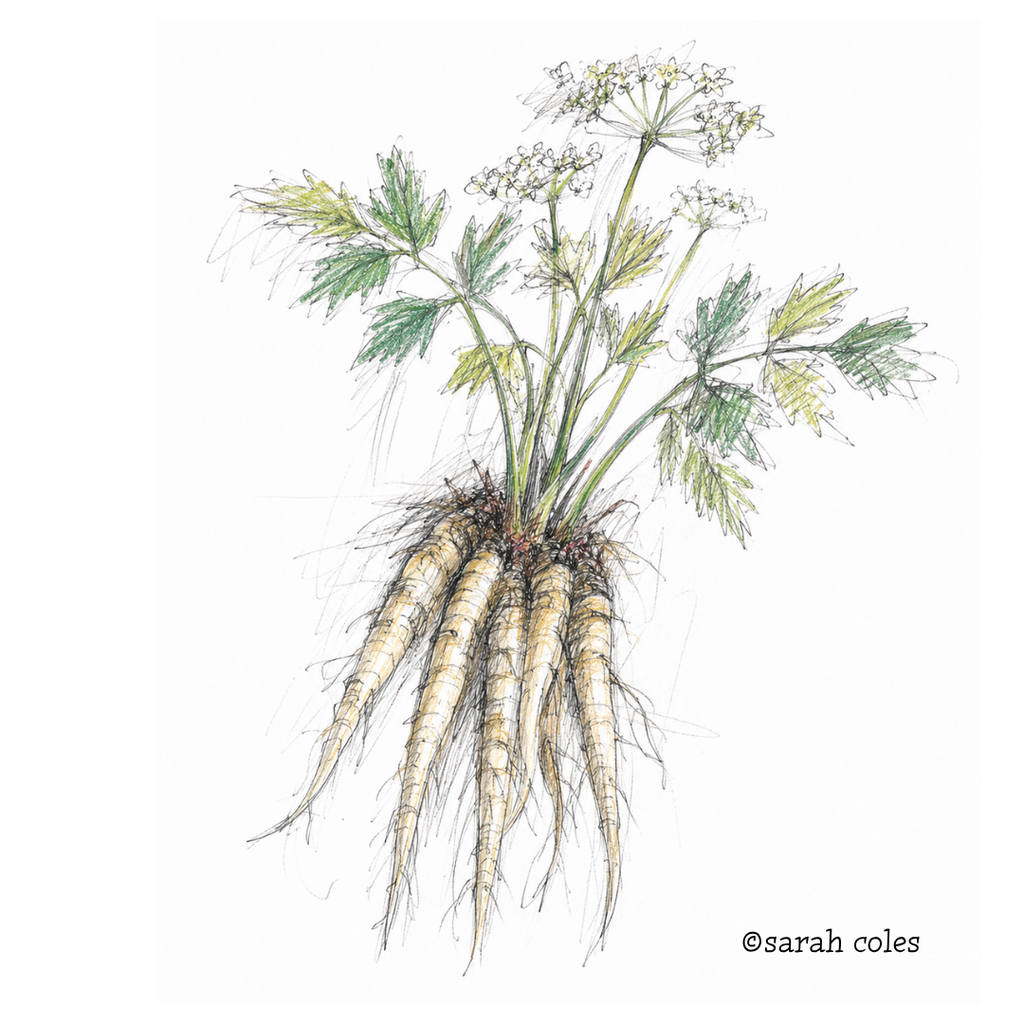
Skirret is a hardy, clump-forming perennial in the Apiaceae family, alongside carrots, parsnips, celery and parsley.
Rather than producing a single large root, as a carrot or parsnip does, skirret develops a crown surrounded by a cluster of long, pale roots. It is these roots that are harvested and eaten.
The plant itself can reach around 1–1.5 metres when in growth, producing leafy stems topped with umbels of small white flowers in summer.
Although skirret is often described as an ancient Asian vegetable, its origins are rather more complicated. Its natural range stretches from parts of eastern and south-eastern Europe through western and central Asia. What we do know is that it has a long history of cultivation and was once valued as a root vegetable in Europe.
In Britain, it was eaten before the potato became widely established – one reason this now-obscure vegetable offers such an intriguing connection with our gardening past.
Why is skirret sometimes called sugar root?
You may come across skirret described as ‘sugar root’, and it’s easy to understand why. Its roots have a noticeably sweet flavour, particularly when cooked.
There is a little linguistic history hidden here too. German Zuckerwurzel, Dutch suikerwortel and Danish sukkerrod all translate as ‘sugar root’.
The origins of the English name ‘skirret’, however, are less straightforward. Early forms of the word appear in Middle English, probably influenced by words associated with brightness or whiteness and by earlier French names for the plant.
So while ‘sugar root’ is a wonderfully apt description, it isn’t quite as simple as saying that this is what the English word skirret literally means.
What does skirret taste like?
The roots are mildly sweet and aromatic, with a flavour often compared with a cross between a carrot and a parsnip.
They can be boiled, roasted or used in other savoury dishes, and skirret also has a history of appearing in sweeter recipes.
The roots are much narrower than modern carrots or parsnips, so preparing them can take a little patience. That may partly explain why skirret eventually lost ground to larger, easier-to-handle root crops.
But perhaps that is missing the point.
Skirret belongs to a different sort of kitchen garden – one in which a crop wasn’t expected to be perfectly uniform or conveniently shaped. Its charm lies partly in its irregularity.
How to grow skirret
Once you have an established plant, growing skirret is relatively straightforward.
Choose a sunny position with deep, fertile soil that holds moisture without becoming waterlogged. Good soil preparation is worthwhile, as the quality of the roots will depend in part on the conditions in which they develop.
Water plants during prolonged dry weather, particularly if you are growing them for their roots. Allowing the soil to become excessively dry can result in tougher, more fibrous roots.
Skirret is perennial, so there is no need to sow a completely new crop every year. As the plant matures it forms a clump, and established crowns can be divided while dormant to create new plants.
This is one of the great pleasures of growing it. Once you have found a particularly good plant, you can keep it going rather than returning to seed each spring.
When and how to harvest skirret
Skirret roots are best harvested while the plant is dormant, from autumn into early spring.
Rather than pulling individual roots from the ground, carefully lift the clump. You will find a crown with a mass of roots attached beneath it.
Not every root will be worth taking into the kitchen. Select the best, cutting away the larger, more useful roots, then retain a healthy section of crown and roots to replant.
Established clumps can also be divided at this stage. Each healthy section can be replanted and allowed to develop into a new plant.
This makes skirret rather different from an annual root crop. Harvesting doesn’t necessarily mean the end of the plant. Part can go into the kitchen while part returns to the garden to grow again.
What causes woody skirret roots?
One of skirret’s less appealing characteristics is its tendency to produce the occasional root with a tough or woody centre.
Once a root has developed a hard core, cooking won’t reliably soften it, so these are best discarded.
Growing conditions appear to have an influence. Skirret appreciates consistent moisture, and plants allowed to become too dry are more likely to produce disappointing roots. Deep, moisture-retentive soil and watering during dry spells should give the crop the best chance of producing tender roots.
There can also be considerable variation between plants raised from seed.
For the home gardener, that variation can actually be useful. If one plant consistently gives you good, tender roots, keep it. Divide the crown and propagate from that plant rather than relying solely on another batch of seedlings.
Over time, you can build up your own clump of skirret particularly well suited to your garden.
Can you eat skirret flower shoots?
The roots aren’t the only useful harvest.
Young, immature flower shoots can also be eaten. Harvested while still tender, they have a pleasant flavour reminiscent of carrot and can be cooked rather like other young vegetable shoots.
There is a relatively short window for picking them. Once the stems begin to mature they quickly become tough, so harvest only the young, tender growth.
Don’t take too much from a newly established plant. Allowing skirret time to build up a strong crown and root system will reward you with a more substantial plant in the years ahead.
Growing skirret from seed
Finding skirret plants or crowns can be more difficult than growing mainstream vegetables, which means many gardeners will need to start with seed.
The first rule is simple: buy the freshest seed you can find.
Like a number of plants in the carrot family, skirret seed can be erratic in germination and does not store indefinitely well. Older seed may give disappointing results.
Cold stratification – exposing seed to a period of cool conditions before germination – is often used when raising skirret and can help with germination. It is better, however, to think of this as a useful technique rather than a guarantee.
Patience is important. Skirret isn’t a crop to choose if you’re looking for instant results.
But once those first plants are established, growing it becomes considerably easier because good crowns can be divided and replanted.
Growing skirret from crowns
If you can find skirret crowns or young plants, they offer a simpler route than seed.
Established clumps can be lifted and divided while dormant, ideally between late autumn and early spring. Replant healthy sections into prepared soil, leaving enough root and crown for each division to establish.
If you’re fortunate enough to be given a division from an established plant, all the better. Old vegetables such as skirret have traditionally survived through exactly this sort of gardening – plants being divided, saved and passed from one gardener to another.
Is skirret worth growing?
If measured purely by yield or convenience, there are certainly easier root vegetables to grow.
A carrot is simpler to prepare. A parsnip produces a larger root. A potato provides far more food for the space it occupies.
But that isn’t the only reason we garden.
Growing skirret brings something different to the vegetable patch. It is perennial, unusual and edible, but it also carries a story. This was once a useful kitchen-garden crop, cultivated by generations who would have regarded many of today’s familiar vegetables rather differently from the way we do.
Then fashions changed. New crops arrived, gardens changed with them, and skirret slowly disappeared from everyday use.
Planting it again gives this forgotten vegetable another chance.
And there is something rather satisfying about lifting a cluster of sweet white roots from the winter soil, taking what you need for the kitchen, then dividing the crown and returning a piece to the ground.
Not everything in a productive garden needs to be new. Sometimes the most interesting plants are the ones waiting to be rediscovered.
Further Reading: My Garden Journal & Notes
