


“An apple a day keeps the doctor away.”
It’s one of those sayings most of us have known for so long that we rarely stop to question it.
Presumably, somewhere in Britain, generations of children have been handed an apple with the vague implication that finishing it might save everyone a trip to the GP.
If only healthcare were quite so straightforward.
Apples are certainly good food. They provide fibre, contribute to our daily fruit and vegetable intake and come conveniently packaged in their own edible skin. But they aren’t medicine, and no particular variety possesses mysterious powers of immortality.
The real story of the apple is, arguably, much more interesting.
It begins thousands of miles from Britain, travels through ancient civilisations and Roman orchards, passes through medieval monasteries and Victorian gardens, and eventually arrives in the fruit bowl on the kitchen table.
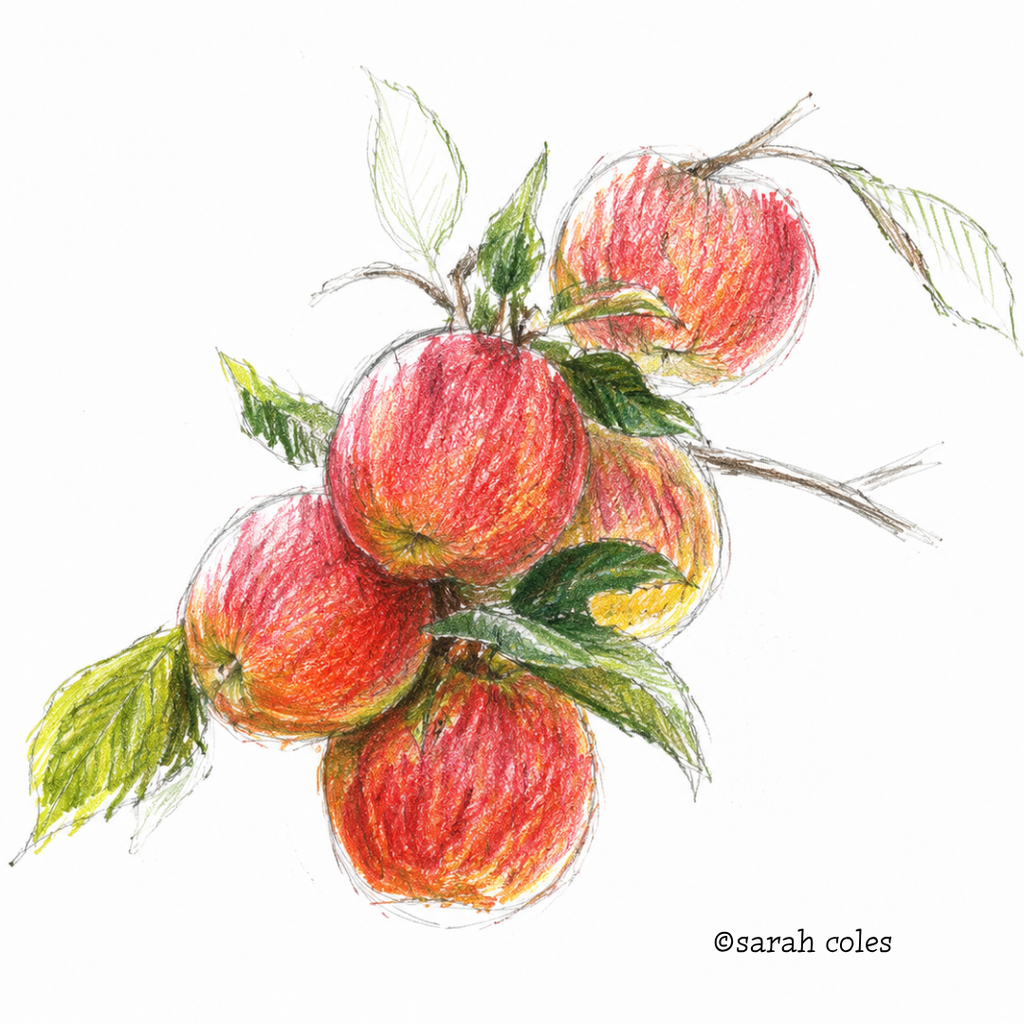
So, does an apple a day really keep the doctor away? And how did this familiar fruit become such an enduring part of British life?
Let’s start at the beginning.
Where did apples originally come from?
It would be rather neat if Britain’s favourite orchard fruit had begun life somewhere among the hedgerows of Kent, Herefordshire or Somerset.
It didn’t.
The domestic apple, Malus domestica, can trace its origins to Central Asia. Its wild ancestors grew in the region around modern-day Kazakhstan, and apples gradually travelled west along ancient trade routes.
By the time the Romans came along, people had already been cultivating apples for centuries.
Wild apples were present in Neolithic Britain, but according to the RHS, it was the Romans who brought sweeter cultivated varieties here and established the first British orchards.
They also brought knowledge of growing, grafting and managing fruit trees.
Our relationship with the apple was beginning to take root.
Apples, monasteries and a medieval fruit seller
Apple growing declined after the Romans left Britain, before orchards began flourishing again following the Norman Conquest.
Many were established around monasteries, where monks cultivated fruit and developed different varieties.
One apple that became widely grown by the 13th century was called the ‘Costard’.
Its sellers became known as costardmongers.
And from there, rather wonderfully, we eventually got the word costermonger – the traditional name for a street seller of fruit and vegetables.
It’s the sort of small historical connection that makes looking into apples rather dangerous.
You start wondering what to make for pudding and emerge knowing the linguistic history of a greengrocer.
Britain once grew an extraordinary range of apples
Today, it’s easy to think of apples as belonging to a fairly small cast of familiar characters.
But the history of British apple growing is remarkably diverse.
By the middle of the 17th century, around 60 apple cultivars were recorded in UK production. They weren’t simply divided into eating and cooking apples, either. Apples were grown for eating, cooking and cider-making, as well as for other uses.
Breeding and cultivation accelerated considerably during the 19th and early 20th centuries, giving us varieties that are still familiar today.
‘Cox’s Orange Pippin’, for example, was introduced by Richard Cox in the 19th century.
Then there’s ‘Bramley’s Seedling’, perhaps Britain’s most famous cooking apple.
Its story began not with a professional fruit breeder, but with a young woman called Mary Ann Brailsford, who planted apple pips in her garden in Southwell, Nottinghamshire, in the early 19th century.
One of those seedlings grew into an extraordinary tree.
Decades later, a local nurseryman recognised the quality of its fruit and began propagating it.
The original tree became the ancestor of generations of Bramleys.
Quite an achievement for something that began with a pip in a Nottinghamshire garden.
So, is an apple actually good for you?
Yes.
But perhaps not for the reasons suggested by centuries of enthusiastic apple publicity.
The NHS recommends eating at least five portions of a variety of fruit and vegetables each day. For adults, one medium apple counts as one portion of your 5 A Day.
Fruit and vegetables provide vitamins and minerals and are an important source of dietary fibre.
Apples contribute to that.
Fibre is important for normal digestion and gut health, and UK guidance recommends adults aim for around 30g of fibre each day.
But here’s the important bit: eating an apple doesn’t cancel out everything else you’ve eaten that week.
Health comes from the overall pattern of our diet and lifestyle, not from finding one particularly virtuous piece of fruit and assigning it superhero status.
The apple is good.
It doesn’t need a cape.
Myth: apples are packed with vitamin C
Apples do contain vitamin C, but they’re not among its richest sources.
If vitamin C is your sole objective, other fruits and vegetables can provide considerably more.
That doesn’t make apples nutritionally pointless. Far from it.
Part of their value comes from the fact that they’re an easy way to eat whole fruit and contribute towards your daily intake of fruit, fibre and other plant compounds.
And, unlike some foods that acquire a healthy reputation only after being powdered, fermented, imported from somewhere distant and placed in a tiny packet, an apple requires very little preparation.
Wash.
Crunch.
Done.
Myth: you should peel an apple before eating it
For most people, there is no need.
Apple skin is edible, so if you enjoy it, give the fruit a good wash and eat the skin along with the flesh.
Leaving the skin on also means less preparation and less food waste.
There are, of course, occasions when peeling makes sense. Apple sauce may be smoother without it, and some puddings call for peeled fruit.
But an apple eaten straight from the fruit bowl doesn’t require undressing first.
Myth: green apples are healthier than red apples
The colour of an apple isn’t a nutritional traffic-light system.
Red, green, yellow and russet apples differ in flavour, texture and their particular mix of plant compounds, but there isn’t a simple rule that one skin colour makes an apple universally “healthier” than another.
Choose the apple you actually enjoy eating.
A beautifully nutritious apple sitting untouched in the fruit bowl because you don’t like the taste isn’t achieving very much.
And flavour is one of the great pleasures of exploring different apple varieties.
A ‘Cox’s Orange Pippin’ doesn’t taste like an ‘Egremont Russet’. A ‘Discovery’ doesn’t taste like a ‘Bramley’.
Apples can be sharp, honeyed, aromatic, nutty, crisp, soft or intensely sweet.
They’re far more interesting than simply red or green.
Myth: all apples are basically the same
Spend five minutes at an apple-tasting event and this idea quickly disappears.
The RHS lists hundreds of apples available through plant catalogues and its plant-finding resources, while heritage collections preserve many more unusual cultivars.
Some apples are grown primarily for eating. Others are culinary varieties bred for cooking. Some are dual-purpose, and still others are particularly suited to cider-making.
Their seasons differ too.
Early varieties can be ready while summer is still hanging on. Later apples may be harvested in autumn and, if they’re suitable for storing, enjoyed months afterwards.
The supermarket apple aisle is only a tiny glimpse of what’s out there.
Does an apple a day really keep the doctor away?
Now to the important question.
No, eating one apple every day does not guarantee that you won’t need a doctor.
Rather disappointingly, the arrangement between apples and the medical profession isn’t legally binding.
But the saying has an interesting history of its own.
Versions of the idea appeared before the familiar wording became widespread, while the RHS notes that the modern phrase “an apple a day keeps the doctor away” was popularised as an advertising slogan in the early 20th century.
The sentiment worked because apples already had a reputation as wholesome, everyday food.
And perhaps that’s where the saying remains useful.
Not as medical advice, but as a reminder that eating fruit regularly is a good habit.
One apple can count towards your 5 A Day.
It just doesn’t excuse the other four from turning up.
What about apple juice?
Here’s another place where the whole fruit has an advantage.
Fruit juice can count towards your 5 A Day, but NHS guidance limits fruit juice and smoothies to a combined total of 150ml a day.
That’s because crushing and juicing fruit releases sugars from the structure of the fruit, and juice contains less fibre than eating the whole fruit.
And drinking two glasses doesn’t suddenly make it two portions.
Nice try.
For everyday eating, biting into the actual apple gives you the whole fruit, including its fibre.
Apple juice can certainly be enjoyed.
It simply isn’t nutritionally identical to eating an apple.
Are cooking apples as good for you as eating apples?
The distinction between a cooking apple and an eating apple is mainly about how the fruit tastes and behaves in the kitchen.
Dessert apples are generally pleasant eaten raw. Culinary apples tend to be sharper and often soften particularly well during cooking.
‘Bramley’s Seedling’ is the classic British example.
Cooking the apple doesn’t suddenly turn it into an unhealthy food. What makes the bigger difference is what you cook it with.
Stewed apples with a little cinnamon are one thing.
Apple crumble with butter, sugar and a generous lake of custard is another.
Both have their place.
One simply has rather more enthusiasm.
Apples have always been about more than nutrition
Perhaps concentrating solely on whether apples are “healthy” misses something important.
For centuries, apples were valuable because they could be grown, stored, cooked, preserved and turned into drinks. They were part of the rhythm of the agricultural year.
The RHS records that apples were an important food for poorer rural communities because some could be stored through winter, when fresh produce was harder to come by.
Orchards became part of the landscape as well as the kitchen.
And every named apple carried a little history with it.
Some were associated with particular counties. Others were discovered as chance seedlings. Some were bred deliberately; others simply appeared and proved too good to lose.
When an old apple variety disappears, we don’t only lose a flavour. We lose part of that horticultural history.
Why heritage apples still matter
Traditional orchards and heritage apple collections preserve something the supermarket shelf can’t easily provide: diversity.
Modern shops understandably favour fruit that can withstand transportation, store well and meet expectations around size and appearance.
An old orchard plays by different rules.
Here you might find apples that are oddly shaped, heavily russeted, unusually small or available for only a brief period.
They might also taste extraordinary.
Heritage varieties can carry genetic traits that may prove useful for future apple breeding, including characteristics associated with resilience to particular growing conditions, pests or diseases.
And because named apple cultivars are reproduced through grafting, an old variety represents a living connection with the trees from which it descended.
That’s rather more exciting than simply saying it’s an old apple.
Perhaps the old saying isn’t entirely wrong
No, an apple a day won’t guarantee a doctor’s waiting room remains forever unfamiliar.
No single food can do that.
But apples have endured in our kitchens and orchards for good reasons.
They’re convenient, they contribute towards a varied diet, they provide fibre, and they can be eaten without requiring so much as a chopping board.
More importantly, perhaps, they’re wonderfully diverse.
There are apples for eating beneath the tree and apples destined for pie. Apples for storing through winter, apples for cider, apples with histories stretching back centuries and chance seedlings that became household names.
So eat an apple because you enjoy it.
Try a variety you’ve never encountered before. Visit an orchard in autumn. Compare a russet with a Cox. Bake a Bramley until the kitchen smells wonderful.
And if you’d still like to have one every day?
By all means.
Just keep your doctor’s telephone number.
Further Reading: My Garden Journal & Notes
