


There is something rather irresistible about growing chillies.
Perhaps it’s the extraordinary variety. One plant might be hung with small scarlet fruits fierce enough to transform an entire dish; another produces plump, mild chillies with barely a hint of heat. Some taste fruity, others smoky, sweet or almost citrus-like. And all of this can begin with a few small seeds on a windowsill while the garden outside is still waiting for spring.
For British gardeners, chillies also offer a satisfying challenge. They are plants of warmth and sunshine, neither of which our climate provides particularly reliably. Give them an early start and a sheltered spot, however, and they can be surprisingly generous.
Whether you’re after a gentle warmth for cooking or the sort of chilli that demands considerable caution, the secret is to choose a variety that suits both your taste and the conditions you can give it.
Choosing which chillies to grow
Open a specialist seed catalogue and the choice can be bewildering.
There are hundreds of chilli varieties, differing not only in heat but also in size, shape, colour, flavour and growing habit. Some remain compact enough for a sunny windowsill; others develop into sizeable plants better suited to a greenhouse or conservatory.
Before choosing according to the photograph on the packet, think about what you actually want from your crop.
If you cook regularly with chillies, flavour should come first. Heat is only one part of their character.
Jalapeños offer moderate warmth and thick, useful flesh. Cayenne types are slender and particularly good for drying. Habaneros combine considerable heat with an unmistakably fruity aroma, while Scotch bonnets bring their characteristic flavour to Caribbean cooking.
There are mild chillies too, making them every bit as worthwhile for gardeners who aren’t interested in testing the limits of their taste buds.
And if space is short, look for a naturally compact variety. Chillies can be remarkably productive container plants.
Understanding the Scoville scale
The heat of a chilli is commonly expressed in Scoville Heat Units, or SHU.
At the mildest end, sweet peppers contain little or no capsaicin and register around zero. Jalapeños typically measure in the thousands, while Scotch bonnets can reach into the hundreds of thousands. At the extreme end are super-hot cultivars measuring well over a million SHU.
The figures are useful, but they aren’t an exact prediction of what every fruit will taste like.
Heat can vary between cultivars and individual fruits, and growing conditions and ripeness can influence the final result.
So think of the Scoville scale as a useful map rather than an absolute promise.
What actually makes a chilli hot?
The culprit – or attraction, depending on your point of view – is capsaicin.
One persistent myth is that most of a chilli’s heat is contained in its seeds. It isn’t.
Capsaicin is concentrated particularly in the pale internal tissue to which the seeds are attached. Seeds can become coated with capsaicin from the surrounding tissue, which helps explain their fiery reputation, but they aren’t its main source.
Capsaicin activates heat-sensitive receptors in our mouths, including receptors known as TRPV1. These normally help us detect potentially damaging heat.
In other words, a chilli doesn’t literally make your mouth hot in the way a spoonful of boiling soup does. Capsaicin activates part of the same sensory system, and the brain receives a very convincing message that things are getting warm.
The watering eyes, streaming nose and perspiration that sometimes follow are part of the body’s response.
It’s an extraordinary bit of plant chemistry.
Chillies, birds and a clever evolutionary trick
There is another curious twist to the story.
Humans and other mammals are sensitive to capsaicin, but birds are much less sensitive to it. This is useful to a wild chilli plant.
A mammal may chew and damage seeds as it eats the fruit. A bird can swallow the fruit and later disperse viable seeds elsewhere.
Capsaicin therefore appears to help discourage some less useful diners without putting off the birds that can carry the plant’s seeds to new ground.
Humans, of course, rather disrupted this strategy when we decided we enjoyed the sensation and began cultivating increasingly diverse – and increasingly hot – chillies ourselves.
When to sow chilli seeds in the UK
Chillies need a long growing season, so an early start is important in Britain.
Seeds are generally sown indoors from late winter to mid-spring. Gardeners with a heated propagator and good light can start particularly early, while those relying on a windowsill may find it easier to wait until increasing daylight gives young plants stronger growing conditions.
Warmth is essential for germination. Around 21°C is a useful target.
Once seedlings emerge, they need plenty of light. A warm but gloomy windowsill can produce long, weak seedlings stretching towards the glass, so give them the brightest position available.
When seedlings are large enough to handle, move them carefully into individual small pots of peat-free multi-purpose compost.
From there, pot them on as their roots fill each container rather than immediately placing a tiny plant in a very large pot.
Giving chillies enough light and warmth
This is where British weather becomes part of the adventure.
Chillies are tender plants and perform best with warmth and plenty of sunshine. A greenhouse, polytunnel or sunny conservatory gives the most reliable conditions, although a sheltered south-facing patio or wall can work well in a warm summer.
Compact varieties can also make surprisingly handsome windowsill plants.
Don’t rush plants outdoors in spring.
Young chillies raised inside need to be gradually hardened off, and outdoor planting should wait until the danger of cold nights has passed. As a useful guide, night temperatures should be reliably around 12°C or above before chillies are left outside.
In much of Britain, that means late May or early June.
Even then, choose your warmest, sunniest and most sheltered position.
Growing chillies in pots
Containers are particularly useful for chillies because they allow plants to be moved to make the most of the weather.
A sunny patio may be perfect during a warm spell, while a greenhouse offers protection when temperatures fall.
As a general guide, one chilli plant can be grown in a pot around 22cm across, although larger-growing varieties may appreciate more room as they mature.
Use a good peat-free multi-purpose compost and make sure excess water can drain freely.
The aim isn’t to create permanently wet compost, but neither should chilli plants repeatedly swing between being saturated and bone dry.
Consistency is more useful.
Watering chilli plants
Chillies appreciate an even supply of moisture while actively growing.
Plants in containers can dry surprisingly quickly in hot weather, so check them regularly rather than watering to a rigid timetable. During warm summer spells, pots may need attention every day.
Plants that become too dry can drop flower buds, potentially reducing the crop just when you want it to be setting fruit.
Water thoroughly when required and allow excess water to drain away. Don’t leave containers permanently sitting in water.
A little observation goes a long way. Lift a smaller pot to judge its weight, feel the compost and look at the plant rather than automatically reaching for the watering can.
When should you feed chillies?
Once container-grown plants begin flowering, a high-potassium liquid feed can help support flowering and fruit production.
The RHS recommends feeding container-grown chillies weekly once flowering begins.
Plants growing in fertile, enriched garden soil may need considerably less additional feeding.
More fertiliser isn’t necessarily better. What you’re trying to produce is a healthy plant capable of carrying a good crop, rather than lots of soft leafy growth at the expense of fruit.
Do chilli plants need pruning?
Not usually.
This is one of the pieces of chilli-growing advice that is often repeated more confidently than it deserves to be.
Chillies naturally branch, so routinely pinching out every young plant isn’t necessary for a good harvest.
If a plant reaches around 30cm tall, you can pinch out the growing tip to encourage a bushier shape and potentially a larger number of smaller fruits. There is a trade-off, however: pinching can delay fruiting.
In Britain’s relatively short chilli-growing season, that delay matters.
Unless there is a particular reason to shape the plant, it’s often perfectly sensible to let it get on with growing.
Do chillies need pollinating by hand?
Usually, no.
Chilli flowers are self-fertile, so a single plant can produce fruit. Outdoors, movement from wind and visiting insects generally provides more than enough disturbance to transfer pollen.
Plants grown inside a greenhouse, conservatory or on a windowsill may occasionally benefit from a helping hand if flowers appear but fruit isn’t setting.
This needn’t involve anything complicated. Gently tapping or shaking the plant can help move pollen within the flowers.
Very high temperatures can also interfere with fruit set, so poor cropping isn’t necessarily a pollination problem. If a greenhouse becomes extremely hot in summer, ventilate it well.
Supporting a heavy crop
A small chilli plant laden with fruit can become surprisingly top-heavy.
Taller varieties and those carrying large fruits may benefit from a cane or other discreet support. Add it early enough that you don’t risk pushing it through a well-developed root system later.
Tie stems loosely, remembering that chilli branches can be brittle.
It’s a small job that becomes particularly worthwhile towards the end of summer, when a plant that looked rather modest in June may suddenly be carrying dozens of fruits.
Watching for chilli pests
Chillies are generally straightforward plants, but protected growing conditions can also suit a few unwanted visitors.
Aphids, glasshouse red spider mite and other sap-feeding pests can become troublesome, particularly indoors and under glass.
Check plants regularly, including the undersides of leaves.
Catching a problem early is much easier than dealing with a large infestation. Encourage natural predators where possible, maintain sensible growing conditions and avoid overcrowding plants.
Good airflow is useful too, particularly under glass, where stagnant conditions can encourage grey mould.
When are chillies ready to pick?
One of the pleasures of growing chillies is watching the fruits change colour.
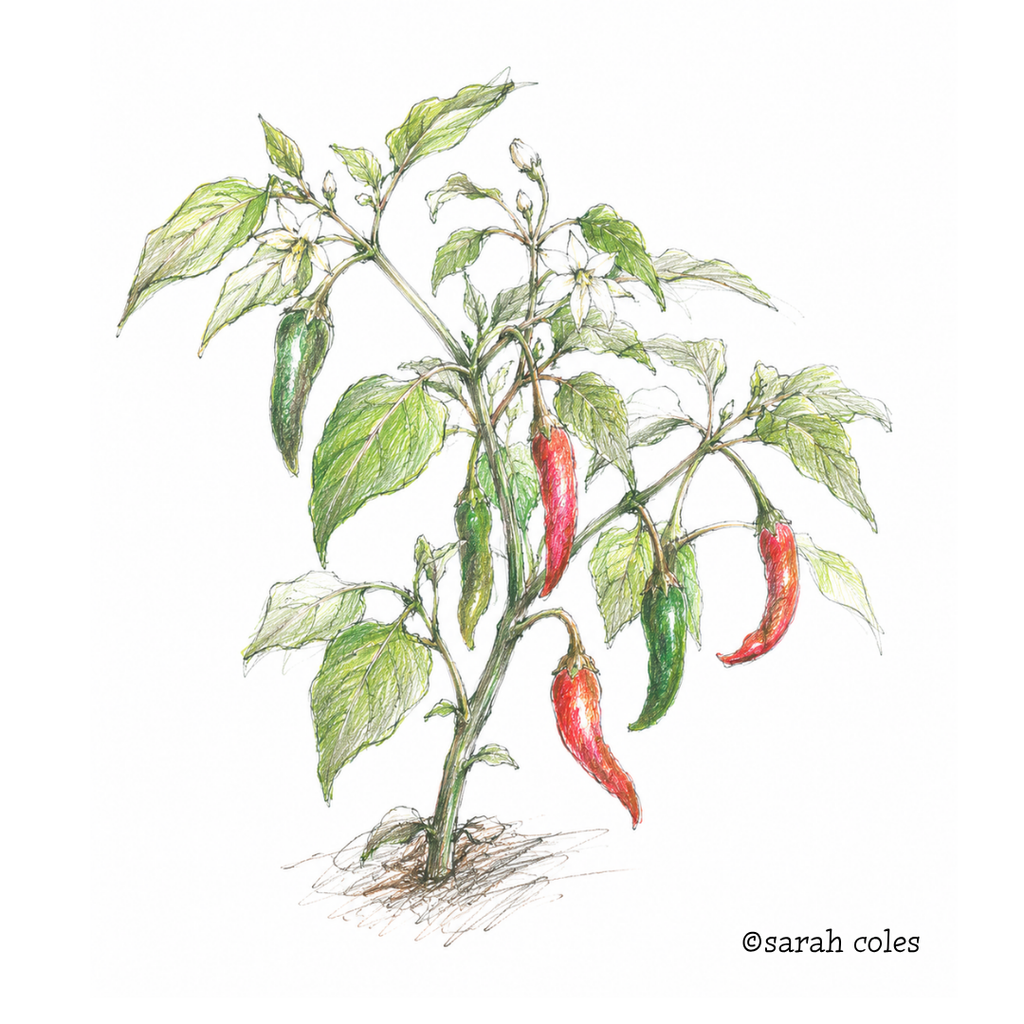
Many begin green and gradually ripen to red, orange, yellow, purple or another mature colour according to the cultivar.
You don’t always need to wait.
Green chillies are perfectly usable, and harvesting some fruits while green can encourage the plant to continue flowering and producing more.
Allowing fruits to mature fully on the plant generally gives them a richer flavour and, in many cultivars, greater heat. But leaving lots of early fruits to ripen can slow the production of further flowers and reduce the total number harvested.
So there is a choice.
Pick young for quantity, or leave selected fruits to ripen fully for their mature flavour and colour.
A mixture of the two often gives the best of both worlds.
What to do with your chilli harvest
By late summer, a successful plant can leave you wondering what on earth to do with so many chillies.
Fortunately, they’re wonderfully easy to preserve.
Thin-walled varieties such as cayenne types can be dried and stored whole or ground into flakes or powder. Many chillies freeze well too, making it possible to take one from the freezer whenever a recipe needs some warmth.
They can also be pickled or turned into sauces and relishes.
And, of course, some are best eaten straight from the plant – although perhaps with a little caution if you’ve forgotten which variety you planted.
When handling very hot chillies, wearing gloves is sensible. Capsaicin can remain on the skin and is particularly unpleasant if transferred to the eyes.
What should you do if a chilli is too hot?
The instinctive response is often to reach for a glass of water.
Unfortunately, that isn’t especially effective.
Capsaicin doesn’t dissolve readily in water, so a cold drink may provide momentary relief without doing much to remove it from the mouth.
Milk or yoghurt can be more helpful. Dairy products contain proteins, including casein, which can help remove capsaicin from receptors in the mouth.
Starchy foods such as bread or rice may also make the experience more manageable by physically helping remove or dilute some of the capsaicin.
Mostly, though, the best solution is the simplest one: know roughly how hot the chilli is before taking an heroic bite.
Are chillies good for you?
Chillies can certainly be part of a healthy, varied diet.
Fresh chilli peppers provide useful nutrients, including vitamin C, and capsaicin has attracted considerable scientific interest for its biological effects.
It is sensible, however, not to turn that into claims that eating hot food will automatically boost metabolism, lower cholesterol or extend life.
Research has found associations between chilli consumption and various health outcomes, and capsaicin has recognised medical uses – including in some topical pain-relief treatments – but nutrition and human health are considerably more complicated than a single ingredient.
For the gardener, there’s a simpler reason to grow them.
They’re delicious.
Five chillies worth growing for the kitchen
If you’re choosing your first packet of seeds, it can help to start with the way you like to cook.
Jalapeño is a good all-rounder. Its moderate heat and thick flesh make it useful fresh, stuffed, pickled or added to salsas.
Cayenne produces long, slender fruits particularly well suited to drying. Once completely dry, they can be kept whole or ground for use through winter.
Poblano is relatively mild with a rich, earthy character. When dried, the ripe form is known as ancho – a useful distinction if you’ve ever wondered why recipes seem to use both names.
Habanero is considerably hotter, but heat isn’t its only attraction. Its fruity, aromatic flavour makes it excellent in sauces and salsas when used carefully.
Scotch bonnet has similarly formidable heat and a distinctive fruity character closely associated with Caribbean cooking.
There is no single ‘best’ chilli.
The right one is the variety that suits your garden, your kitchen and your appetite for heat.
Common chilli-growing mistakes
Most disappointing chilli crops come down to a handful of fairly simple problems.
Starting too late leaves plants racing against autumn before their fruits have had time to ripen.
Not providing enough light produces weak, stretched growth and poor cropping.
Putting plants outside too soon can check their growth just as the season is beginning.
Letting pots dry out repeatedly can cause stress and flower-bud drop.
Overwatering is equally unhelpful, particularly when plants are young or conditions are cool.
And assuming every chilli needs pruning can unnecessarily delay a crop in an already short British growing season.
Give plants warmth, light, steady moisture and enough time, and much of the rest takes care of itself.
A little heat from the garden
Perhaps the most enjoyable thing about growing chillies is that the harvest never feels entirely predictable.
For months you nurture a small green plant. Then the flowers appear, followed by tiny fruits. Slowly they swell, change colour and develop the flavours – and heat – determined by their variety and growing conditions.
Eventually comes the moment when you pick one.
Perhaps it becomes a gentle warmth running through a supper. Perhaps it is dried and saved for a dark winter evening. Or perhaps you discover, rather abruptly, that the seed packet wasn’t exaggerating.
Either way, there is something deeply satisfying about adding heat to a dish from a plant you’ve raised yourself.
And when January comes around again, with the garden quiet and spring still some way off, there are those seed packets waiting.
A small promise of summer – and perhaps just a little fire – on the windowsill.
Grow Chillies with SowItGrowItandFeast!
Further Reading: My Garden Journal & Notes
