


There is something rather appealing about gardening by the Moon. Long before weather apps, growing guides and carefully printed planting calendars, gardeners looked to the natural world for signs of when to sow, plant and harvest. The Moon, with its dependable cycle and changing appearance, was one of the most obvious markers.
For generations, people have observed the relationship between the Moon, tides, seasons and the rhythms of life. This led to various traditions around lunar gardening – choosing particular times to sow, plant, prune or harvest according to the phase of the Moon.
Today, gardening by the Moon remains an intriguing practice. Some gardeners follow lunar calendars closely, while others simply enjoy using the Moon as another way of connecting with the natural rhythms of the garden.
But what do we actually know about lunar gardening? Does the Moon really affect plants, and can planting according to its phases improve your crops?
The answer is a little more nuanced than some gardening calendars suggest.
What is gardening by the Moon?
Gardening by the Moon is the practice of timing gardening activities according to the phases of the lunar cycle.
The traditional idea is that the Moon’s changing gravitational influence, together with its effect on water, somehow influences the movement of moisture within the soil and plants. According to some lunar gardening traditions, the waxing Moon is associated with increasing growth above ground, while the waning Moon is linked with root development and harvesting.
Different traditions use slightly different rules, so there isn’t one universal system of lunar gardening.
Some calendars concentrate on the four main phases of the Moon, while others take into account the Moon’s position among the zodiac signs. This latter approach is sometimes referred to as biodynamic gardening or lunar-sidereal gardening, although biodynamic agriculture is a much broader system with its own principles and preparations.
It is worth separating tradition from established horticultural science. There is no strong scientific evidence that sowing seeds according to the Moon’s phase consistently produces better germination, larger crops or healthier plants. The Moon certainly has measurable effects on Earth – most obviously through the tides – but that doesn’t mean that its phase determines when a vegetable seed should be sown.
That doesn’t make lunar gardening worthless, however. It can be an enjoyable gardening tradition and a useful prompt to observe the garden more closely.
Understanding the phases of the Moon
The lunar cycle takes approximately 29.5 days from one new Moon to the next. We commonly divide it into four principal phases:
New Moon – the Moon is positioned between the Earth and the Sun, so the illuminated side is facing away from us.
First Quarter – roughly a week later, half of the Moon’s visible face is illuminated.
Full Moon – the Earth lies between the Sun and Moon, and the Moon’s visible face is fully illuminated.
Last or Third Quarter – another week or so later, the Moon appears half illuminated again, before moving towards the next new Moon.
Between these main stages are the waxing and waning periods. A waxing Moon is increasing in apparent illumination, while a waning Moon is decreasing.
These changing phases are the foundation of most lunar gardening calendars.
What does a waxing Moon mean for the garden?
Traditional lunar gardening generally associates the waxing Moon with increasing energy and growth.
The period between the new Moon and full Moon is therefore often considered a favourable time for sowing and planting crops that produce their harvest above ground.
Depending on the particular lunar gardening tradition, this might include:
- Lettuce and other salad leaves
- Peas and beans
- Spinach and chard
- Brassicas
- Tomatoes
- Courgettes
- Cucumbers
- Flowers grown for their blooms
The underlying traditional belief is that as the Moon grows, so too does the upward movement of moisture and plant energy.
There is an attractive logic to this idea, but it is important not to present it as a proven horticultural rule. Seed germination and plant growth are influenced far more clearly by factors such as temperature, moisture, light, soil conditions and the needs of the individual plant.
So if your seed packet says that peas can be sown when the soil has warmed sufficiently, that practical advice should take precedence over the lunar calendar.
What about the waning Moon?
As the Moon moves from full towards new, it is said to be waning.
Traditional lunar gardening associates this period with activity below ground and is therefore often considered a good time for root crops such as:
- Carrots
- Beetroot
- Parsnips
- Radishes
- Turnips
- Potatoes
- Onions and garlic
Harvesting is also sometimes recommended during the waning Moon, particularly for crops that will be stored.
Again, this is part of the tradition rather than a horticultural certainty. The best time to harvest a crop is usually determined by its maturity, the weather and how you intend to use or store it.
A carrot pulled from the ground at the right stage of development will be ready to eat whether the Moon is waxing or waning.
Does the Moon really affect plants?
This is where lunar gardening becomes particularly interesting.
The Moon unquestionably affects the Earth. Its gravitational pull is responsible for the rise and fall of ocean tides, and these effects are particularly noticeable because the oceans contain such enormous quantities of water.
Plants contain water, of course, but the scale is very different. There is currently no convincing evidence that the Moon’s changing phases cause a significant enough movement of water within plants or garden soil to dictate when crops should be sown.
There have been studies looking at possible relationships between lunar cycles and biological activity, including plant growth and germination. However, evidence is inconsistent and doesn’t establish lunar planting calendars as a reliable method for improving garden yields.
In practical gardening terms, soil temperature, rainfall, daylight, frost, seed quality and the requirements of each plant are much more important considerations.
That distinction is useful. It means you can enjoy lunar gardening without having to choose between tradition and good horticultural practice.
Gardening by the Moon and the seasons
Perhaps the most useful way to approach lunar gardening is to place it within the much bigger picture of seasonal gardening.
The Moon follows its own cycle, but plants respond strongly to the changing seasons.
A warm spring day may tempt you to sow beans, but if the soil is still cold and wet, germination may be poor. Likewise, a lunar calendar might suggest planting out tender vegetables, but a late frost could cause considerable damage.
This is why experienced gardeners learn to read several signs at once.
Look at the soil. Watch the weather. Consider the lengthening days. Pay attention to what plants are doing around you. Then, if you enjoy following the Moon, let its cycle become another part of your gardening calendar.
There is something rather pleasing about working with several natural rhythms rather than relying on a date printed on a calendar.
Don’t ignore the weather
A lunar gardening calendar should never override common sense.
Weather is one of the most important factors governing successful gardening. Seeds need the right conditions to germinate, young plants need protection from frost and established crops need sufficient water and light.
If heavy rain has left the soil saturated, it is better to wait before sowing or planting, even if your chosen lunar calendar says it is the ideal day.
Similarly, if a dry spell is forecast, newly planted crops may need watering and protection regardless of the Moon’s phase.
Gardening has always involved a certain amount of observation and flexibility. Nature rarely follows a timetable perfectly.
Use the Moon as a reason to observe your garden
One of the nicest aspects of lunar gardening is that it encourages us to look up from our everyday gardening jobs.
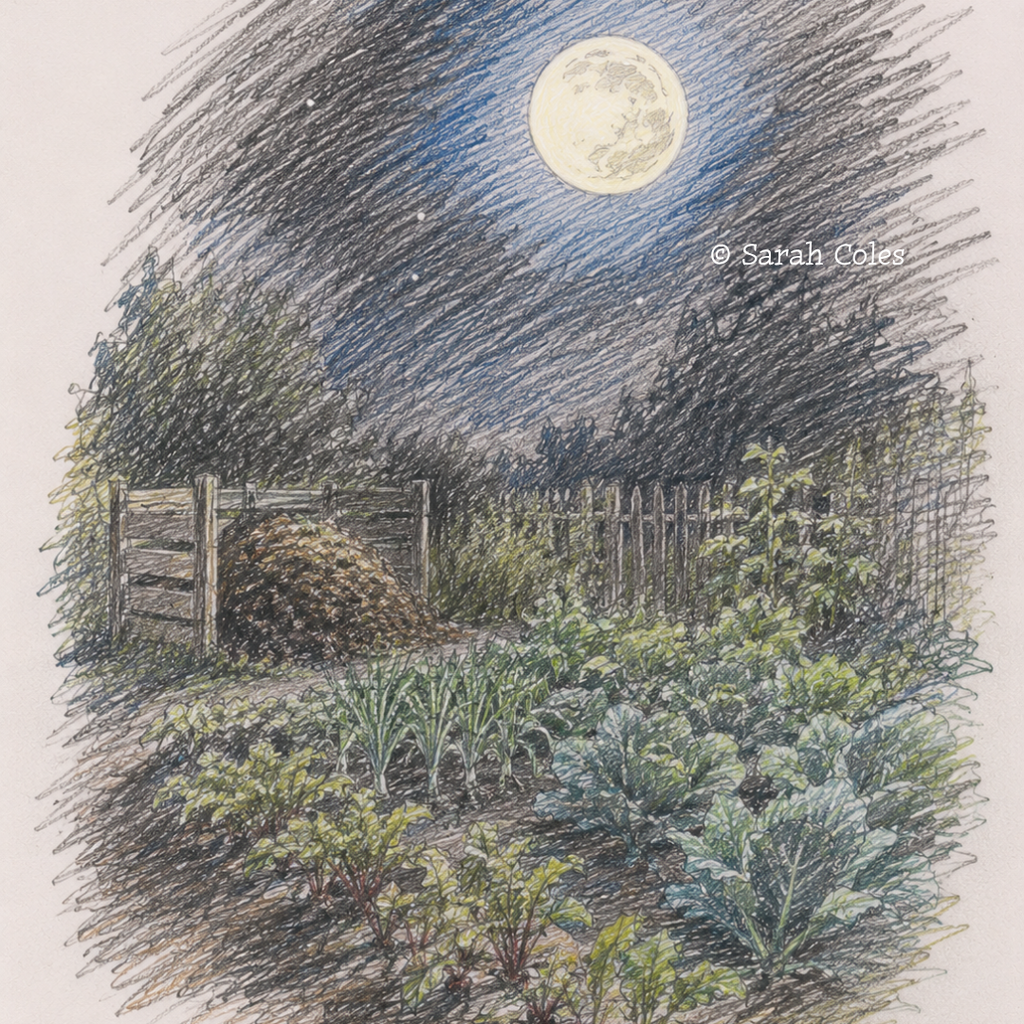
Take a moment to notice the Moon when you are outside in the evening. Watch how it changes from a fine crescent to a bright full disc and back again. Notice how different the garden feels beneath a clear full Moon compared with a dark night.
You might even keep a lunar gardening journal.
Record when you sow seeds, when they germinate, when plants flower and when crops are ready to harvest. Note the weather and soil conditions alongside the phase of the Moon.
Over time, you will build up something far more interesting than a generic lunar planting chart: your own record of how your garden behaves.
If you notice that certain crops consistently perform well when sown at a particular time, investigate why. Perhaps the Moon is part of the story, but perhaps the real reason is that the soil had reached the right temperature or the weather happened to be settled.
That process of observation is at the heart of good gardening.
A simple lunar gardening calendar
If you would like to experiment with gardening by the Moon, you don’t need to change your entire approach.
You could start with a simple system:
New Moon to First Quarter: traditionally associated with sowing leafy and above-ground crops.
First Quarter to Full Moon: traditionally associated with vigorous above-ground growth and planting crops that produce fruit and seed above the soil.
Full Moon to Third Quarter: traditionally associated with harvesting and planting crops where the root is the main harvest.
Third Quarter to New Moon: traditionally considered a quieter period, suitable for garden maintenance, weeding, pruning and preparing the soil.
These are traditional interpretations rather than scientifically established rules, so use them as a framework for observation rather than a strict set of instructions.
What should you actually use to decide when to sow?
For reliable results, start with the plant itself.
Seed packets and reputable growing information will usually tell you when a crop can be sown, whether it prefers direct sowing or protection under glass, and what conditions it needs.
Then consider your own garden.
A sheltered garden may warm earlier in spring than an exposed plot. Heavy clay soil behaves differently from a light sandy soil. A sunny raised bed can become productive earlier than a shaded corner.
And every season is different.
This is why gardening is as much an art of observation as it is a collection of instructions.
Can gardening by the Moon be sustainable?
It can certainly sit comfortably alongside sustainable gardening practices.
Whether or not you believe the Moon influences plant growth, paying attention to natural cycles can encourage a slower, more observant approach to gardening.
Combine lunar gardening with practices that have clear benefits for the garden, such as:
- Making and using homemade compost
- Improving soil with organic matter
- Saving seed where appropriate
- Growing plants suited to your conditions
- Collecting rainwater
- Encouraging pollinators and other wildlife
- Rotating vegetable crops
- Avoiding unnecessary chemicals
- Growing some of your own food
The garden doesn’t need to be perfectly managed to be productive. In fact, allowing some space for wildlife, fallen leaves and natural processes can make it a much richer place.
Gardening by the Moon: tradition, observation and a little magic
There is a reason lunar gardening has remained part of gardening folklore for so long. The Moon is a constant presence in our skies, and its cycle provides a natural rhythm against which we can mark the passing weeks.
We should be careful not to confuse an old tradition with established scientific fact. There isn’t good evidence that planting according to the Moon will automatically produce bigger harvests or healthier plants.
But gardening isn’t only about yields.
There is value in noticing the changing light, keeping track of the seasons and becoming more attentive to the natural world around us. If following the Moon encourages you to spend more time observing your plants, keeping records and understanding the rhythms of your garden, then it has something worthwhile to offer.
So by all means, look up at the Moon before you sow your next row of seeds. Just remember to look down at the soil, too.
The Moon may provide the rhythm, but good soil, suitable conditions and attentive gardening are what really help a garden flourish.
Further Reading: My Garden Journal & Notes
