


After a scorching summer, the garden and I had reached an unspoken agreement: I wouldn’t bother it, and it wouldn’t remind me how much work needed doing.
Then the weather changed. A few properly wet days softened the ground, revived the grass and persuaded everything to look green again. When the forecast promised a warm, dry weekend, I knew my reprieve was over. It was time to go outside and restore some order.
There was, I confess, another reason for my sudden enthusiasm.
Nearly two weeks earlier, my husband had bumped into one of our neighbours while out walking. During their conversation, the neighbour casually asked:
“Has Sarah decided to give up on the garden, then?”
The comment had been quietly eating away at me ever since.
A useful garden—and usually a pretty one
I like to think I present a nice garden. In fact, I aim for something more than nice: a garden that is both useful and pretty, loosely inspired by the traditional potager, where vegetables, herbs and flowers happily share the same beds.
Over the past few years, however, my priorities have changed. I have been trying to garden more sustainably and create space for wildlife. I want the garden to give something back—to the soil, the insects, the birds and, in its own modest way, the planet.
This has required me to tolerate rather more disorder than comes naturally.
My neighbour’s garden features plants planted in obediently straight lines and gnomes standing to attention at every fence post. I have occasionally revelled in the thought of him peering over at my wildlife-friendly “mess” with a scowl on his face. It gave him something else to moan about.
But if I’m honest, my approach to wild gardening has always been rather controlled. I want to help the insects, certainly—but preferably within clearly defined boundaries and with reasonably tidy edges.
I frequently have to fight the urge to rush outside and straighten everything. It is much like resisting a piece of cake: possible in theory, but requiring an exhausting amount of inner negotiation.
The great garden tidy-up begins
This weekend was going to be different. I would tackle the dried grasses and seed heads, harvesting the best ones for Christmas decorations and clearing away the rest. By lunchtime, I imagined, the garden would once again suggest that somebody responsible lived here.
Armed with my tools, I began cutting.
Almost immediately, I heard a loud hum.
At first, I assumed it was coming from somewhere else. Then I stopped and looked more closely.
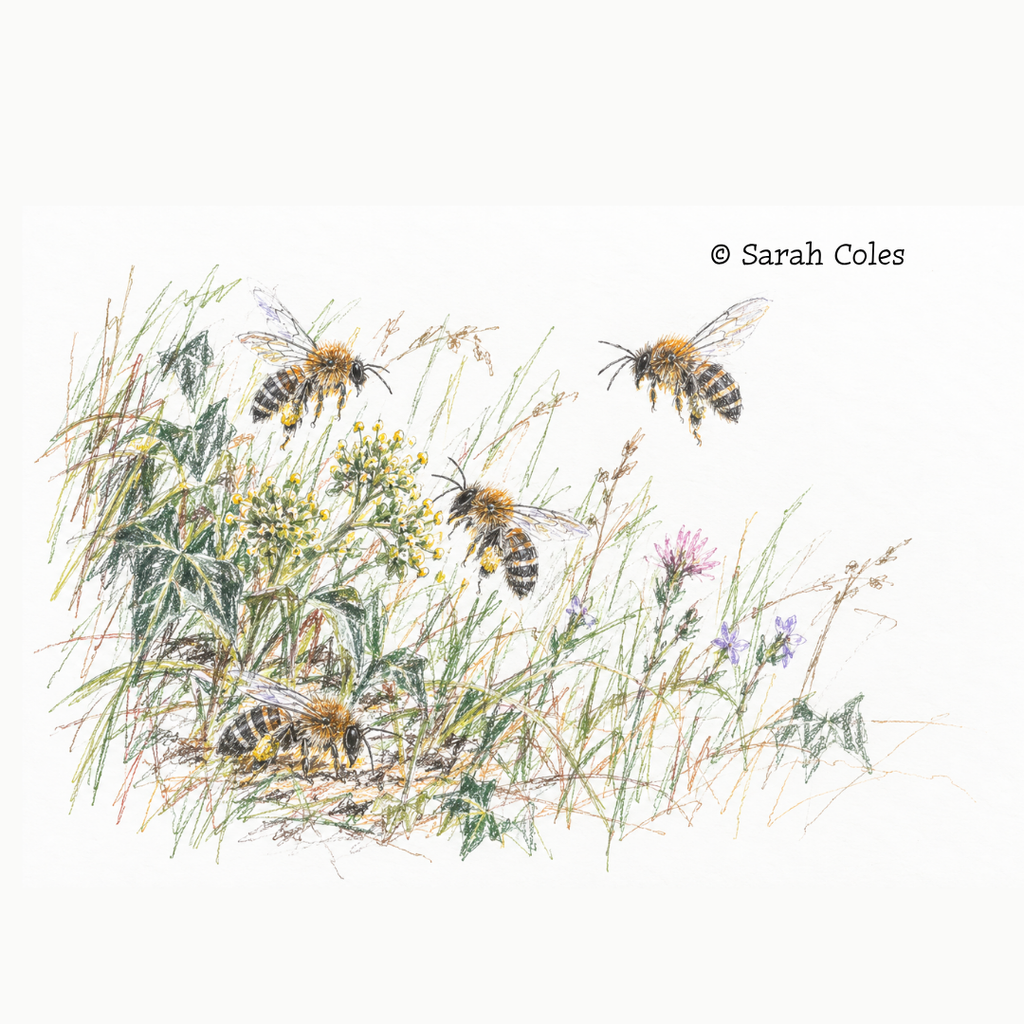
The whole plot was alive with bees.
There were hundreds of them, flying just above the ground in a hurried, bustling cloud. Yet they weren’t aggressive or particularly interested in me. They were gentle bees, entirely occupied with their own affairs, weaving among the grasses as though running very late for a series of important appointments.
I put down my tools.
After much observation, filming, photographing and research, they appear to be ivy bees (Colletes hederae).
Meet the ivy bees
Ivy bees are solitary, ground-nesting bees that emerge towards the end of summer, usually from late August or early September. Despite being described as solitary, they often build their individual nests close together, creating large nesting aggregations.
In other words, they live independently—but they appreciate good neighbours. Perhaps there is a lesson in that.
The lively cloud above the ground is likely to consist mainly of male ivy bees waiting for females to emerge from their burrows. The males cannot sting, while the females are extremely docile and unlikely to sting unless badly handled.
Their ginger-brown thoraxes and neatly banded abdomens make them look a little like small honeybees. Ivy provides an important source of late-season pollen, although the bees also need suitable, undisturbed ground in which to nest.
Without meaning to, my untidy patch had given them exactly that.
Officially excused from gardening
Naturally, I took this discovery as permission to abandon the entire tidy-up.
It would have been irresponsible to continue. Positively anti-environmental, in fact. I had no option but to spend the rest of the day at leisure while the bees carried on with the important business of being bees.
I had been let off the hook.
Had I continued, I might have ended up like Mr Fussy from one of my favourite childhood books, attempting to make the garden perfectly neat and—if memory serves—straightening individual blades of grass.
I have never quite gone that far. However, I have spent a ridiculous amount of money over the years on lawn treatments, worrying about the precise shade of green and whether the stripes were perfectly straight.
Now, a patch I had been feeling guilty about neglecting was supporting hundreds of pollinators.
That feels like progress.
How gardening advice has changed
The experience made me think about how dramatically gardening has changed during my lifetime.
When I studied for my Royal Horticultural Society qualifications at Hadlow College in the 1990s, we were still learning about the benefits of double digging. Organic gardening occupied perhaps a couple of lectures. Much of our education involved learning which chemical should be used to solve which problem.
Today, many gardeners are moving towards no-dig methods, healthier soils, reduced mowing and fewer chemicals. We are learning to leave seed heads standing, allow fallen leaves to shelter insects and accept that a wildlife-friendly garden does not always look conventionally tidy.
I now garden without chemicals. I leave areas undisturbed and try to see spent plants not as rubbish, but as food, shelter and nesting material.
That doesn’t mean I have conquered my fondness for order. Far from it.
There is still a small Mr Fussy living inside me, clutching a pair of edging shears and looking anxiously at the long grass. He would very much like to restore the lawn stripes.
But he is gradually being outnumbered.
Learning to see the garden differently
A sustainable garden needn’t be abandoned, and it certainly doesn’t have to be unattractive. It can still contain structure, productive beds, beautiful planting and places to sit. The difference is that not every corner needs to be controlled.
Sometimes the most valuable thing we can do is leave a patch alone.
Long grass, hollow stems, dry seed heads and undisturbed soil may appear untidy to us, but to wildlife they can mean food, shelter and somewhere to raise the next generation.
My neighbour may see a garden that has been neglected. The ivy bees clearly see prime real estate.
Watching them fizzing over the ground brought me more pleasure than a flawless lawn ever did. Their arrival reassured me that my changing approach to gardening is achieving something tangible. This little patch is not merely less tidy; it is alive.
So the dried grasses will remain for now. The seed heads can wait. The garden will continue to hum, and I shall enjoy the rare satisfaction of knowing that doing nothing is the most useful job on my list.
As for the neighbour, should he ask again whether I have given up on the garden, I shall be ready with my answer:
“No. I’ve simply handed part of it over to the bees.”
Further Reading: My Garden Journal & Notes
