


There are some plants that arrive in a blaze of glory, already in flower and quite certain of their place in the garden. Wallflowers are not among them.
Bought bare-root in autumn, they tend to come in muddled bundles: a congregation of lanky stems, dangling roots and rather weary leaves. They may be tied together with an elastic band and look as though they have endured a difficult journey involving several buses and no breakfast. It takes a little imagination to see what they will become.
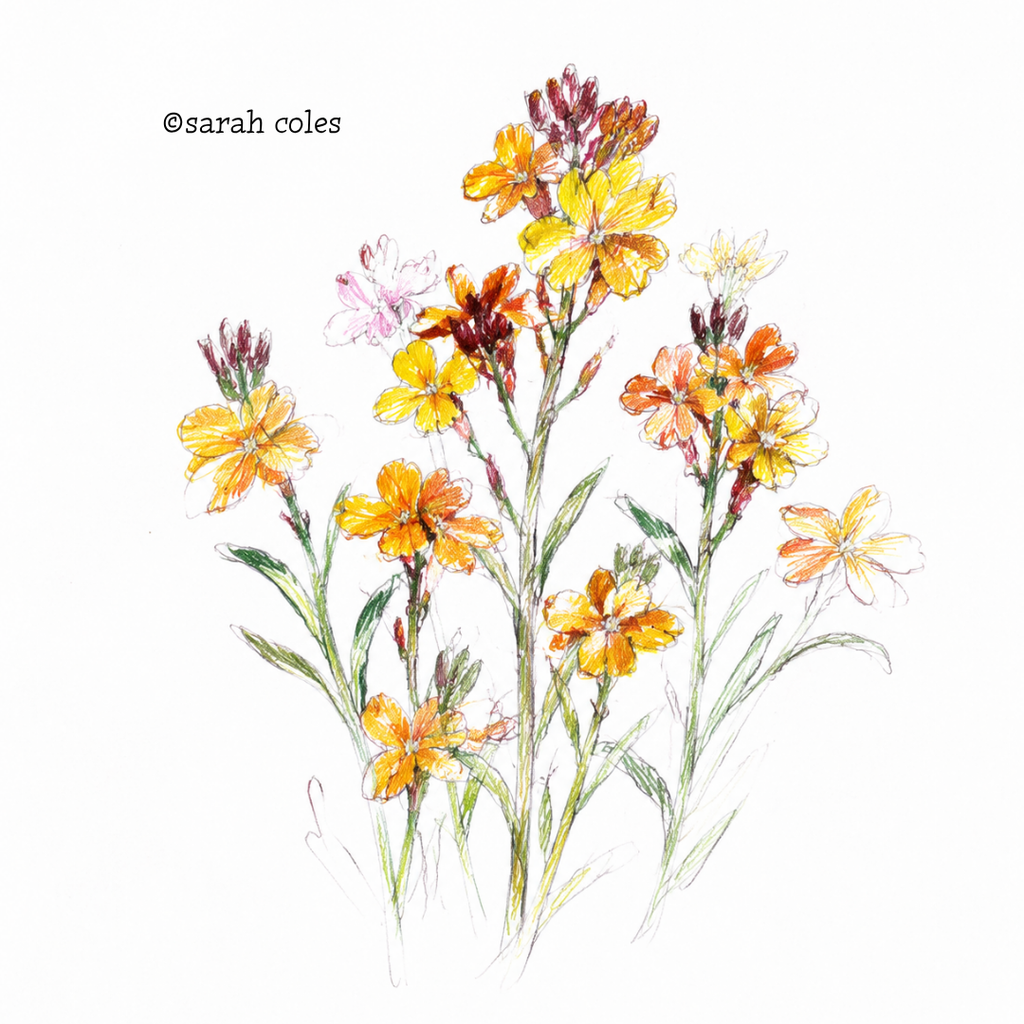
But that is part of their charm. Plant these ragged little things now and, come spring, they will be transformed. Their buds will open into velvety flowers of gold, copper, claret, cream, plum and burnt orange. On a warm day, their scent will drift across the garden. What appeared to be a bundle of horticultural washing-up will have become a box of jewels.
A flower made for walls
The common wallflower, known to generations of gardeners as Cheiranthus cheiri, is now placed in the genus Erysimum. The Royal Horticultural Society uses the name Erysimum cheiri, while Kew’s current classification gives it as Erysimum × cheiri. The small multiplication sign reflects its probable hybrid origin.
Gardeners may therefore encounter all three names in nurseries, seed catalogues and older books. Botanical names sometimes move house. Fortunately, the plants take very little notice.
Wallflowers belong to the cabbage family, Brassicaceae. Look closely at an individual bloom and the relationship becomes easier to see. Each flower usually has four petals arranged in a cross—the feature that gave the family its older name, Cruciferae.
Kew records the native range of Erysimum × cheiri as Greece, within south-eastern Europe. From there, it travelled widely as a cultivated plant. Wallflowers have been grown in Britain for centuries and were described by the herbalist John Gerard in the sixteenth century.
They escaped from cultivation and found old stonework very much to their liking. With their preference for sharp drainage, sunshine and neutral to alkaline ground, they established themselves on walls, ruins, rocky banks and other dry places. Their common name is pleasingly literal: this really is a flower of walls.
They seem entirely at home among weathered bricks and crumbling mortar, flourishing where a more cosseted plant would complain to the management. Their roots find a narrow crevice, their leaves withstand poor soil, and their flowers turn bare stone into something briefly magnificent.
The common wallflower is a short-lived, evergreen perennial or subshrub, but the familiar bedding varieties are usually grown as biennials. Seed is sown one year, the young plants grow through autumn and winter, and they flower the following spring. Many are replaced after flowering, particularly when they become woody or leggy or succumb to diseases such as clubroot.
This may sound wasteful, but it provides an excellent excuse to try another colour—and wallflower colours are dangerously collectable.
The scent of the spring garden
Wallflowers have a special talent for companionship. They are rarely aloof specimen plants, demanding an empty bed and everyone’s undivided attention. Instead, they mingle.
Plant them among tulips and they hide the tulips’ bare ankles. Deep red wallflowers bring out the dark markings of a tulip; bronze and orange varieties glow beside purple; creamy yellow sorts soften pinks and whites. They also sit happily with forget-me-nots, primroses, violas and other spring-flowering bulbs.
Their perfume is part of the pleasure: warm, sweet and slightly spicy, particularly noticeable when the sun reaches the flowers. A few stems can be cut for a small vase, although it is worth leaving plenty outdoors.
Wallflowers are included in the RHS Plants for Pollinators scheme. Their spring flowers can provide nectar and pollen for visiting insects at a time when fewer plants are in bloom.
They are useful plants for containers, too. A generous pot filled with wallflowers and tulip bulbs creates a complete spring display in very little space. Position it near a doorway or path, where the scent can be appreciated rather than dispatched to the far end of the garden.
Despite their family connection with cabbages, wallflowers are ornamental plants, not a crop for the kitchen. Members of the genus Erysimum contain cardiac glycosides as part of their natural chemical defences, so no part should be eaten. Their proper use is to feed the eye, the nose and visiting insects—which is quite enough work for one plant.
Planting bare-root wallflowers in autumn
Bare-root wallflowers are traditionally sold in autumn, while the soil is still holding some warmth. They are inexpensive and require no individual plastic pots, although their first appearance can test one’s faith.
Unwrap the bundle as soon as it arrives and plant it promptly. Bare roots must not be allowed to dry out. If planting has to be delayed, keep the plants somewhere cool and frost-free with the roots covered, or heel them temporarily into loose soil or compost.
Before planting, stand the roots in water for about 30 minutes. If they are particularly dry, they can be soaked for a little longer—but not for days. Wallflowers enjoy a drink, not a prolonged bath.
Choose an open, sunny position with well-drained soil. Wallflowers prefer neutral or alkaline conditions and are less happy in persistently wet, heavy ground. On clay soil, plant them in a raised, well-drained position or grow them in containers of free-draining compost. A little horticultural grit can improve drainage when incorporated across the wider planting area, but simply filling an isolated hole with grit or compost will not cure waterlogged ground.
Separate the plants gently. Some will be larger than others and a few may be bent, but do not dismiss the scruffier specimens too quickly. Remove only leaves that are yellow, broken or decaying.
Make a hole deep enough to accommodate the roots without bending them sharply upwards. Set the base of the stem level with the surface of the soil. Spread out the roots, return the soil and firm it carefully around them. Good contact between roots and soil matters, especially when autumn winds begin tugging at the tops.
Allow about 20cm between compact bedding wallflowers, giving taller or broader varieties more room if their label recommends it. Water thoroughly after planting, even if rain is forecast—the British weather should never be denied an opportunity to change its mind.
Watch the plants during dry spells while they establish. If frost loosens the soil around them, firm them in again once the ground has thawed. Slugs, snails and flea beetles may investigate, and wallflowers can also be affected by clubroot, downy mildew and other diseases. Well-drained soil and healthy young plants give them the best start.
Then comes the difficult part: leaving them alone. Through winter they may remain unremarkable, a row of green rosettes quietly holding their ground. Beneath that modest exterior, however, spring is being prepared.
Growing wallflowers from seed
Growing wallflowers from seed requires a little more patience but offers a wide choice of colours and a satisfying number of plants for very little expense.
Traditional biennial bedding wallflowers are commonly sown between late spring and late summer, with May to July being usual for many varieties. Sowing instructions vary, however, so follow the directions on the seed packet. The young plants are raised through summer and planted in their flowering positions in late summer or autumn.
They can be sown in a prepared seedbed outdoors or in pots and trays filled with seed compost.
For an outdoor seedbed, choose a patch of fine, weed-free soil in sun or light shade. Make shallow drills, sow the seeds thinly and cover them lightly with soil. Water with a fine rose so that the seeds are not washed into one rather crowded corner. Keep the ground moist while they germinate.
Once the seedlings are large enough to handle, thin them so they have room to develop. When they have made sturdy young plants, lift them carefully and move them to their flowering positions. Water them well after the move.
If sowing in trays or pots, cover the seed only lightly and keep the compost moist but not sodden. Prick the seedlings out when they are large enough to handle, holding them by a leaf rather than the delicate stem. Grow them somewhere bright and airy, then gradually accustom them to outdoor conditions before planting.
Choose an open position rather than a dark or overly sheltered corner. Compact, sturdy plants cope with winter better than soft, drawn ones. Wallflowers thrive in poor to moderately fertile soil and rarely require generous feeding. Too much fertiliser encourages leafy growth when what we really want is flowers.
Seed-raised plants may produce small surprises. A packet described as a mixture can result in colours that are difficult to predict while the plants are young. This makes planting rather like arranging a room in the dark, but the spring reveal is all the more enjoyable.
Small plants, long memories
Wallflowers have never been especially fashionable. They belong to an older rhythm of gardening: sowing in summer, transplanting in autumn and waiting through winter for the result. They are associated with cottage plots, walled gardens, municipal bedding and the spring borders of houses visited year after year.
Yet there is something timely about them. Bare-root plants require less packaging than individually potted ones. They are affordable, resilient and generous. They ask us to look beyond present appearances and trust in what roots, soil and time can accomplish together.
So do not be discouraged by the bundle. Unfasten it, tease apart the roots and give each unpromising plant a place in the earth. They may look half dead. They may lean. One may possess only three leaves and the air of having mislaid its luggage.
Plant them anyway.
In spring, when the low sun catches their petals and the first breath of their perfume reaches the path, they will repay that small act of faith—ragged autumn waifs turned, almost overnight, into jewels.
Further Reading: My Garden Journal & Notes
