


There are few sights in the kitchen garden quite as cheering as the first rhubarb of the year.
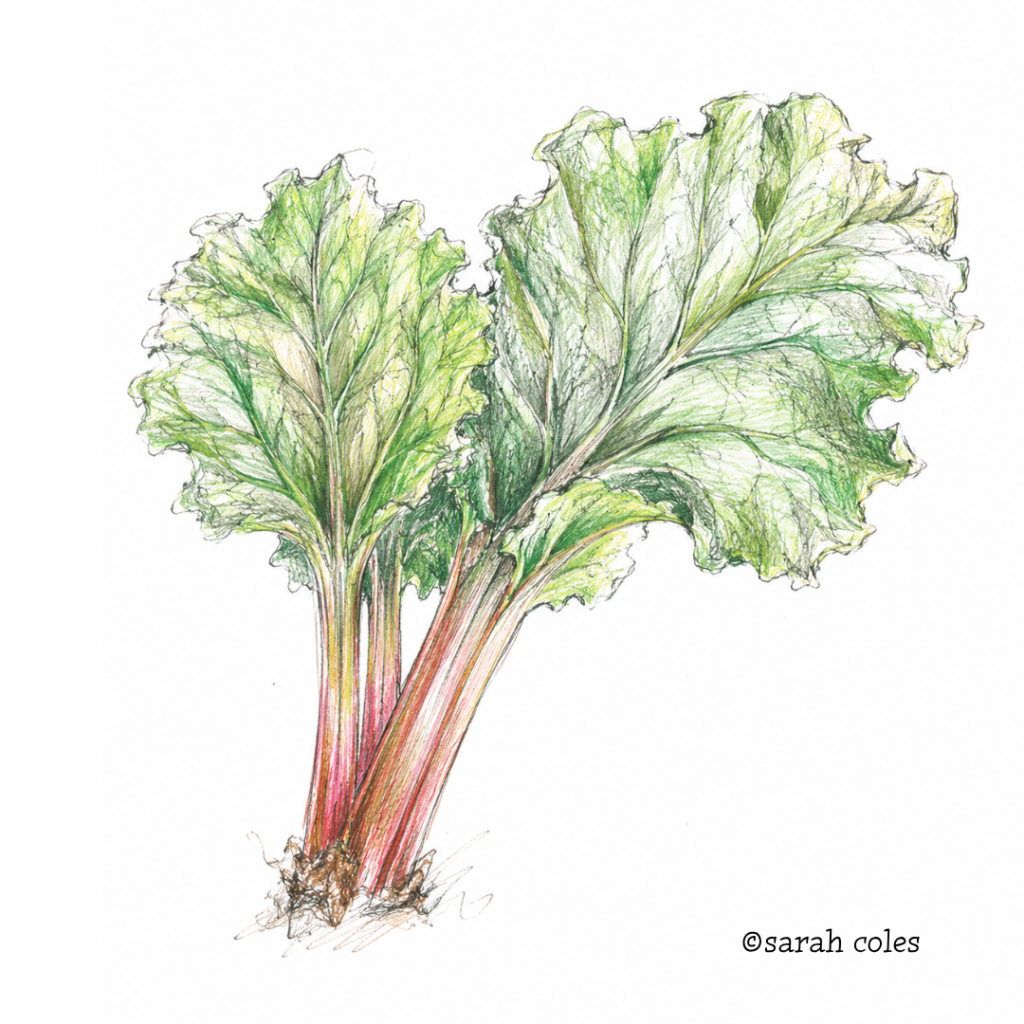
After spending winter apparently asleep beneath the soil, the crowns begin to stir. Tightly folded leaves push upwards, slowly unfurling into great green fans above thick, succulent stalks. Depending on the variety and growing conditions, these can range from fresh green flushed with pink to a glorious deep red.
For many gardeners, it’s one of the unmistakable signs that the growing year has begun.
Rhubarb has long earned its place in British gardens. Hardy, generous and remarkably long-lived, an established crown can provide harvests for many years. Technically a vegetable but treated almost invariably as a fruit in the kitchen, its sharp stalks have become inseparable from crumbles, pies, jams, fools and compotes.
But every armful of rhubarb presents the gardener with a question.
What should you do with all those enormous leaves?
They can’t go into the crumble. Rhubarb leaves are harmful if eaten and should never be used as food. But that doesn’t necessarily make them waste.
In fact, one of the simplest and most useful things we can do with them is return them to the garden from which they came.
First things first: can you eat rhubarb leaves?
No. Rhubarb leaves should not be eaten.
The stalks – more accurately called leaf stalks or petioles – are the edible part we harvest. The broad leaf blades should be removed and kept out of the kitchen.
Rhubarb leaves contain relatively high concentrations of oxalic acid as well as other compounds, and eating them can be harmful.
That distinction is worth remembering, particularly if children are helping with the harvest: stalk for the kitchen, leaf for the compost heap.
There is no need to become alarmed by the plant itself. Rhubarb has been grown safely in gardens for generations. Simply treat the leaves as you would any other potentially harmful garden plant: don’t eat them, wash your hands after handling them and wear gloves if you have sensitive skin.
Put rhubarb leaves on the compost heap
This is perhaps the best use of all.
There is a persistent gardening myth that poisonous rhubarb leaves will somehow make compost poisonous. Fortunately, that isn’t the case.
Rhubarb leaves can safely be added to a garden compost heap. During decomposition, the oxalic acid they contain breaks down.
Their sheer size also makes them satisfying composting material. A few enormous leaves can look rather formidable when first added, so tearing or chopping them into smaller pieces will help them collapse and decompose more quickly.
Mix them with a variety of other compostable material rather than adding a great dense layer of leaves all at once. Combine softer green material with drier, more fibrous ingredients such as twiggy prunings, shredded cardboard or dry stems.
Then leave the organisms in the compost heap to do what they do best.
There is a pleasing circularity to it. A rhubarb crown draws nutrients from the soil to produce its magnificent foliage; we take the stalks for the kitchen, compost the unwanted leaves and eventually return the finished compost to the garden.
Nothing complicated. Very little wasted.
Use the leaves as temporary ground cover
If the compost bin is already overflowing, those huge leaves have another simple use.
Lay freshly removed rhubarb leaves directly over bare soil as a short-lived organic covering.
They won’t make a permanent mulch – soft rhubarb foliage wilts and decomposes fairly rapidly – but that is part of their usefulness. The leaves cover the soil for a while, then gradually break down and become incorporated into its surface.
Large leaves can also be laid over small patches of annual weeds after weeding or used around established ornamental plants where appropriate.
Think of them less as a long-lasting mulch and more as composting in situ.
As with any fresh plant material, don’t heap thick, wet layers directly against the crowns or stems of plants, where stagnant conditions could encourage rotting. A loose layer over open ground is enough.
And if a rhubarb plant is diseased or badly affected by a problem you don’t recognise, don’t automatically spread its foliage around the garden. Healthy leaves are the ones to reuse.
Turn a rhubarb leaf into a garden cast
Before consigning every leaf to the compost heap, take a moment to turn one over.
The underside is surprisingly beautiful.
Strong veins radiate through the leaf, branching into increasingly delicate networks towards the edge. What looks from above like an enormous green umbrella becomes, underneath, an intricate natural pattern.
This makes rhubarb particularly good for making leaf casts.
A fresh leaf can be laid vein-side upwards over a gently shaped mound of sand and used as a mould for an outdoor casting material. Once the cast has cured and the leaf is peeled away, its network of veins remains impressed in the surface.
The resulting cast can become a decorative garden dish, bird-water dish or simply an ornament tucked among plants.
It is one of those garden projects that encourages you to look at a very familiar plant differently. Suddenly the leaf you normally remove and discard becomes a ready-made mould, complete with a pattern no human hand could quite reproduce.
If creating a water dish for wildlife, keep it shallow, provide an easy way for small creatures to climb out, and avoid finishes that could be harmful to wildlife.
Experiment with rhubarb leaves for natural dyeing
Garden plants have been used to colour fibres for centuries, and rhubarb leaves offer an interesting material for anyone curious about natural dyeing.
This is best approached as an experiment rather than a recipe with a guaranteed result.
Natural dyes are wonderfully unpredictable. The colour obtained can change according to the fibre being dyed, the mineral content and pH of the water, the preparation of the material and any mordant used. Even two batches of leaves from the same garden need not produce precisely the same shade.
And that is part of the pleasure.
A dye pot becomes a small experiment in garden chemistry, producing subdued botanical tones rather than the uniform colour we expect from commercial dyes.
Because rhubarb leaves contain oxalic acid and are not edible, use equipment kept specifically for dyeing rather than saucepans and utensils that will later be used for cooking. Wear gloves, work in a well-ventilated place and dispose of the spent material responsibly.
What about cleaning pans with rhubarb leaves?
This is one of the more curious traditional uses associated with rhubarb.
Oxalic acid has genuine cleaning properties and is used commercially in some cleaning and rust-removal products. This probably explains the long-standing idea of using rhubarb leaves to help clean stained metal.
But there’s an important distinction between recognising the chemistry and recommending that gardeners boil poisonous leaves in their everyday cooking pans.
For that reason, I wouldn’t suggest making rhubarb-leaf cleaning liquid in kitchen equipment.
If the aim is simply to avoid wasting the leaves, the compost heap is safer, easier and ultimately more useful to the garden.
Sometimes an old-fashioned use is interesting as part of a plant’s story without necessarily being something we need to revive.
Should you make rhubarb-leaf insecticide?
Recipes for homemade rhubarb-leaf sprays have been passed between gardeners for years. They usually involve boiling or steeping the leaves in water and applying the resulting liquid to plants as an insecticide.
It’s one tradition I’d leave in the past.
The fact that a substance is natural doesn’t automatically make it harmless. Rhubarb leaves contain biologically active compounds, and homemade preparations have no standard concentration, application rate or established instructions for safe use.
There are better ways to deal with most garden pests.
Aphids can often be tolerated in small numbers, squashed by hand or dislodged where practical. Healthy gardens also attract their own pest controllers: ladybirds, hoverflies, lacewings and birds all feed on insects that gardeners might otherwise regard as troublesome.
Rather than turning rhubarb leaves into a pesticide, put them on the compost heap and let them become part of the garden’s cycle.
Don’t remove too many leaves while harvesting
Making good use of rhubarb leaves begins with harvesting the plant properly.
Once an established crown is ready for picking, choose a good-sized stalk and grasp it close to the base. Pull and twist gently so that the whole stalk comes away from the crown.
Avoid simply cutting stalks and leaving short stumps behind, as these can be prone to rotting.
Then cut off the leaf and take the stalk into the kitchen.
It can be tempting, when faced with a particularly vigorous rhubarb plant, to strip it enthusiastically. Resist.
Those enormous leaves aren’t there simply to make the plant look impressive. They are its solar panels, capturing the light it needs to replenish the crown beneath the soil.
Newly planted rhubarb shouldn’t normally be harvested in its first year. Harvest lightly in its second, then more normally once the crown is well established. Even then, don’t remove all the stalks at once. Leaving plenty of healthy foliage allows the plant to continue feeding itself and building reserves for the following year.
Towards the end of the growing season, let the remaining foliage die back naturally.
The surprisingly long life of a rhubarb crown
Perhaps this is why rhubarb feels so at home in an old garden.
It asks us to think beyond a single season.
A lettuce is sown, harvested and gone. A row of peas comes and goes within a summer. But a well-grown rhubarb crown can occupy the same patch of ground for ten years or more, becoming one of the permanent characters of the kitchen garden.
In winter, there may be almost nothing to see.
Then spring returns and so does the rhubarb.
Its success depends partly on those leaves we so readily regard as a by-product. Through spring and summer they gather energy, sustaining the crown below ground and preparing it for another year.
Once they have done their work, we can return them to the compost heap, where fungi, bacteria and countless small organisms begin another transformation.
Months later, what was once a leathery green rhubarb leaf is no longer recognisable. It has become dark, crumbly organic matter ready to feed the soil.
Making the most of the whole plant
There is a temptation in gardening to divide everything neatly into two categories: useful and useless.
The strawberry is useful; its old leaves are waste. The pea is useful; its spent vines are waste. The rhubarb stalk goes into the kitchen; therefore the leaf must go in the bin.
A garden rarely works quite like that.
Plants grow, we harvest them, and what remains can often begin another cycle. Stems become compost. Leaves cover bare soil. Prunings provide habitat. Finished compost feeds another generation of plants.
Rhubarb leaves are a particularly good reminder of this.
They may never belong in a pie or crumble, but that doesn’t make them useless. Tear them up for the compost heap, let them break down on bare soil, capture their extraordinary veins in a garden cast or experiment with them as a natural craft material.
Or simply stand for a moment and admire them before they go.
After all, those great green leaves have spent the season doing exactly what the garden needed them to do.
And when their work is finished, the most natural thing of all is to give them back.
Further Reading: My Garden Journal & Notes
