


As autumn settles over the garden, it can feel as though the growing year is drawing quietly to a close. Leaves gather beneath trees, borders soften and daylight slips away a little earlier each evening. Yet beneath the soil, another season can already be beginning.
Planting spring bulbs in autumn is a simple act of faith in the months ahead. Each bulb holds the promise of colour: the first snowdrops beneath bare branches, crocuses opening in weak February sunshine and daffodils brightening the garden when winter has lingered long enough.
With thoughtful planting now, borders, lawns and containers can provide flowers from late winter into early summer.
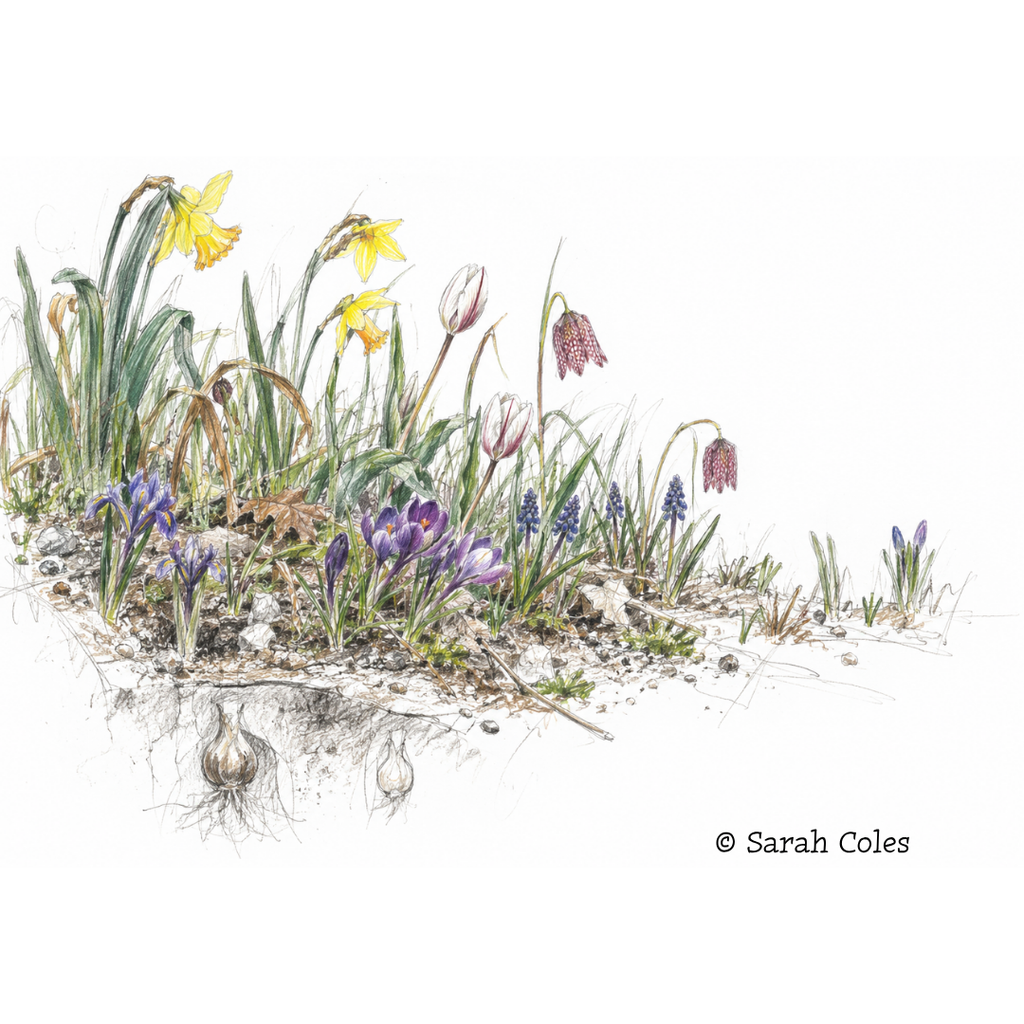
Why plant spring bulbs in autumn?
Spring-flowering bulbs are planted while dormant. The cool, moist conditions of autumn allow them to begin making roots before winter, while the colder months provide the seasonal conditions many need before flowering.
Most spring bulbs should be planted as soon as practical after purchase. Tulips are the notable exception: planting them in November, once the soil has cooled, may help reduce the risk of tulip fire, a fungal disease that thrives in warmer, damp conditions.
Choose firm, healthy bulbs without soft patches, mould or obvious damage. If they cannot be planted immediately, keep them somewhere cool, dry and well ventilated—but do not leave them forgotten in their packaging for weeks.
The best bulbs to plant in autumn
A good spring display rarely depends on a single variety. By combining bulbs that flower at different times, you can create a succession that changes gently as the season unfolds.
Daffodils
Few flowers signal spring quite like a daffodil. There are miniature forms for pots and rock gardens, fragrant varieties, elegant white narcissi and familiar golden trumpets.
Daffodils are generally dependable and many will return for years when grown in suitable conditions. They look particularly at home in generous drifts through grass, beneath deciduous trees or woven between emerging perennials.
Plant them in early autumn if possible, usually at around two to three times the bulb’s own depth.
Tulips
Tulips bring clarity and drama to spring borders. Their colours range from soft creams and dusky apricots to deep plum, scarlet and near-black.
Most prefer full sun and free-draining soil. Many modern tulips give their best display in their first spring, while species tulips and some perennial varieties are more likely to return reliably.
Plant tulips later than most bulbs—November is usually ideal in the UK—and position them roughly two to three times their own depth.
Crocuses
Crocuses are small but invaluable. Their goblet-shaped flowers appear close to the ground in shades of purple, white, yellow and striped mauve, often providing an early source of nectar for pollinating insects.
Plant them in sunny borders, gravel gardens, containers or short grass. They are most effective in loose groups and drifts rather than neat rows.
Hyacinths
Hyacinths offer rich colour and a fragrance that can fill a garden on a still spring day. Their densely packed flower spikes work well near paths, doorways and seating areas, where their scent can be appreciated.
Garden hyacinths prefer a sunny position and well-drained soil. Prepared hyacinths sold for indoor flowering require different treatment, so check the label before planting.
Snowdrops
Snowdrops bring a quiet beauty to the garden at the point when it is most needed. They prefer humus-rich soil that remains reasonably moist without becoming waterlogged, often thriving beneath deciduous trees and shrubs.
Dry bulbs can be planted in autumn, although snowdrops frequently establish more successfully when bought and planted “in the green”—after flowering, while their leaves are still present. The RHS snowdrop guide recommends allowing their foliage to fade naturally.
Alliums
Ornamental alliums carry the bulb season towards early summer. Their spherical flower heads rise above borders in shades of purple, mauve and white, adding strong shape without appearing heavy.
Most ornamental alliums prefer full sun and well-drained soil. Their dried seed heads can remain attractive long after flowering and may be left standing if they suit the character of the border.
Grape hyacinths
Grape hyacinths, or muscari, produce clusters of small bell-shaped flowers, most commonly in vivid blue. They are easy to grow and spread readily in favourable conditions.
That enthusiasm is useful beneath shrubs, along path edges and in informal borders, although it is worth choosing their position carefully if you do not want them to travel.
Other bulbs worth discovering
Winter aconites, native bluebells, dwarf irises, snake’s-head fritillaries and camassias can all extend the season or introduce a different character.
Choose bulbs for the conditions you have. Snake’s-head fritillaries enjoy moisture-retentive ground, while dwarf irises need sharper drainage. Native English bluebells are best suited to the dappled shade and leaf-rich soil beneath deciduous trees.
Choosing the right place
Before reaching for a trowel, take a little time to notice the garden.
Where does winter rain collect? Which borders receive spring sunshine before nearby trees come into leaf? Where will early flowers be seen from a window or passed on the way to the front door?
Most bulbs dislike sitting in waterlogged soil. If the ground is heavy, improve its structure with organic matter or choose raised beds and containers. Adding a small pocket of grit beneath each bulb is not a cure for persistently wet ground; good drainage needs to work across the wider planting area.
Light matters too. Many spring bulbs grow well beneath deciduous trees because they can use the sunlight that reaches the ground before the canopy fills. Tulips and most ornamental alliums generally perform best in open, sunny positions.
Consider what will surround the bulbs later in the year. Deciduous grasses, ferns, hostas and herbaceous perennials can hide fading bulb foliage while taking over the display for summer.
How deep should bulbs be planted?
As a general guide, plant bulbs at a depth equal to two or three times their own height. A bulb measuring 5cm from base to tip should therefore sit approximately 10–15cm below the soil surface.
Set bulbs with the pointed shoot facing upwards and the flatter root plate beneath. If the shape makes this difficult to judge, place the bulb on its side; the developing shoot will usually turn towards the surface.
In borders, space most bulbs at least twice their own width apart. Containers can be planted more closely—about one bulb’s width apart—provided the bulbs are not touching.
Avoid pressing bulbs into the base of a hard planting hole, as this can leave an air pocket beneath them. Set each one gently on loosened soil, backfill and firm the surface lightly.
Ways to plant spring bulbs
There is no single correct way to arrange bulbs. The best method depends on the setting and the effect you hope to create.
Planting in borders
Individual holes are useful when threading bulbs between established plants. A narrow trowel or bulb planter causes less disturbance to surrounding roots.
For larger groups, lift a section of soil to the required depth, arrange the bulbs beneath and replace the soil. This is quicker and often creates a more natural display than making dozens of separate holes.
Aim for generous groups rather than isolated bulbs. The RHS suggests planting at least six together, with 25–50 bulbs often needed for a strong display.
Naturalising bulbs in grass
Daffodils and crocuses can look beautiful scattered through grass. For an informal effect, cast handfuls of bulbs gently across the area and plant them where they land, adjusting only those that fall too close together.
The display will last longer if the grass is not cut until the bulb foliage has yellowed and died back. The leaves need time to photosynthesise and replenish the bulb for the following year. Drifts of daffodils, snowdrops and crocuses are among the classic spring features recommended in RHS meadow guidance.
Avoid planting bulbs into species-rich or ancient grassland without specialist advice, as digging may damage an established habitat.
Layering bulbs in containers
A layered bulb pot—sometimes called a bulb lasagne—creates a long display from a relatively small space.
Use a large frost-resistant container with unobstructed drainage holes and peat-free compost. Place larger, later-flowering bulbs towards the bottom, medium-sized bulbs above them and smaller, earlier-flowering bulbs close to the surface.
Late tulips might form the lowest layer, followed by miniature daffodils, with crocuses or grape hyacinths near the top. Position bulbs so that those in one layer are not directly above those beneath.
The RHS guide to planting bulbs in pots recommends watering after planting and keeping the compost moist—but never waterlogged—once growth begins.
Planning a succession of spring colour
Flowering times vary according to location, cultivar and weather, but the following sequence offers a useful starting point:
- January and February: snowdrops, winter aconites and early crocuses
- March: dwarf irises, crocuses, early daffodils and species tulips
- April: many daffodils, hyacinths, grape hyacinths and mid-season tulips
- May: late tulips, camassias and early ornamental alliums
- June: later alliums and the first summer perennials
Read the expected flowering period on bulb labels and choose a mixture of early, middle and late varieties. In smaller gardens, concentrating on two or three harmonious colours can make the display feel generous without becoming confused.
Looking after bulbs after planting
Autumn-planted bulbs need relatively little attention. If the soil is already moist, watering may not be necessary; in dry conditions, water after planting to settle the soil.
Containers require closer attention, particularly during dry spells and once shoots appear. Keep the compost evenly moist but ensure surplus water can escape.
Squirrels sometimes investigate freshly planted pots, particularly those containing tulips and crocuses. A temporary covering of wire mesh can discourage digging. Remove it as shoots begin to emerge.
After flowering, deadhead tulips and daffodils if you do not want them to produce seed, but leave the foliage in place until it has yellowed naturally. Do not tie leaves into knots: green foliage is still feeding the bulb beneath the soil.
Creating a display that belongs in your garden
The most memorable bulb planting often feels connected to its setting. Pale narcissi beneath an old fruit tree, crocuses beside a worn stone path or tulips rising through young perennial growth can become part of the garden’s seasonal story.
Rather than spacing bulbs with mathematical precision, plant in loose groups of varying size. Repeat a few varieties through neighbouring areas to draw the eye onwards, and position some where they can be enjoyed from indoors during the darker months ahead.
Planting bulbs is a hopeful autumn ritual. The work is modest and much of it is soon hidden, but beneath the soil roots are forming and next spring’s display is quietly gathering strength.
Further Reading: My Garden Journal & Notes
